



Building Offline-First Apps in Flutter: Why Enterprise Mobile Strategies Are Shifting
Enterprise mobile strategies in North America are hitting a familiar wall. Applications look polished, APIs are scalable, cloud costs are optimized—yet user experience collapses the moment connectivity drops. For organizations operating at scale, this is no longer an edge case. Field teams, logistics networks, healthcare staff, and retail operations routinely function in low or inconsistent connectivity environments.
This gap directly impacts revenue workflows. When applications depend entirely on real-time connectivity, they introduce latency, data loss risks, and operational inefficiencies. Decision-makers are now reevaluating a core assumption: apps should not fail when networks do.
Offline-first architecture, particularly when implemented using Flutter, is emerging as a practical response—not as a feature, but as a structural shift in how applications are designed.
The Real Problem: Connectivity Assumptions Break Enterprise Workflows
Most enterprise applications still follow an “online-first” pattern. Data is fetched from APIs, user actions are sent back immediately, and local storage acts as a temporary cache at best. This model works in controlled environments, but breaks down in real-world usage.
Teams experience this in measurable ways:
- Field service agents lose job updates mid-task
- Retail staff face delays during peak transaction periods
- Logistics teams operate with stale or incomplete data
- Customer-facing apps degrade under poor network conditions
According to industry analyses from organizations like Gartner and Forrester, poor mobile experience directly affects employee productivity and customer retention, especially in distributed operations.
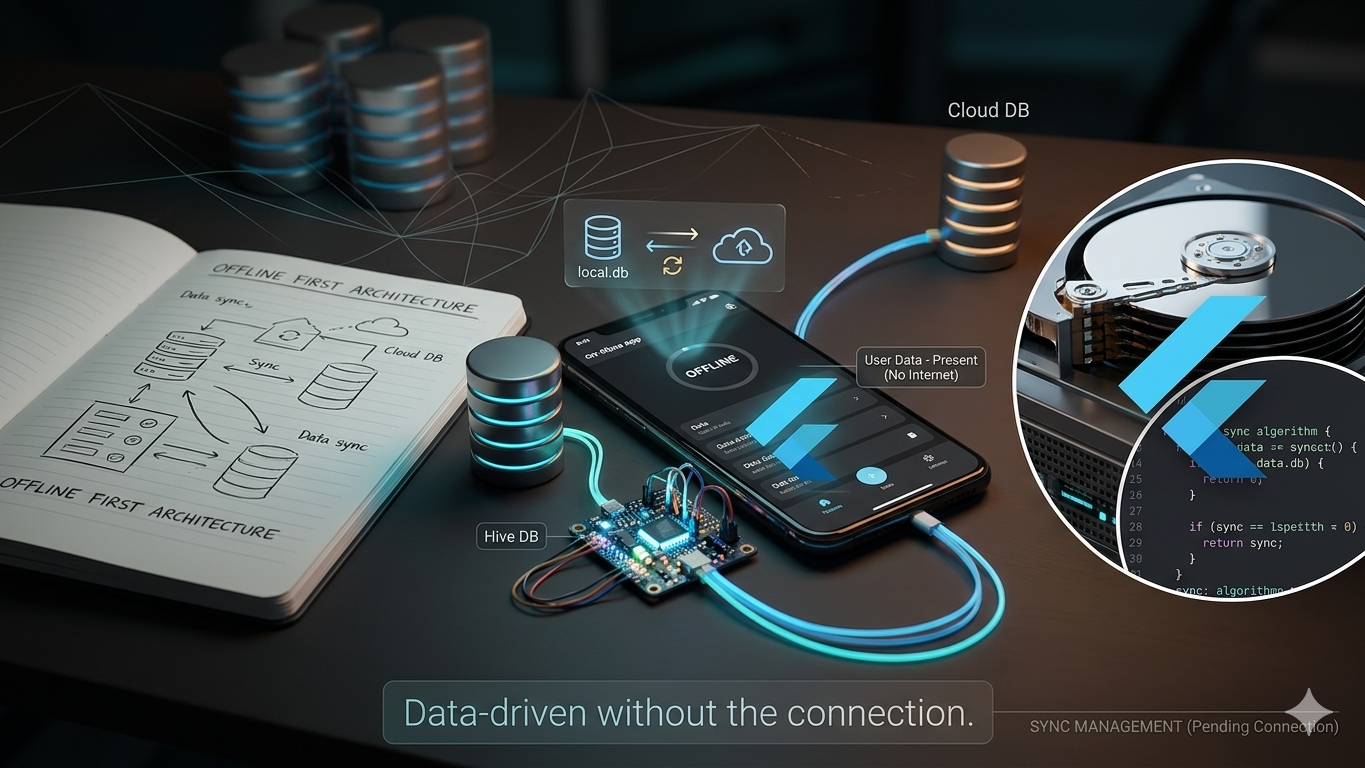
Offline-first architecture reverses the dependency. Instead of treating the network as the source of truth at all times, it prioritizes local data and synchronizes changes in the background. Flutter, with its cross-platform consistency and robust state management ecosystem, provides a strong foundation to implement this shift.
What Offline-First Actually Means in Flutter Architecture
Offline-first is often misunderstood as “adding caching.” That framing is incomplete. True offline-first systems treat local storage as the primary data source and the network as a synchronization layer.
Flutter’s architectural guidance emphasizes a layered approach:
- Local database layer using tools like SQLite, Hive, or Drift
- Repository layer that abstracts data sources (local + remote)
- Synchronization engine that handles background updates and conflict resolution
- UI layer that reacts to local state changes instantly
This approach ensures that user actions are never blocked by network availability. Data writes happen locally first and sync asynchronously.
A typical flow looks like this:
- User performs an action (e.g., submits a form)
- Data is written to local storage immediately
- UI updates instantly, reflecting success
- Background sync attempts to push data to the server
- Conflicts are resolved if discrepancies arise
The complexity lies not in storing data locally, but in managing synchronization and consistency across distributed systems.
Where Enterprise Teams Struggle: Synchronization and Conflict Resolution
The technical challenge in offline-first systems is not storage—it is data integrity.
When multiple users or devices modify the same data while offline, conflicts are inevitable. Without a clear resolution strategy, systems risk overwriting critical updates or creating inconsistent states.
Common strategies include:
- Last-write-wins, which is simple but risky in critical workflows
- Operational transforms, used in collaborative systems
- Custom conflict resolution rules, tailored to business logic
Flutter implementations often rely on queue-based sync mechanisms, where changes are logged locally and replayed when connectivity returns. Advanced implementations introduce versioning, timestamps, and server-side reconciliation logic.
This is where many enterprise teams stall. Building a reliable sync engine requires coordination across mobile, backend, and DevOps teams. It also introduces testing complexity, especially under intermittent network conditions.
Why Flutter Is Being Chosen for Offline-First Use Cases
Flutter’s adoption in enterprise environments is no longer experimental. Its ability to deliver consistent performance across iOS and Android, combined with a single codebase, directly reduces development overhead.
For offline-first strategies, Flutter offers additional advantages:
- Predictable UI rendering independent of backend latency
- Strong support for reactive programming patterns
- Mature ecosystem for local storage and state management
- Flexibility to integrate with existing backend systems
More importantly, Flutter allows teams to enforce architectural discipline. By centralizing data access through repositories and state management layers, organizations can standardize how offline behavior is implemented across applications.
How Leading Companies Are Using Offline-First to Gain Operational Leverage
Top engineering organizations are not adopting offline-first as a technical upgrade—they are using it as a business enabler.
Companies like GeekyAnts, along with leading digital engineering firms such as ThoughtWorks, EPAM Systems, and Globant, are operationalizing offline-first architectures as a core product strategy rather than a fallback capability. These organizations are embedding local-first data models, intelligent sync layers, and conflict-aware systems directly into applications across fintech, healthcare, and logistics—ensuring that critical workflows remain uninterrupted regardless of network conditions. The emphasis is not on enabling offline mode, but on aligning application behavior with real-world operational environments where connectivity is inconsistent and reliability directly impacts business outcomes.
Other leading firms in the mobile and platform engineering space are applying similar strategies:
- Building resilient retail POS systems that function during network outages
- Enabling healthcare applications to capture patient data in remote environments
- Supporting logistics platforms where real-time connectivity cannot be guaranteed
The advantage is measurable. Applications become more reliable, user trust increases, and operational bottlenecks caused by connectivity issues are significantly reduced.
Implementation Realities: What Leaders Need to Plan For
Offline-first architecture introduces new layers of complexity that leadership teams must account for early.
Data modeling becomes more intricate. APIs must support idempotency and conflict resolution. Monitoring systems need to track sync failures and inconsistencies. Security considerations also expand, as sensitive data may reside on devices for extended periods.
There are also organizational implications. Teams need alignment across mobile, backend, and cloud infrastructure. Testing strategies must include offline scenarios, not just standard API performance tests.
Two areas typically require the most attention:
- Observability and Debugging
Without visibility into sync operations, diagnosing issues becomes difficult. Teams need logging mechanisms that track data flow across local and remote layers. - User Experience Design
Offline-first is not just a backend concern. UX must communicate sync states clearly—whether data is pending, synced, or conflicted—without overwhelming users.
The Strategic Shift: From Network Dependency to Experience Ownership
What is changing at the leadership level is the definition of reliability.
Reliability is no longer measured by API uptime alone. It is defined by whether users can complete tasks regardless of network conditions. Offline-first architecture shifts control from infrastructure constraints to application design.
For VP-level leaders, this represents a broader transformation. It aligns mobile applications with the realities of distributed workforces and global operations. It also reduces dependency on perfect network conditions—something enterprises cannot guarantee.
Organizations that adopt this model are not just improving app performance; they are redesigning how digital systems support business continuity.
A Practical Way Forward
Most enterprises do not need to rebuild entire applications to adopt offline-first principles. The transition can start with high-impact workflows—areas where connectivity issues directly affect revenue or productivity.
The key is to approach it as an architectural decision, not a feature addition.
Teams that have successfully implemented offline-first systems often begin with targeted consultations—evaluating existing app architecture, identifying failure points, and defining a phased implementation strategy.
This is where experienced partners bring clarity. Firms that have implemented Flutter-based offline-first solutions across industries can accelerate this process by avoiding common pitfalls and aligning technical decisions with business outcomes.
For leaders navigating this shift, the question is no longer whether offline-first is necessary. It is how quickly it can be implemented without disrupting existing systems—and who has already solved these challenges at scale.
FAQs
What is the difference between offline-first and caching?
Caching temporarily stores data to improve performance, while offline-first treats local data as the primary source and ensures full functionality without network access.
Is offline-first suitable for all enterprise applications?
Not all, but it is critical for applications used in environments with unreliable connectivity or where uninterrupted workflows are essential.
Does offline-first increase development cost?
Initial implementation can be more complex, but it reduces long-term operational issues, support costs, and productivity losses.
How does Flutter simplify offline-first development?
Flutter’s architecture supports clear separation of concerns, enabling teams to integrate local storage, sync mechanisms, and reactive UI efficiently.
How do companies like GeekyAnts approach offline-first apps?
They align offline capabilities with business workflows, focusing on reliability, sync efficiency, and scalable architecture rather than treating offline mode as an afterthought.
What are the biggest risks in offline-first architecture?
Data conflicts, sync failures, and lack of observability. These can be mitigated with proper architecture, tooling, and testing strategies.