




Enterprise engineering leaders are no longer asking whether cross-platform frameworks can scale—they are asking how fast teams can ship without breaking maintainability. In 2026, Flutter sits in a pragmatic middle ground: fast enough for product velocity, mature enough for enterprise adoption, but still easy to misuse at scale.
For a VP of Engineering or Head of Platform, the problem is not writing Flutter code—it’s structuring systems that survive growth. Teams that rushed early MVPs are now dealing with tightly coupled UI layers, duplicated business logic, and release cycles slowed by regression risks. The challenge is not theoretical. It shows up in missed sprint commitments, rising defect rates, and platform teams acting as bottlenecks instead of enablers.
This guide focuses on what actually works in production—how high-performing teams structure Flutter apps to scale across codebases, teams, and business domains.
The Real Constraint: Scaling Teams, Not Just Code
Most Flutter “best practices” break down when more than three teams touch the same codebase. Architecture decisions that look clean in isolation often collapse under organizational complexity.
Large North American enterprises—especially those managing multi-product ecosystems—face three recurring friction points:
- Feature teams ship faster than platform teams can standardize
- Code reuse becomes accidental, not intentional
- Testing pipelines lag behind release expectations
According to the 2024 Accelerate State of DevOps Report by Google Cloud, elite teams deploy code 973x more frequently than low performers, yet maintain lower failure rates. The differentiator is not tooling—it’s architectural clarity aligned with team structure.
In Flutter ecosystems, that translates into modularity with strict boundaries. Without it, velocity becomes unsustainable.
A Production-Grade Flutter Architecture That Holds Under Pressure
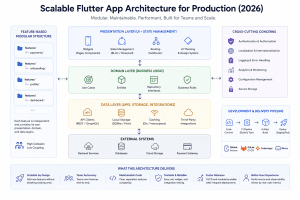 High-scale Flutter apps in 2026 are rarely monoliths. They adopt a layered, modular architecture that separates concerns across three axes: domain, application logic, and delivery.
The most effective pattern combines Clean Architecture with feature-based modularization.
At a high level:
- Presentation Layer (UI + State Management)
This is where Flutter shines—but it’s also where most technical debt accumulates. Mature teams isolate UI logic using predictable state management patterns such as BLoC or Riverpod. The key is consistency, not preference. - Domain Layer (Business Logic)
This layer remains framework-agnostic. It defines use cases, entities, and contracts. When teams skip this separation, business logic leaks into widgets—making testing and scaling harder. - Data Layer (APIs, Storage, Integrations)
This layer handles external communication—REST, GraphQL, caching, and persistence. It should never directly influence UI decisions.
What changes in 2026 is not the pattern itself—but how teams enforce it. Forward-looking organizations treat architecture as a platform capability, not a developer choice.
Feature-Based Modularity: Where Most Teams Either Win or Fail
Traditional folder structures—“models,” “services,” “widgets”—do not scale. They optimize for readability, not ownership.
Modern Flutter teams structure code by feature domains, not technical layers.
Instead of this:
lib/
models/
services/
widgets/
They adopt:
lib/
features/
payments/
onboarding/
profile/
Each feature contains its own presentation, domain, and data layers. This approach aligns directly with how enterprise teams operate: independently, but within shared guardrails.
The impact is immediate:
- Teams deploy features without stepping on each other
- Code ownership becomes explicit
- Refactoring risk is localized
This mirrors how backend systems evolved toward microservices—but without the operational overhead.
State Management Isn’t the Problem—Inconsistency Is
Flutter offers multiple state management approaches, and teams often waste time debating which one is “best.” At scale, that debate is irrelevant.
What matters is standardization across teams.
Organizations that succeed typically:
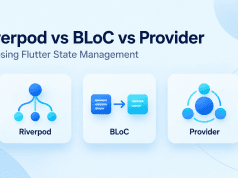
- Choose one primary pattern (BLoC, Riverpod, or Provider)
- Define usage guidelines centrally
- Enforce it through code reviews and templates
Inconsistent state management leads to fragmented debugging, onboarding friction, and unpredictable performance.
Engineering leaders should treat this as a governance issue, not a technical preference.
Backend Integration: The Hidden Bottleneck in Full-Stack Flutter Apps
Flutter’s frontend efficiency often masks backend inefficiencies. Teams ship UI faster than backend systems can evolve, creating mismatched release cadences.
High-performing organizations solve this by decoupling frontend and backend through:
- API contracts defined early (OpenAPI / GraphQL schemas)
- Mock servers for parallel development
- Backend-for-Frontend (BFF) layers to simplify client logic
Companies like Netflix and Airbnb have long used BFF patterns to optimize client performance and team autonomy. The same principle applies to Flutter ecosystems.
Without this separation, Flutter apps become tightly coupled to backend changes—slowing down releases and increasing coordination overhead.
Performance and Observability: Where Production Apps Break
Flutter apps perform well out of the box—but production environments expose edge cases:
- Memory leaks in long-lived widgets
- Frame drops under heavy UI rendering
- Network latency impacting perceived performance
Engineering leaders increasingly rely on observability tools such as Datadog and New Relic to monitor real-user performance.
The shift in 2026 is toward experience-level metrics, not just technical ones. Teams measure:
- Time to interactive (TTI)
- User journey completion rates
- Crash-free sessions
This aligns performance optimization with business outcomes—something leadership teams can directly act on.
CI/CD and Release Strategy: The Multiplier for Flutter Scalability
Even well-structured apps fail without disciplined delivery pipelines.
Enterprise Flutter teams typically:
- Automate Testing at Multiple Levels
Unit tests for logic, widget tests for UI behavior, and integration tests for flows. - Adopt Incremental Rollouts
Feature flags and phased releases reduce risk in production. - Standardize Build Pipelines
Tools like GitHub Actions or GitLab CI/CD pipelines ensure consistent delivery across teams.
The key insight: CI/CD is not just about speed—it’s about predictability. Leadership teams value reliability over raw deployment frequency.
The Organizational Shift Behind Scalable Flutter Systems
The biggest misconception about Flutter scalability is that it’s purely technical. In reality, it’s organizational.
Companies that scale successfully:
- Align architecture with team boundaries
- Invest in internal developer platforms
- Treat reusable components as products
This approach mirrors platform engineering trends across enterprises. Flutter becomes one layer within a broader ecosystem—not a standalone solution.
According to insights from Gartner, platform engineering is now a top priority for enterprises aiming to reduce cognitive load on developers while increasing delivery speed.
Flutter fits well into this model—but only when structured intentionally.
What Engineering Leaders Should Do Next
Most teams already have Flutter apps in production. The question is whether those systems can scale over the next 18–24 months.
Leaders evaluating their current architecture should ask:
- Can teams ship independently without cross-team friction?
- Is business logic isolated from UI layers?
- Are backend dependencies slowing down releases?
- Do performance metrics tie back to user experience?
If the answer to any of these is unclear, the issue is not tooling—it’s structure.
Forward-looking organizations are now conducting architecture audits, not just code reviews. They treat scalability as a continuous capability, not a one-time milestone.
A More Practical Way to Approach This
There’s a noticeable shift in how enterprise teams approach Flutter in 2026. Instead of rewriting systems, they incrementally restructure—introducing modular boundaries, standardizing patterns, and improving observability over time.
For leadership teams, the most effective next step is not a full transformation. It’s a structured evaluation of where the current architecture creates friction—and where small changes unlock disproportionate gains.
In practice, that often starts with a conversation: mapping business priorities to technical constraints, identifying bottlenecks, and aligning teams around a scalable path forward.
The teams that get this right don’t just build Flutter apps. They build systems that keep shipping—long after the initial release.
1. Is Flutter actually viable for large-scale enterprise applications in 2026?
Yes—but viability depends less on Flutter itself and more on how teams structure the system around it. Enterprises are successfully running Flutter in production across customer-facing apps and internal platforms. The limitation is not framework capability, but architectural discipline. Without modular boundaries and governance, even well-built Flutter apps degrade quickly at scale.
2. What is the biggest mistake teams make when scaling Flutter applications?
Teams treat Flutter like a UI framework instead of a full application layer. This leads to business logic leaking into widgets, tight coupling with APIs, and poor testability. The real issue is not code quality—it’s lack of separation between presentation, domain, and data layers.
3. Should engineering teams adopt Clean Architecture for every Flutter project?
Not blindly. Clean Architecture introduces structure, but also overhead. For enterprise-scale applications with multiple teams and long-term roadmaps, it becomes essential. For smaller products, a lighter modular approach may be sufficient. The decision should be based on expected team size, release frequency, and system lifespan—not trend adoption.
4. How do teams transition from an existing monolithic Flutter app to a scalable structure?
A full rewrite is rarely justified. High-performing teams incrementally refactor by:
- Introducing feature-based modules one domain at a time
- Extracting business logic into domain layers
- Standardizing state management gradually
This approach reduces risk while improving maintainability over time.
5. Which state management approach is best for enterprise Flutter apps?
There is no universally “best” solution. What matters is consistency across teams. Whether it’s BLoC, Riverpod, or another approach, organizations should standardize one pattern, define clear usage guidelines, and enforce it through governance. Inconsistent state management creates more problems than any specific tool choice.
6. How does Flutter fit into a broader enterprise platform engineering strategy?
Flutter should not operate in isolation. It works best as part of a platform ecosystem that includes:
- Shared design systems
- Backend-for-Frontend (BFF) layers
- CI/CD pipelines and developer tooling
Organizations that treat Flutter as just a frontend framework miss the opportunity to align it with platform engineering goals.
7. What are the key performance risks in production Flutter apps?
Performance issues typically emerge from:
- Overloaded UI layers with business logic
- Inefficient rendering in complex screens
- Poor network handling and latency
The solution is not just optimization—it’s observability. Teams need real-user metrics to identify where performance impacts actual user journeys.
8. How can engineering leaders ensure faster releases without compromising stability?
Speed without structure leads to instability. Mature teams achieve both by combining:
- Automated testing across layers
- Feature flags for controlled rollouts
- Incremental deployment strategies
This shifts releases from high-risk events to predictable processes.
9. What role does backend architecture play in Flutter scalability?
A significant one. Flutter teams often move faster than backend systems, creating bottlenecks. Decoupling through API contracts, mock services, and BFF layers allows frontend and backend teams to operate independently—reducing coordination delays and improving release velocity.
10. How should teams measure the success of a scalable Flutter architecture?
Success is not measured by code quality alone. Leaders should track:
- Deployment frequency and lead time
- Change failure rate
- User experience metrics (e.g., load times, crash rates)
These indicators reflect whether the architecture supports both engineering velocity and business outcomes.
11. When does it make sense to invest in modular architecture?
The tipping point usually appears when:
- Multiple teams contribute to the same codebase
- Release cycles slow due to dependencies
- Bugs in one feature impact unrelated areas
At this stage, modularization is not an optimization—it becomes necessary to sustain growth.
12. Is Flutter a long-term strategic choice for enterprise digital products?
Flutter continues to evolve with strong backing from Google, and its ecosystem has matured significantly. For enterprises prioritizing cross-platform efficiency and faster time-to-market, it remains a viable long-term option—provided the underlying architecture is designed for scale from the outset.