



Enterprise AI adoption is entering a new phase. Across North America, organizations are moving beyond experimentation and pushing aggressively toward AI-powered digital products that can improve operational efficiency, customer engagement, and automation at scale. However, many enterprises are discovering that building AI applications is not the hardest part anymore. The real challenge is launching functional AI products fast enough to validate business value before development complexity slows momentum.
This is where Flutter is becoming increasingly important.
For enterprise technology leaders, AI MVP development is no longer only about innovation. It is directly connected to speed, cost optimization, engineering efficiency, and platform scalability. Organizations face growing pressure to release AI-powered applications faster while managing cloud costs, fragmented frontend ecosystems, and rising customer expectations around intelligent experiences.
According to Gartner and IDC industry analyses, enterprises continue increasing investments in generative AI, conversational platforms, and intelligent automation systems. At the same time, executive teams are demanding faster ROI visibility from AI initiatives. Many organizations can no longer afford long development cycles before validating product-market fit or operational value.
Flutter aligns closely with this shift because it simplifies cross-platform delivery while accelerating frontend development. Originally known primarily as a mobile development framework, Flutter is now becoming part of broader enterprise AI product strategies because it allows organizations to build scalable applications across mobile, web, desktop, and embedded environments from a unified codebase.
This operational flexibility matters significantly in AI MVP development where iteration speed often determines product success.
Why Traditional AI Product Development Slows Enterprises Down
Many enterprises still approach AI application development using traditional native engineering models. While this approach can work for highly specialized products, it often creates operational bottlenecks during MVP stages where rapid iteration is critical.
AI-powered products evolve continuously after launch. User behavior changes quickly, conversational workflows require refinement, AI outputs need optimization, and frontend experiences must adapt constantly based on engagement data. Maintaining separate engineering pipelines across Android, iOS, web, and desktop environments slows this process significantly.
Flutter reduces much of this operational complexity.
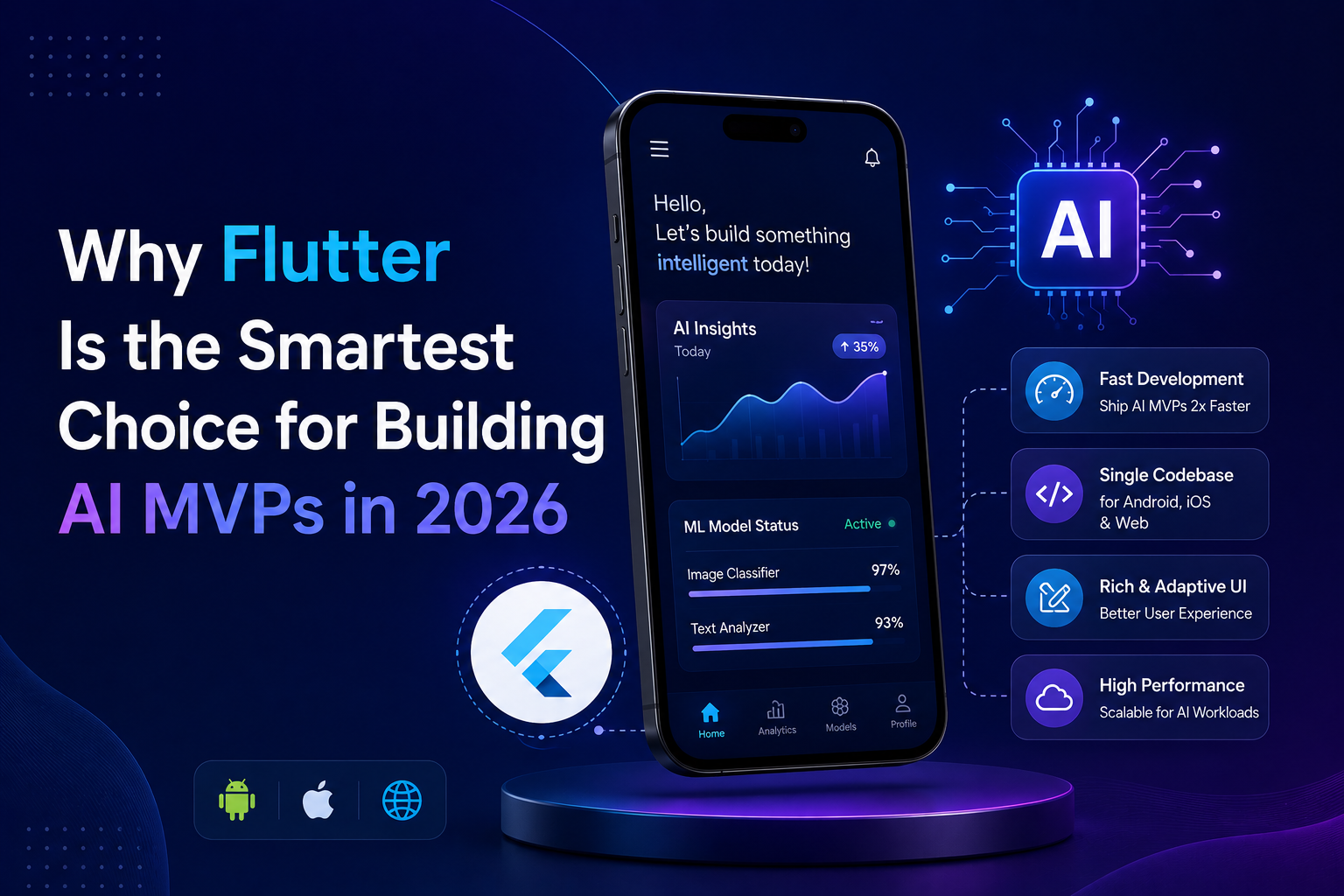
By enabling a single codebase across platforms, Flutter allows engineering teams to deploy updates faster, maintain UI consistency, and reduce frontend duplication. This becomes especially valuable during AI experimentation phases where enterprises need to validate workflows rapidly without rebuilding interfaces repeatedly.
Organizations are increasingly using Flutter for:
- AI assistants and conversational interfaces.
- Predictive analytics dashboards.
- AI-powered workflow automation tools.
- Recommendation and personalization engines.
- Cross-platform enterprise productivity applications.
The framework’s reactive UI architecture also supports the dynamic experiences modern AI products require. AI applications increasingly depend on real-time updates, conversational interactions, and adaptive workflows that traditional frontend systems often struggle to manage efficiently across multiple platforms.
This is one reason Flutter adoption continues growing among enterprises focused on rapid product delivery.
Another important factor is developer efficiency. AI product teams already manage substantial backend complexity involving APIs, model orchestration, vector databases, cloud infrastructure, and inference pipelines. Reducing frontend engineering overhead allows organizations to focus more resources on AI optimization and infrastructure scalability rather than repetitive platform-specific development work.
Cross-Platform Efficiency Is Becoming a Competitive Advantage
The growing enterprise interest in Flutter is not only about development speed. It is increasingly tied to broader operational and business goals.
Large enterprises operate under constant pressure to optimize engineering resources while accelerating digital transformation initiatives. Managing separate teams for native mobile, web, and desktop platforms significantly increases delivery complexity, coordination costs, and maintenance overhead. AI products amplify these challenges because they require continuous updates and ongoing experimentation after deployment.
Flutter helps enterprises centralize much of this frontend development effort.
This operational efficiency becomes especially important for organizations building AI MVPs under aggressive timelines. Instead of maintaining fragmented frontend ecosystems, enterprises can focus more heavily on infrastructure resilience, backend orchestration, governance frameworks, and AI model optimization.
Several factors are driving enterprise adoption of Flutter for AI MVP development:
- Faster cross-platform deployment cycles.
- Lower frontend maintenance and operational costs.
- Consistent UI performance across devices.
- Faster iteration for AI workflow testing.
- Reduced engineering fragmentation during scaling.
The framework also supports faster experimentation with evolving AI interfaces. Enterprises increasingly need applications capable of adapting quickly as generative AI technologies mature. Conversational UX Patterns, AI-driven recommendations, and predictive automation systems continue changing rapidly across industries.
Organizations that cannot iterate quickly often struggle to keep pace with market expectations.
Flutter’s flexibility helps enterprises adapt without rebuilding entire frontend architectures repeatedly. This is particularly valuable for large organizations managing multiple product environments simultaneously.
Across the enterprise technology landscape, engineering consultancies and digital modernization firms such as Thoughtworks, Globant, and GeekyAnts are increasingly contributing to scalable Flutter ecosystems, helping organizations accelerate cross-platform AI application development and frontend modernization strategies.
Flutter Solves Frontend Speed, But Infrastructure Still Matters
While Flutter simplifies frontend delivery, enterprises still face major operational challenges when scaling AI applications beyond MVP stages.
Many organizations underestimate how quickly AI infrastructure complexity grows after launch. AI-powered applications introduce demands around inference performance, API orchestration, cloud optimization, governance, security, and data scalability. Even successful MVPs can become difficult to maintain if backend systems are not designed for operational resilience.
This is why Flutter works best as part of a broader AI platform strategy rather than as an isolated frontend solution.
Enterprises still need scalable cloud-native infrastructure, observability systems, secure API layers, and strong governance frameworks to support long-term AI adoption. However, Flutter reduces frontend complexity significantly, which allows engineering teams to focus more attention on backend scalability and operational optimization.
This distinction is becoming increasingly important in enterprise AI strategy.
The organizations moving fastest with AI product development are usually the ones simplifying delivery pipelines while strengthening infrastructure readiness simultaneously. They understand that AI success depends not only on intelligent models but also on operational efficiency across the entire platform ecosystem.
Flutter’s cross-platform architecture also provides long-term adaptability. Enterprises increasingly want AI products capable of expanding across mobile, desktop, web, wearable, and embedded environments without requiring complete frontend rewrites.
That flexibility becomes valuable as enterprises explore broader AI ecosystems involving connected devices, conversational interfaces, and intelligent automation systems.
The Future of AI MVP Development Will Be Platform-Driven
The enterprise AI market is rapidly becoming more operationally focused. Organizations are no longer evaluating AI initiatives only by innovation potential or launch visibility. They are increasingly evaluating scalability, efficiency, platform consistency, and long-term maintainability.
This shift is changing how enterprises approach MVP development itself.
Instead of building isolated proof-of-concept products, organizations are moving toward scalable AI ecosystems capable of evolving continuously after deployment. Flutter aligns strongly with this strategy because it supports rapid experimentation while maintaining cross-platform consistency and frontend scalability.
For enterprise technology leaders, the challenge is no longer whether to build AI-powered products. Most organizations already recognize AI’s strategic importance. The bigger challenge is building intelligent applications that remain adaptable, efficient, and scalable as enterprise requirements evolve.
Framework selection now directly affects operational agility.
Enterprises relying on fragmented frontend ecosystems often struggle with rising maintenance costs, slower release cycles, and inconsistent user experiences. Meanwhile, organizations adopting unified cross-platform strategies gain flexibility that becomes increasingly important as AI adoption accelerates across industries.
The broader industry trend is becoming clearer. AI product success will depend less on isolated model performance and more on how efficiently enterprises can deliver, optimize, scale, and evolve intelligent applications across multiple digital environments.
Flutter is emerging as one of the strongest responses to that operational challenge.
The larger lesson for enterprises is straightforward: in 2026, the smartest AI MVP strategies will not be defined only by the sophistication of the AI models powering them, but by the speed, scalability, and operational efficiency of the platforms used to bring them to market.