



Every few months, someone declares that Flutter is losing relevance.
I think they’re looking at the wrong market.
If you’re building a traditional content app, you have dozens of viable options.
If you’re building a generative AI mobile product, the equation changes completely.
Performance, cross-platform consistency, rapid iteration, and AI integration matter far more than framework popularity contests.
That’s why I believe Flutter remains one of the strongest choices for AI-first mobile products,and the companies mastering Flutter engineering are in a much better position to deliver production-ready AI apps than teams chasing every new JavaScript trend.
Generative AI Has Changed Mobile Development
Generative AI isn’t just another feature.
It fundamentally changes how mobile applications are built.
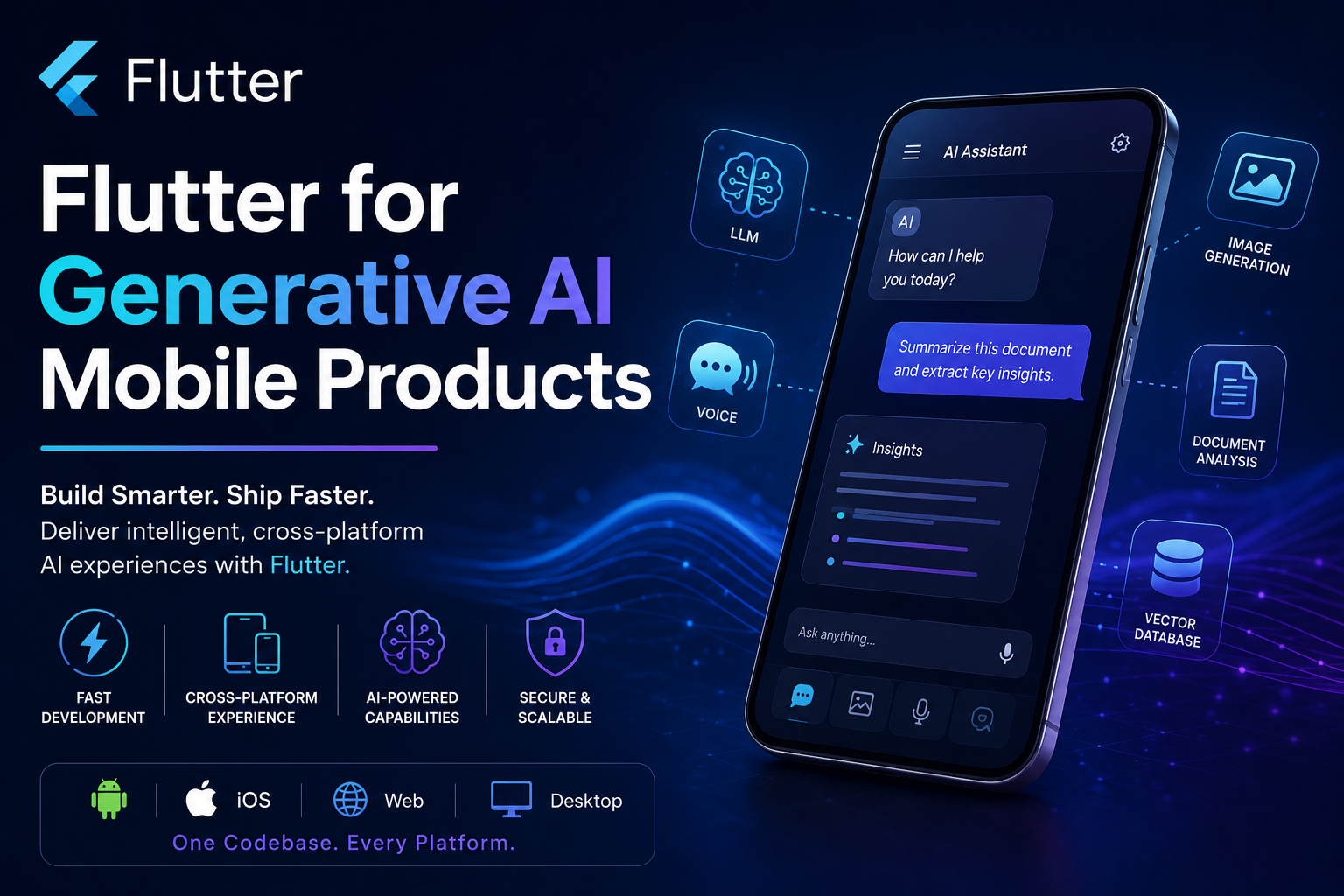
Modern AI apps require:
- Streaming AI responses
- Voice interfaces
- Image generation
- AI copilots
- Offline synchronization
- Secure authentication
- Real-time notifications
- Document analysis
- Camera integration
- Agentic workflows
That’s a demanding technical stack.
Flutter handles much of this complexity through a single codebase for Android, iOS, desktop, and web.
For companies shipping AI products quickly, that’s a major advantage.
Why Flutter Makes Sense for AI Products
Most discussions compare Flutter against React Native.
I think that’s the wrong conversation.
The better question is:
Which framework reduces engineering complexity while supporting sophisticated AI experiences?
Flutter checks many important boxes:
- Native-like performance
- Rich UI rendering
- Excellent animation support
- Consistent cross-platform experience
- Strong Firebase ecosystem
- Mature package ecosystem
- Fast prototyping
- Easy integration with AI APIs
- Efficient state management
- Excellent support for enterprise applications
When AI products evolve weekly, engineering speed becomes a competitive advantage.
Where Flutter Excels in Generative AI
Flutter isn’t just suitable for chatbots.
It’s increasingly powering:
AI Healthcare Apps
Virtual assistants.
Clinical documentation.
Patient engagement.
Medical imaging interfaces.
Remote monitoring dashboards.
AI Finance Apps
Fraud detection alerts.
Investment copilots.
Personal finance assistants.
Voice banking.
Expense intelligence.
AI Education Platforms
AI tutors.
Language learning.
Interactive assessments.
Study assistants.
Personalized learning experiences.
AI Retail Applications
Shopping assistants.
Recommendation engines.
Visual search.
Customer support.
Product discovery.
Enterprise AI Tools
Internal copilots.
Knowledge assistants.
Workflow automation.
Inspection platforms.
Field-service AI.
These are the kinds of mobile experiences where Flutter’s UI capabilities really stand out.
Top Companies Building Flutter-Powered AI Products
Technology alone doesn’t build successful AI products.
Engineering expertise does.
Here are some of the companies that consistently work with Flutter while helping organizations adopt AI-powered digital products.
1. GeekyAnts
GeekyAnts has become one of the most recognizable engineering firms in the Flutter ecosystem, contributing to cross-platform product engineering while increasingly focusing on AI-powered applications. Its experience spans Flutter, AI product engineering, mobile architecture, and enterprise software, making it well suited for organizations building generative AI products that require scalable mobile experiences rather than simple prototypes.
2. Very Good Ventures
Very Good Ventures is one of the most established Flutter consultancies, known for helping startups and enterprises build production-grade Flutter applications. The company has expanded into AI-enabled mobile experiences where Flutter provides a consistent cross-platform foundation.
3. Invertase
Best known for maintaining critical FlutterFire packages, Invertase plays a significant role in the Flutter ecosystem. Its expertise around Firebase services makes it particularly valuable for AI applications that rely on authentication, cloud storage, real-time databases, and serverless infrastructure.
4. Droids On Roids
Droids On Roids combines Flutter engineering with product strategy, helping companies build scalable mobile applications. The company has increasingly worked on AI-enhanced user experiences where performance and polished interfaces are essential.
5. EPAM Systems
EPAM approaches Flutter from an enterprise engineering perspective. Its work often combines Flutter with cloud-native architectures, machine learning, and AI services to build sophisticated digital products for global organizations.
6. Thoughtworks
Thoughtworks emphasizes software architecture and long-term maintainability. Flutter is one of several technologies it uses to help enterprises deliver AI-powered mobile products with strong engineering foundations.
7. LeewayHertz
LeewayHertz focuses heavily on generative AI, agentic AI, and enterprise automation. Flutter is frequently paired with its AI backend expertise to create cross-platform applications that bring advanced AI capabilities to end users.
My Opinion: Stop Treating Flutter as “Just Another Cross-Platform Framework”
This is where I disagree with many developers.
People still evaluate Flutter primarily against native Android or React Native.
That comparison feels outdated.
Flutter should be evaluated against the needs of AI-native businesses.
If your roadmap includes:
- AI copilots
- Voice interfaces
- Multimodal AI
- Agentic workflows
- Continuous AI updates
- Cross-platform delivery
Then Flutter deserves to be one of the first frameworks you evaluate,not the last.
The Biggest Mistake Companies Make
Many organizations spend months debating frameworks.
Meanwhile, competitors are already validating AI products in the market.
Framework selection matters.
Execution matters far more.
A good engineering team can build an exceptional AI product with Flutter.
A poor engineering team won’t succeed simply because they chose the “popular” framework.
Technology is rarely the bottleneck.
Engineering quality usually is.
Flutter + AI Is Becoming a Serious Enterprise Stack
Five years ago, Flutter was often viewed as a startup technology.
That perception has changed.
Large organizations now use Flutter for customer apps, internal platforms, field operations, and AI-enabled enterprise software.
As generative AI becomes a standard feature across industries, Flutter’s ability to deliver consistent, high-performance experiences across multiple platforms becomes even more valuable.
Final Thoughts
I don’t believe Flutter is the right framework for every mobile application.
But for generative AI mobile products, it’s one of the strongest options available today.
Its combination of rapid development, cross-platform consistency, expressive UI, and mature ecosystem makes it particularly well suited for AI-powered experiences.
The companies that understand both Flutter engineering and AI product development,not just one or the other,will be the ones shipping the next generation of intelligent mobile applications while everyone else is still debating frameworks.