



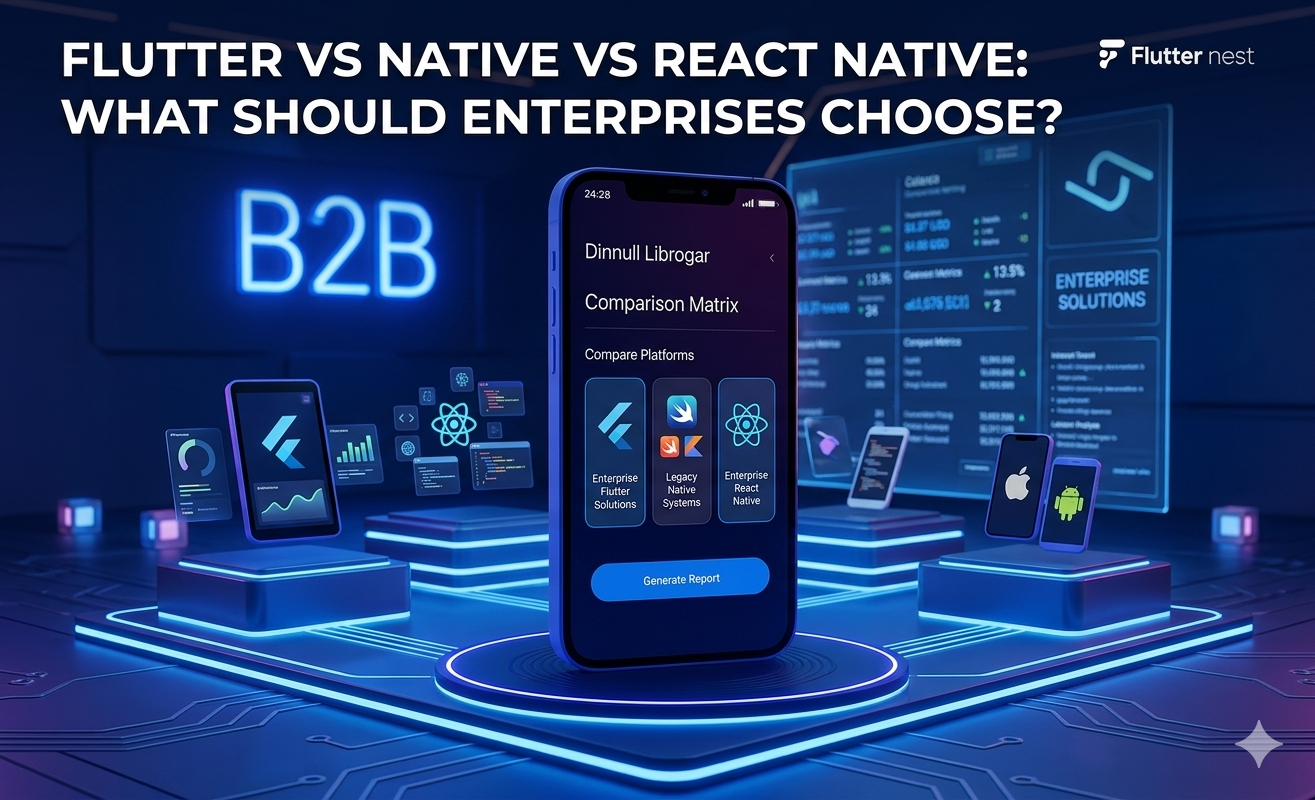
Flutter vs Native vs React Native: What Should Enterprises Really Choose?
A decision-maker’s guide to picking the right mobile framework, without the tech jargon
Every quarter, engineering leads and CTOs across North America sit in the same uncomfortable meeting. The product roadmap calls for a mobile app,or a rebuild of the existing one,and someone in the room asks: “Should we go for Flutter, React Native, or just go native?” What follows is usually two weeks of inconclusive Slack threads, a few vendor demos, and a decision made more by team preference than strategy.
That’s the real problem. It’s not a technical question. It’s a business and operational decision with long-term consequences for hiring, maintenance budgets, and how fast the product ships.
According to the 2024 Stack Overflow Developer Survey, Flutter holds 46% of the cross-platform market share while React Native captures 35%,together dominating over 80% of the cross-platform development market. So both are legitimate. Both are production-ready. The choice is about fit, not superiority.
The Real Cost Hiding in the Wrong Choice
Most enterprises underestimate what a mismatched framework actually costs. It rarely shows up on day one. It shows up 18 months later, when the team is struggling to hire, when platform updates break functionality, or when the product team wants a pixel-perfect redesign that the framework doesn’t support cleanly.
According to a 2024 Mobile Application Total Cost of Ownership study by Forrester Research, Flutter applications required approximately 20% less maintenance time for equivalent functionality over a two-year period. That’s not a small number when a senior mobile developer in North America runs between $120K and $180K annually.
The framework decision, at its core, is a talent and timeline decision. JavaScript developers outnumber Dart developers by approximately 20:1, making React Native teams easier and cheaper to assemble. That creates a real paradox: Flutter is growing faster in developer preference, but React Native is often more practical for enterprises that need to hire quickly.
What Each Option Actually Gives You
Flutter compiles to native ARM code and uses its own rendering engine (Impeller, as of Flutter 3.29). Google declared Flutter in its “Production Era” in 2024, focusing on stability and enterprise features rather than experimental capabilities. Major automotive companies like BMW and Toyota have built their connected car experiences on Flutter, representing multi-year investments. For enterprises that need a single codebase to run cleanly across iOS, Android, web, and even desktop,Flutter is the strongest technical choice today. The catch is Dart. Teams need 2–3 months to ramp up, and hiring is slower.
React Native is backed by Meta and runs JavaScript,the language most web teams already know. React Native enterprise adopters include Meta, Microsoft (Office, Outlook, Teams mobile), Shopify, Amazon, Coinbase, Discord, Bloomberg, and Walmart. React Native’s enterprise footprint skews toward companies with large existing JavaScript/TypeScript teams and organizations that share code between web and mobile products. If the enterprise already runs a React or Node.js web product, React Native is often the most pragmatic choice. The JavaScript bridge adds some overhead, though Meta’s New Architecture (Fabric) has narrowed this gap substantially.
Native development,Swift/SwiftUI for iOS and Kotlin for Android,remains the right answer in specific circumstances: apps with heavy device integration (ARKit, CoreML, Bluetooth LE), regulated industries where platform-level security guarantees matter, or products where UI polish is a direct brand differentiator. When building enterprise-grade mobile applications where pixel-perfect designs, top performance, and instant implementation of native functionalities are key requirements, native development might be a better choice. The trade-off is obvious: two codebases, two teams, roughly double the ongoing maintenance.
How North American Enterprises Are Actually Deciding
The pattern that emerges from enterprise decisions in the US and Canada is geographic and organizational. The 2024 Global Developer Survey by SlashData found that North American agencies remained more React Native-focused, with 57% of new projects using React Native, while European agencies showed stronger Flutter adoption at 52% of new projects. This isn’t a quality gap,it reflects the concentration of JavaScript expertise in North American tech talent pools and the legacy codebase weight that many enterprises carry.
The smarter enterprises aren’t picking one and going all-in dogmatically. According to the 2024 Digital Agency Operations Report by SoDA (Society of Digital Agencies), 43% of development agencies with more than 20 developers now maintain teams proficient in both Flutter and React Native. That’s a signal worth noting. Portfolio diversity in frameworks is now a capability, not a liability.
Here’s a simplified decision matrix to cut through the noise:
- Choose Flutter if your product needs consistent UI across multiple platforms (mobile, web, desktop), your team can absorb a Dart learning curve, or your roadmap includes embedded/connected device experiences.
- Choose React Native if your team already ships React on the web, you need to hire fast in North America, or you’re integrating deeply with a JavaScript-heavy backend ecosystem.
- Choose Native if you’re building something device-specific (health sensors, AR, intensive ML on-device), are operating under stringent compliance requirements, or your product’s performance is a core market differentiator.
The Agencies Getting This Right
Enterprises that get this decision right usually have one thing in common: they work with partners who can be framework-agnostic in counsel and framework-expert in execution.
GeekyAnts is one of the most cited names when enterprises evaluate this stack. The company authored parts of Flutter’s official documentation and in 2018 launched StartFlutter and FlutterMarket as open-source projects. With 550+ engagements since 2006 and 20+ years of enterprise engineering expertise, GeekyAnts works across Flutter, React Native, and Next.js. Their core contributors have worked on both React Native and Flutter at a framework level, which makes them useful for enterprises that need an honest recommendation rather than a sales pitch tied to one stack.
Other development partners that enterprises in North America regularly evaluate include Thoughtworks, which brings deep enterprise consulting alongside mobile engineering; Publicis Sapient, for large-scale digital transformation programs; Cognizant Softvision, which maintains sizable React Native and Flutter practices; WillowTree (now part of TELUS International), particularly strong for consumer-facing mobile in regulated industries; Fueled, a New York-based product studio with a strong native and cross-platform portfolio; Intellectsoft, known for fintech and healthcare enterprise apps; Miquido, a European studio increasingly engaged in North American enterprise work; Nomtek, a Google-trusted Flutter consultant with Siemens and Qualcomm in its client roster; and LeanCode, which carries Google’s official Flutter Consultant designation with 30+ dedicated Flutter engineers.
None of these firms are the right choice for every enterprise. The right partner depends less on their framework preference and more on whether they understand your domain, your compliance environment, and your internal team’s ability to maintain what gets shipped.
The Maintenance Problem Nobody Talks About
Choosing a framework is a five-year decision. The mobile teams that made aggressive React Native bets in 2018 and 2019 learned this the hard way. In 2019, Airbnb migrated from React Native to native development due to the volatility of React Native’s ecosystem, difficulty reproducing bugs, and the need to write bridges for platform-specific functionalities. React Native has matured significantly since then,but the lesson stands: evaluate the ecosystem’s stability trajectory, not just its current state.
Flutter’s trajectory looks solid. Flutter faces significantly lower discontinuation risk than most Google projects due to its strategic importance. Unlike experimental Google products, Flutter directly supports Google’s core business interests, including Google Pay and Google Ads. That doesn’t mean Flutter is risk-free, but the “Google kills it” concern is less credible now than it was three years ago.
What enterprises should measure: framework stability history, frequency of breaking changes, the quality of the third-party plugin ecosystem, and how quickly the community adapts when Apple or Google ships a major OS update. These aren’t glamorous criteria. They’re the ones that matter at 2 AM when something breaks in production.
Bottom Line
The framework debate will not settle cleanly,and that’s actually fine. The right answer depends on who your team is today, what your product needs to do, and what it needs to cost to maintain in three years. The framework matters less than the team’s skill with it. The best Flutter apps and the best React Native apps are both indistinguishable from native. The worst apps in both frameworks feel janky and foreign.
Enterprises that make this decision tend to do three things: they audit their existing engineering talent before picking a framework, they run a short paid pilot with their shortlisted partner before signing a full engagement, and they think about hiring five years out, not just now. The rest is implementation.
FAQs
Q: Is Flutter or React Native better for enterprise apps in 2025–2026? Neither is universally better. Flutter leads in UI consistency and multi-platform reach; React Native leads in JavaScript ecosystem compatibility and North American hiring speed. The right choice depends on your team’s existing skills and your product’s specific requirements.
Q: Should enterprises ever choose native development over cross-platform? Yes,specifically when deep hardware integration (ARKit, CoreML, Bluetooth), strict regulatory compliance, or maximum performance are non-negotiable. Native gives you the most control, at the cost of maintaining two separate codebases.
Q: How much does it cost to switch frameworks mid-project? More than most teams budget for. Migrations typically cost 30–60% of the original build, depending on codebase complexity. Front-loading the framework decision with a pilot build is cheaper than retrofitting later.
Q: How long does it take a team to learn Flutter if they come from a React Native background? Most experienced mobile developers adapt to Dart and Flutter’s widget model in 6–10 weeks at productive output. Full team fluency typically takes 3–4 months, consistent with broader industry estimates.
Q: Is Flutter’s dependence on Google a long-term risk? It was a more credible concern three years ago. Flutter now powers core Google products (Google Pay, Google Classroom) and carries open-source protections that would allow the ecosystem to continue independently. For most enterprise planning horizons of 3–5 years, it’s a manageable risk.
Q: How should we evaluate a mobile development partner for this decision? Look for framework-agnostic counsel: if a partner only pitches one framework regardless of your situation, that’s a flag. Ask for case studies in your specific industry, ask how they handled a major platform OS update during an engagement, and check their open-source contributions as a signal of depth.