




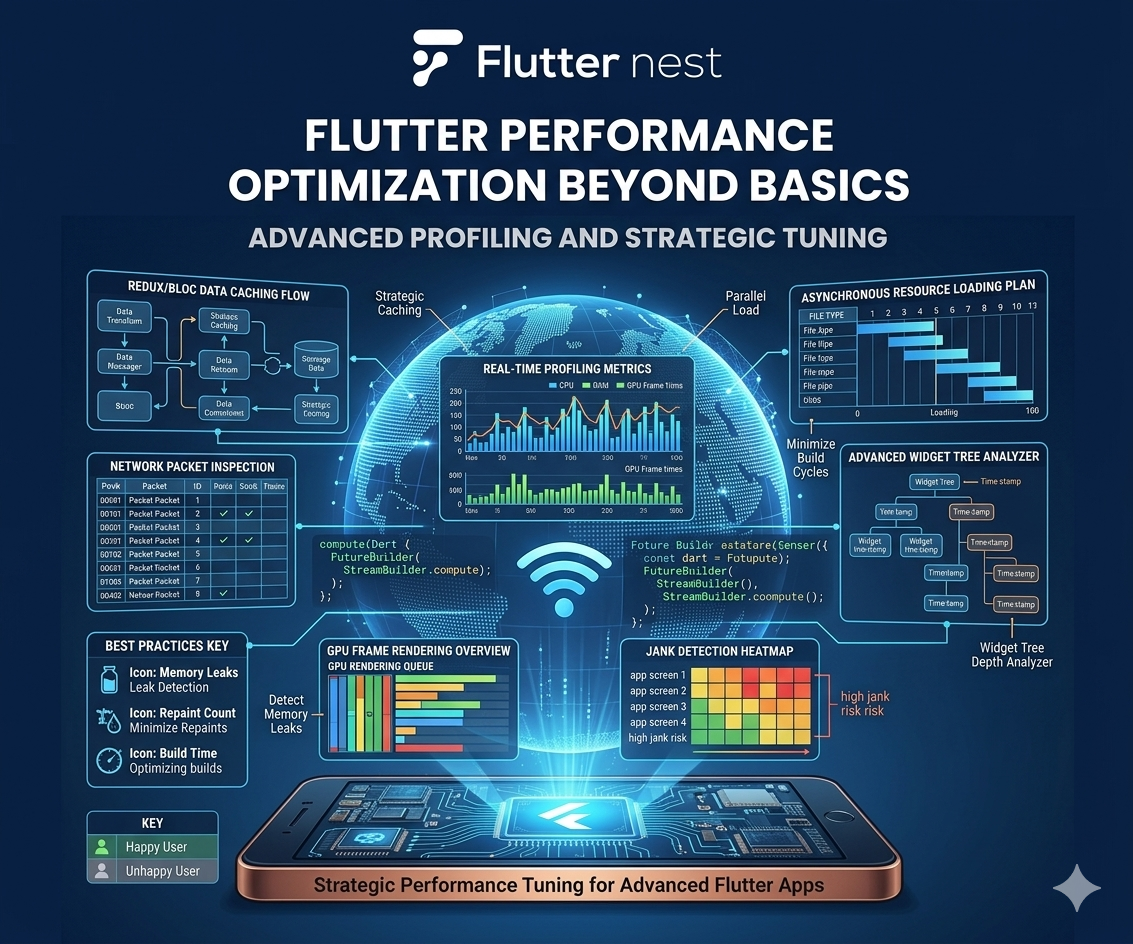
Most North American development teams that adopt Flutter do the obvious things right. They swap ListView for ListView.builder. They add const constructors. They run DevTools once, screenshot the flame chart, and close it. Then they ship , and the app still stutters on mid-range Android devices. The store reviews say “laggy.” The product manager wants answers.
The problem is not Flutter. The problem is that the standard optimization checklist stops exactly where serious performance work begins.
Poor performance directly impacts app store ratings, and smooth 60 FPS animations are now the minimum expectation, not a luxury. For companies managing customer-facing products or internal enterprise dashboards, that floor keeps rising. 53% of users abandon apps that take over three seconds to load, and Google’s Play Store algorithms penalize resource-heavy apps. That is not an engineering problem in isolation , it is a business problem with a measurable cost in retention and revenue.
The teams pulling ahead are not just applying more of the same techniques. They understand where frames are actually being lost, and they fix those first.
The Rendering Problem Most Teams Ignore Until It’s Too Late
For years, the most stubborn hidden killer in Flutter apps was shader compilation jank , the stutter that occurs when a new visual effect runs for the first time and Flutter has to compile GPU instructions on the fly. It looked like a bug. It felt like lag. It was a fundamental architectural limitation of the legacy Skia renderer, and no amount of widget optimization would fix it.
That problem now has a structural answer. Impeller is now the default renderer on iOS and modern Android devices, eliminating the shader compilation jank that plagued apps using the older Skia engine. Instead of compiling shaders at runtime, Impeller pre-compiles them, ensuring consistent 60–120 FPS animations. Impeller compiles all shaders and reflection offline at build time and builds all pipeline state objects upfront.
The performance delta is not subtle. Production data shows complex clipping frame times reduced from 450 ms with Skia to 11 ms with Impeller, with no shader compilation stutter on startup and roughly 100 MB less memory use while maintaining higher performance.
As of Flutter 3.29, Android has joined iOS in using Impeller as its default renderer, with the exception of devices running Android API level 28 and lower. Teams managing enterprise device fleets that include older hardware need to account for this split explicitly. Impeller handles the render layer , but the architecture of the application still controls everything above it, which is where most real-world performance problems actually live.
Where Teams Actually Lose Frames
Even with a modern rendering engine underneath, most Flutter performance problems at scale trace back to the same three sources: uncontrolled widget rebuilds, blocking work on the UI thread, and poorly scoped state.
Avoid repetitive and costly work in build() methods since build() can be invoked frequently when ancestor widgets rebuild. In production codebases with multiple state layers, it is easy to trigger cascading rebuilds that consume the entire frame budget before any actual rendering happens. Efficient widget management can reduce rebuild frequency by 50%, cutting frame render times from 16 ms to under 8 ms on 60 Hz displays.
Two techniques that reliably move numbers here:
- RepaintBoundary around widgets that update at high frequency , real-time charts, timers, live feeds , so surrounding UI is not redrawn on every tick.
- Dart isolates via compute() for CPU-heavy work like JSON parsing, encryption, and image processing, keeping the main thread available for rendering.
Isolating heavy-updating widgets becomes critical when scaling up real-time dashboards or adding more live elements to a single screen , it not only keeps animation performance high but also reduces unexpected battery drain and CPU spikes.
State management discipline matters just as much as individual techniques. Teams using granular state containers , Riverpod, Bloc , scope rebuilds tightly. Teams that lift state too high rebuild too much. The difference shows up directly in frame traces and, eventually, in user reviews.
What Companies Actually Winning at This Are Doing Differently
The most instructive signal is not what the best Flutter teams know , it is what they prioritize structurally before a single line of code gets written.
GeekyAnts, which topped Business Today’s enterprise software rankings for 2024–25 with over 700 completed projects, builds its Flutter work on a foundation of open-source tooling and deep platform integration , including contributions to projects like NativeBase and BuilderX. The pattern across their work is treating performance as a design constraint, not a sprint task.
LeanCode, a Warsaw-based firm with a significant enterprise client base in North America and Europe, took a different but equally disciplined route. Frustrated with the limits of Flutter’s default testing tools, they built Patrol, a UI testing framework that overcomes the limitations of existing Flutter solutions , the only framework that works with both Flutter and native UI. Patrol now has 200K monthly downloads and 1,100+ GitHub stars, and has become a go-to solution for large enterprise clients including Tide, Sennheiser, and easyJet. The reason this matters for performance: teams that can catch regressions in frame timing and UI behavior before deployment do not discover them in production. LeanCode wins because their quality infrastructure makes performance measurable at every stage of the build cycle, not just after the fact.
Miquido, a Google Certified Partner with a documented track record in fintech and healthcare, focuses on building scalable applications with a proven track record in handling high-user-load applications, combining Flutter expertise with machine learning and cloud solutions. Their edge is architectural: they design for load before it arrives.
At the product company level, the results speak the same language. Alibaba serves over 50 million daily users through Flutter apps that leverage advanced rendering and animation features, reporting 40% faster page load times and 25% improved user retention , outcomes tied directly to performance work, not feature additions. Toyota uses Flutter for infotainment systems in production vehicles, where Flutter’s AOT compilation and rendering engine allows the experience to feel like a premium mobile app rather than a conventional embedded system.
The common thread is not any single technique. It is that the winning teams , whether they are agencies or product companies , define performance targets before architecture decisions are made, build the tooling to measure those targets continuously, and treat regressions as release blockers.
Companies using Flutter have reported up to 30% faster release times and a significant decline in defects after launch. Those numbers do not come from shipping faster. They come from building in quality constraints early enough that they do not have to be patched in later.
Flutter gives North American businesses a credible path to near-native performance across platforms. The rendering engine, the profiling tooling, and the ecosystem are all mature enough. The question is whether the team treats performance as a first-class product requirement , or as something to revisit after the next feature cycle.