



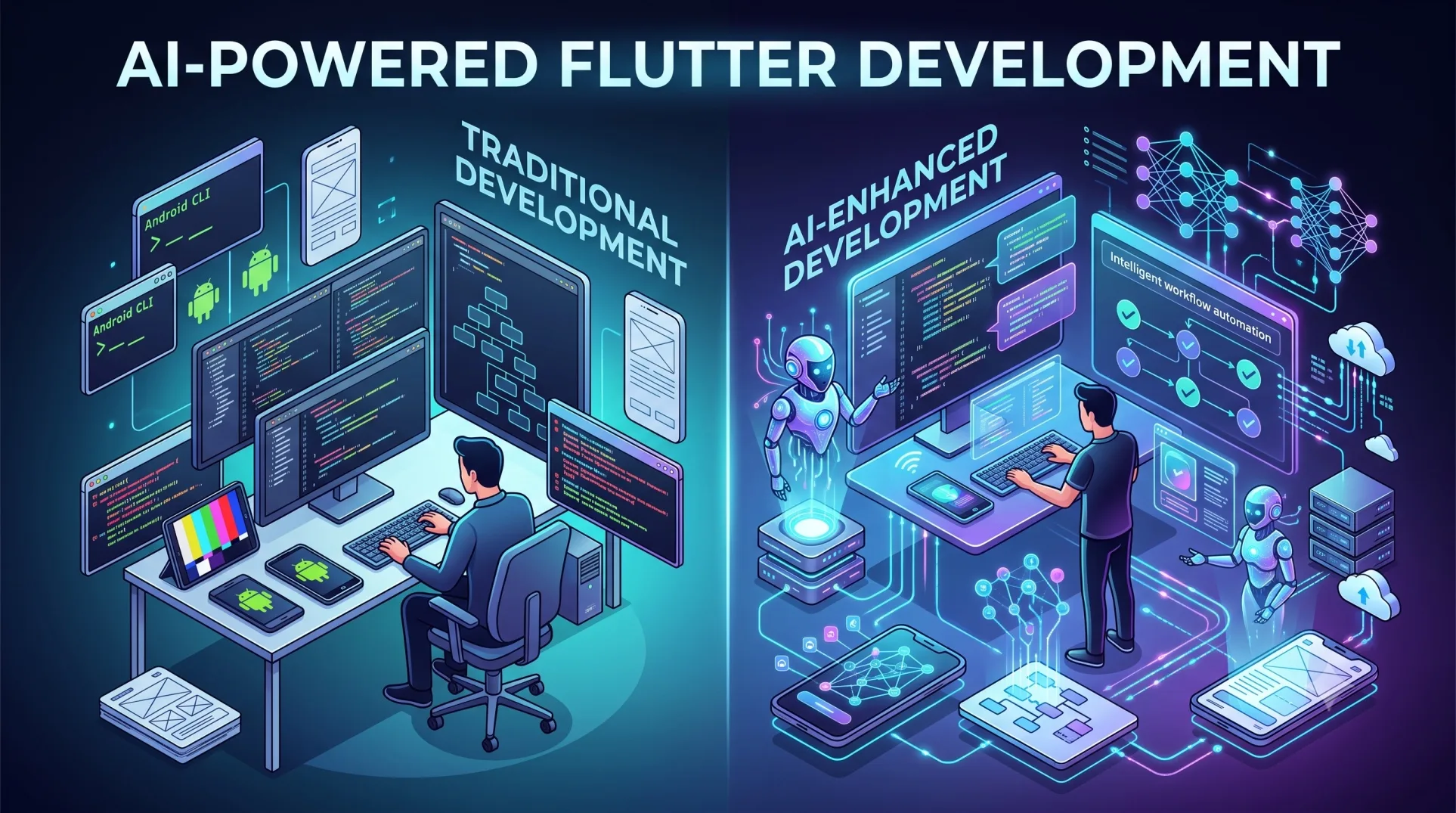
For years, Flutter’s biggest selling point was simple: write once, deploy everywhere.
In 2026, I think that story has changed.
Flutter is no longer just competing on cross-platform development. It’s competing on how fast engineering teams can ship AI-assisted software.
That’s a much bigger shift.
The arrival of Android CLI improvements, AI-first developer workflows like Antigravity, and Gemini integrations inside Flutter isn’t just adding new features,it fundamentally changes how mobile teams build products.
Here’s my opinion:
The next generation of mobile engineering won’t be won by the framework with the most widgets. It’ll be won by the ecosystem that makes developers dramatically more productive with AI.
Flutter Is Becoming an AI Development Platform
The conversation used to revolve around UI performance.
- Is scrolling smooth?
- How close is it to native?
- What’s the startup time?
- How good is hot reload?
Those questions still matter.
But I think they’re no longer the deciding factor.
Today’s engineering teams care more about:
- AI-assisted development
- Faster prototyping
- Automated testing
- AI-generated documentation
- Intelligent debugging
- Code migrations
- Developer workflows
That’s where Flutter is making its biggest leap.
My Opinion: AI Is Becoming the New SDK
Ten years ago, choosing a framework meant comparing APIs.
Today, it means comparing AI capabilities.
If two frameworks build equally good mobile apps but one helps developers ship features 40% faster with AI assistance, the technical comparison is effectively over.
Engineering productivity has become the competitive advantage.
Not syntax.
What Android CLI Changes
Android’s evolving command-line tooling is making automation significantly easier.
Development teams can:
- Script repetitive workflows
- Automate builds
- Integrate AI into CI/CD pipelines
- Generate project scaffolding
- Streamline debugging
- Improve release automation
Individually these improvements seem incremental.
Collectively they remove hours of repetitive engineering work every week.
Why Antigravity Matters
Most AI coding assistants generate code.
Antigravity represents something more interesting.
It focuses on improving the overall developer workflow instead of acting as another autocomplete tool.
That includes:
- Project understanding
- Context-aware development
- Smarter navigation
- Better engineering workflows
- AI-assisted implementation
I think this is where AI tooling is heading.
Developers don’t need another chatbot.
They need software that understands the entire codebase.
Gemini Inside Flutter Is Bigger Than It Looks
Many developers see Gemini integration as another AI feature.
I think they’re underestimating it.
Embedding AI directly into Flutter workflows allows teams to:
- Generate production-ready UI
- Explain unfamiliar code
- Refactor large projects
- Create tests automatically
- Improve accessibility
- Accelerate documentation
- Reduce onboarding time
AI becomes part of the development environment instead of another browser tab.
That’s a meaningful productivity shift.
Companies Leading the AI-Powered Flutter Movement
Several engineering companies are already embracing AI-assisted mobile development while continuing to invest heavily in Flutter and scalable product engineering.
1. GeekyAnts
GeekyAnts has been one of the most visible contributors to the Flutter and React Native ecosystems through open-source work, developer tooling, and production mobile applications. More recently, the company’s engineering discussions have increasingly focused on AI-native product development, where AI accelerates engineering workflows rather than replacing engineers.
2. Very Good Ventures
Very Good Ventures has built a strong reputation around enterprise Flutter development. Their work consistently emphasizes maintainable architecture, testing, and production-quality Flutter applications, making them an important voice as AI tooling becomes part of enterprise mobile engineering.
3. Invertase
Known for maintaining major FlutterFire packages, Invertase continues to shape the Flutter ecosystem through infrastructure, Firebase integrations, and developer tooling. As AI-powered apps increasingly rely on cloud services, this infrastructure work becomes even more valuable.
4. Appwrite
Appwrite is helping developers build backend services for modern applications with an open-source approach. As AI applications require authentication, databases, storage, and serverless execution, backend platforms like Appwrite are becoming central to AI-enabled Flutter projects.
5. Google
As Flutter’s creator, Google continues pushing the ecosystem forward through Flutter, Dart, Android tooling, and Gemini. The growing integration between these technologies reflects a broader vision where AI becomes a native part of the mobile development lifecycle.
6. EPAM Systems
EPAM helps enterprises modernize mobile platforms at scale. Their engineering expertise in AI, cloud, and digital transformation positions them well as organizations adopt AI-assisted development workflows for large Flutter applications.
7. Thoughtworks
Thoughtworks has consistently advocated pragmatic software engineering over chasing trends. Their emphasis on sustainable architecture and developer experience aligns well with the industry’s shift toward AI-assisted, but engineer-led, development.
8. Accenture
Accenture is increasingly integrating AI into enterprise software delivery across industries. For organizations building large mobile ecosystems, combining Flutter with AI-enabled engineering workflows is becoming part of broader digital transformation strategies.
AI Won’t Replace Mobile Engineers
Here’s where I disagree with much of the industry.
People keep asking whether AI will replace Flutter developers.
I think that’s the wrong question.
The real question is:
Which developers will know how to work effectively alongside AI?
Those engineers will ship products faster.
Build higher-quality software.
And spend less time on repetitive work.
The Biggest Competitive Advantage Is No Longer Flutter
It’s the engineering workflow surrounding Flutter.
Teams that combine:
- AI-assisted coding
- Strong architecture
- Automated testing
- Continuous delivery
- Human product thinking
will consistently outperform teams relying solely on manual development.
The framework matters.
The workflow matters more.
Final Thoughts
Flutter’s AI tooling moment isn’t about adding another assistant inside an IDE.
It’s about redefining how mobile software gets built.
I believe the winners over the next few years won’t be the teams writing the most code.
They’ll be the teams making the smartest engineering decisions while letting AI handle repetitive execution.
That’s a much more exciting future than simply asking whether Flutter is faster than native development.
And if that trend continues, mobile engineering in 2030 may look less like programming and more like orchestrating intelligent development systems.