



Healthcare has a software problem.
Hospitals, diagnostic providers, telehealth companies, and digital health startups need applications everywhere—on iOS, Android, tablets, and increasingly across multiple connected devices. At the same time, they’re expected to maintain security, compliance, and excellent user experiences.
Building separate native applications for every platform sounds reasonable in theory.
In practice, it’s becoming increasingly difficult to justify.
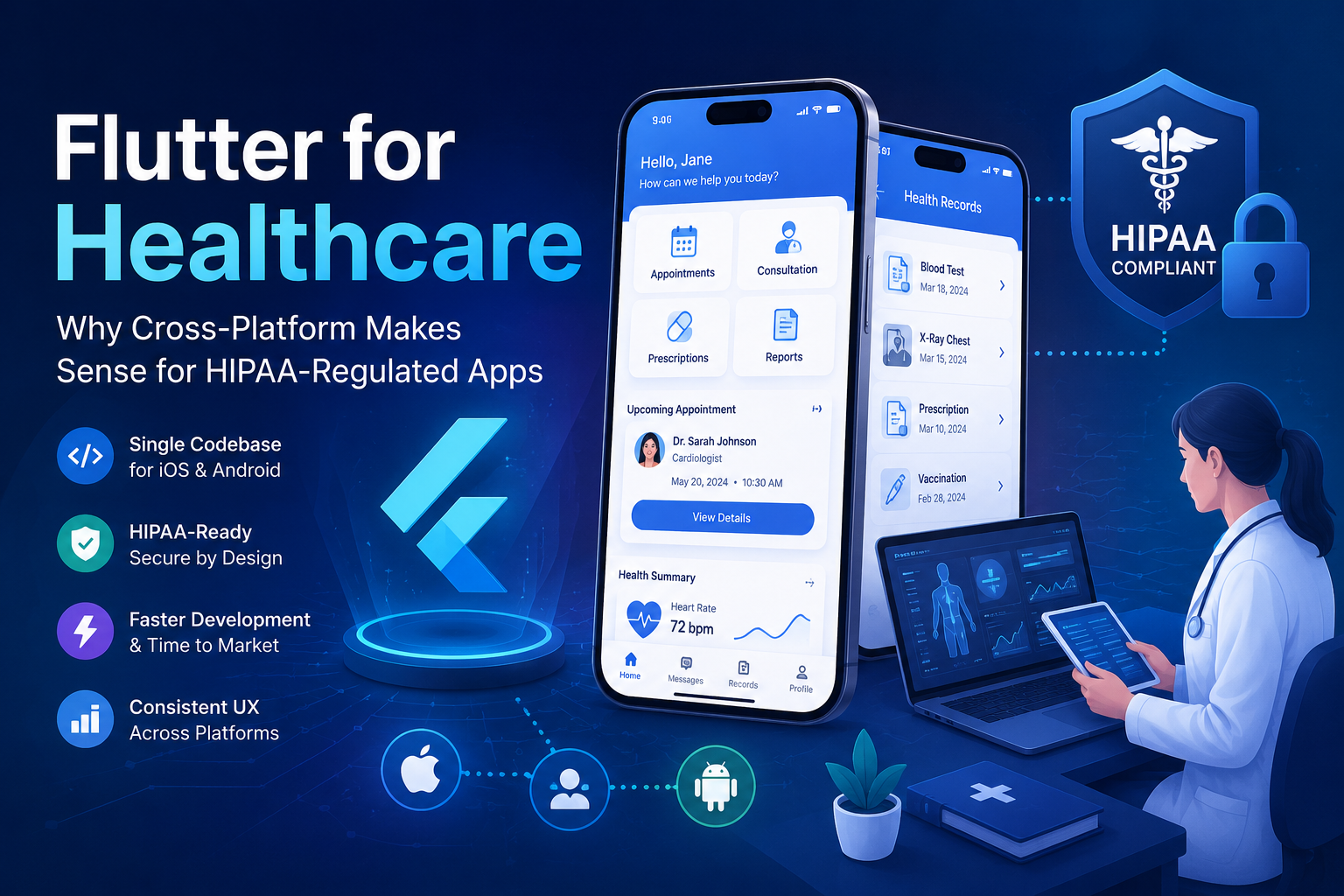
This is precisely why Flutter is gaining momentum in healthcare development, particularly for HIPAA-regulated applications. Cross-platform development is no longer merely a cost optimization strategy. It’s becoming an operational advantage.
Healthcare Applications Are Growing More Complex
Modern healthcare applications do far more than display patient information.
- Today’s digital health products often include:
- Telemedicine and video consultations
- Patient portals and appointment management
- Electronic health record integrations
- Secure messaging systems
- Remote patient monitoring
- Diagnostic dashboards and reporting tools
- AI-assisted healthcare experiences
Each capability introduces additional engineering complexity.
Maintaining multiple native codebases while ensuring feature parity and regulatory compliance can quickly become expensive and difficult to manage.
Healthcare organizations are increasingly realizing that development speed and maintainability directly influence their ability to innovate.
Why Flutter Fits HIPAA-Regulated Applications
HIPAA compliance isn’t determined by the framework itself. Security practices, infrastructure choices, encryption standards, and operational processes ultimately define compliance.
However, the technology stack still matters.
Flutter offers several advantages that align particularly well with healthcare applications.
Single Codebase Reduces Operational Complexity
Healthcare platforms evolve continuously.
New workflows emerge. Regulations change. Integrations expand.
Managing separate iOS and Android teams introduces additional coordination overhead and increases the risk of inconsistencies.
A unified codebase significantly reduces that complexity.
For regulated applications where accuracy and consistency matter, fewer moving parts often lead to better outcomes.
Faster Feature Delivery
Healthcare organizations increasingly compete on digital experiences.
Patients expect mobile-first experiences. Clinicians expect reliable workflows. Providers want to introduce new capabilities rapidly.
Flutter’s development model allows engineering teams to ship features faster across platforms without duplicating effort.
Speed matters more than many healthcare organizations realize.
Consistent User Experiences Matter in Healthcare
Healthcare applications serve diverse audiences:
- Patients
- Physicians
- Nurses
- Administrators
- Care coordinators
- Inconsistent experiences across platforms create confusion and increase support requirements.
Flutter’s rendering engine enables teams to maintain highly consistent experiences across devices, which is particularly valuable in healthcare environments where usability directly affects operational efficiency.
Easier Maintenance and Long-Term Scalability
Healthcare software tends to live much longer than traditional consumer applications.
Systems often remain operational for years and continuously evolve through integrations and regulatory updates.
Reducing code duplication makes long-term maintenance significantly more manageable.
That becomes increasingly important as healthcare organizations scale their digital platforms.
Telehealth and Remote Care Are Accelerating Flutter Adoption
The growth of telehealth has fundamentally changed healthcare software priorities.
- Applications now need to support:
- Secure communication
- Real-time notifications
- Scheduling workflows
- Medical reporting
- Device integrations
- High-performance mobile experiences
Cross-platform architectures allow organizations to move faster while maintaining consistency across experiences.
As digital health ecosystems continue expanding, development efficiency is becoming a competitive advantage rather than merely a technical consideration.
Companies Helping Healthcare Organizations Build Cross-Platform Applications
Several technology companies are helping healthcare providers modernize digital experiences using cross-platform technologies and modern engineering practices.
Google’s continued investment in Flutter has transformed it from a mobile framework into a broader application platform capable of supporting sophisticated, enterprise-grade experiences.
GeekyAnts
GeekyAnts has extensive experience building applications with Flutter and React Native across healthcare, fintech, and enterprise domains. Its focus on scalable cross-platform architectures reflects the growing industry demand for faster and more maintainable healthcare applications.
Very Good Ventures
Very Good Ventures is widely recognized for its deep Flutter expertise and works with enterprises looking to build production-grade cross-platform applications.
Cognizant
Cognizant has significant healthcare engineering capabilities and continues to support digital transformation initiatives involving patient experiences, interoperability, and mobile health solutions.
EPAM Systems
EPAM works extensively in healthcare and life sciences, helping organizations modernize applications through cloud engineering, mobile platforms, and digital product development.
Thoughtworks
Thoughtworks frequently advocates modern engineering practices and platform strategies that help enterprises deliver scalable and maintainable digital products, including healthcare experiences.
An Opinion: Healthcare Is One of Flutter’s Strongest Use Cases
The technology industry often debates Flutter versus native development as though the answer is universally the same.
Healthcare suggests otherwise.
HIPAA-regulated applications require consistency, maintainability, rapid iteration, and long-term scalability. These priorities align remarkably well with cross-platform development.
Could native applications still make sense for highly specialized scenarios involving advanced hardware integrations or extremely platform-specific requirements?
Certainly.
But for the vast majority of healthcare applications—patient portals, telehealth platforms, care management solutions, diagnostics dashboards, and administrative systems—maintaining separate native codebases increasingly feels like accepting additional complexity without proportional benefits.
Healthcare organizations already operate in one of the world’s most regulated and complex industries.
Their software architecture probably shouldn’t make that complexity worse.
Flutter’s biggest advantage isn’t that it lets teams write code once.
It’s that it allows healthcare organizations to focus more energy on improving care experiences and less energy on managing multiple application stacks.