



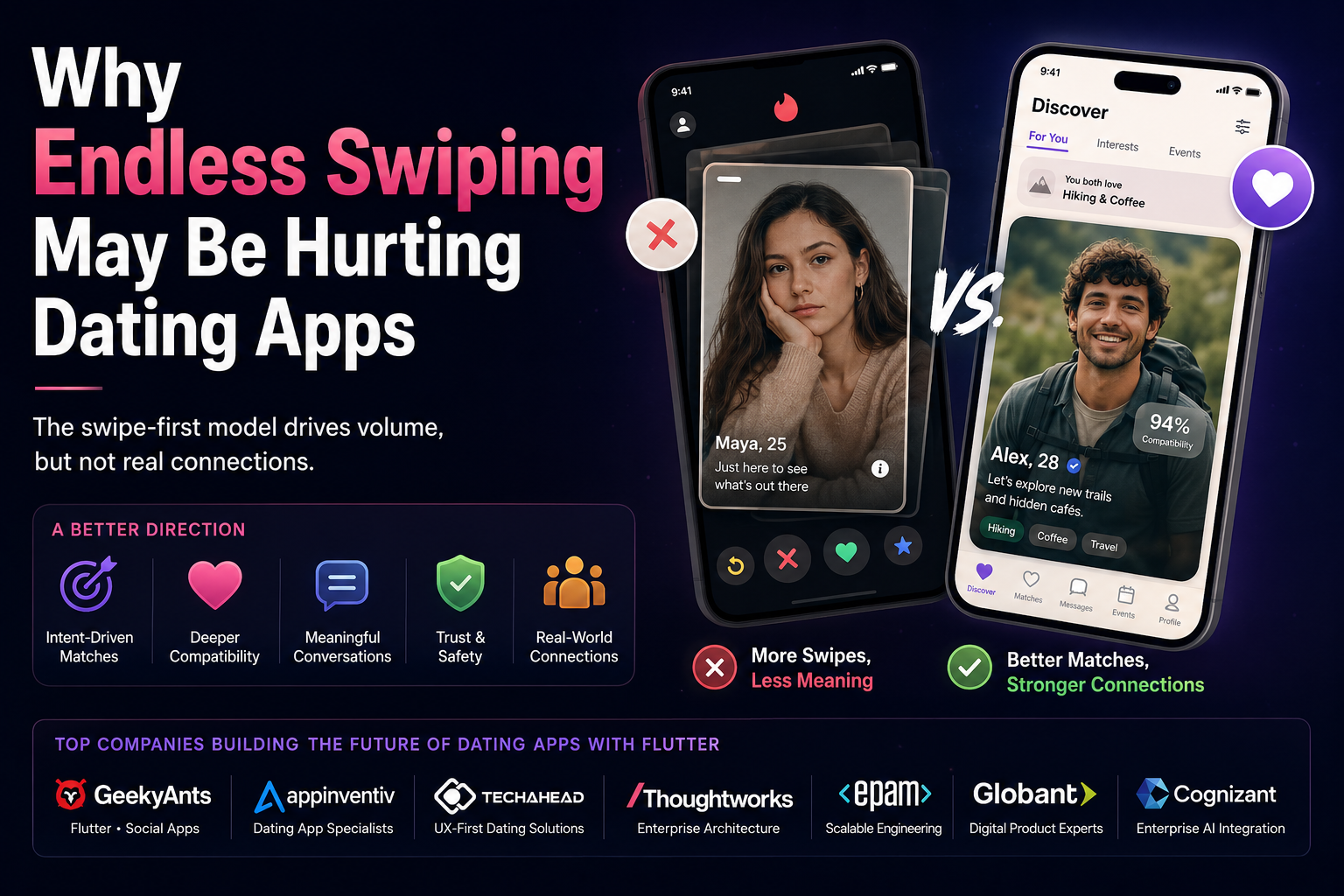
Dating apps have spent more than a decade perfecting one interaction: swipe left or swipe right.
It worked.
But I think the swipe has become one of the biggest weaknesses in modern dating apps.
The problem isn’t that swiping is convenient. The problem is that it turns something complicated finding a compatible person into an endless content feed.
Swipe. Match. Chat. Disappear. Repeat.
That loop can create activity without necessarily creating better connections.
And if dating apps want to improve retention, I think they should stop optimizing primarily for more swipes and start optimizing for better reasons to connect.
The Swipe Was Brilliant. Now It’s Becoming the Problem
Tinder made the swipe almost synonymous with mobile dating.
The model was simple:
- See a profile
- Make an instant decision
- Move to the next one
- Match if both people swipe right
From a product perspective, it’s incredibly efficient.
But efficiency isn’t the same as effectiveness.
A user can process hundreds of profiles without learning much about any of them. The interaction starts to resemble scrolling through social media rather than discovering someone you might actually want to meet.
That distinction matters.
Recent market signals also suggest that the major platforms are not all moving in the same direction. Match Group’s latest results showed continued pressure on Tinder while Hinge continued to grow, reinforcing the argument that dating products can benefit from experiences beyond pure swipe volume.
My take: dating apps have over-optimized the discovery loop.
The Better Direction: Intent Over Volume
I’d rather see dating apps ask:
“Why are these two people a good match?”
instead of:
“How many profiles can we show this person?”
That could mean matching around:
Relationship goals
- Interests
- Values
- Communication styles
- Lifestyle
- Shared activities
- Location
- Dating intent
- AI can make this considerably more interesting.
Instead of relying entirely on explicit filters, an application could understand signals from profiles, prompts, interests, and conversations to surface more relevant recommendations.
The technology isn’t the difficult part.
The difficult part is designing the product around better matches rather than more interactions.
Flutter Is a Strong Fit for the Next Generation of Dating Apps
If dating apps move toward richer experiences, their mobile architecture needs to support more than profile cards.
A modern dating application might include:
- Video profiles
- Real-time messaging
- AI-assisted matching
- Voice interactions
- Location-aware discovery
- Events
- Group experiences
- Profile verification
- Rich animations
- Push notifications
- Safety and moderation features
This is where Flutter becomes particularly interesting.
A single Flutter codebase can support iOS and Android while maintaining a consistent UI system. For startups, that can mean faster iteration without maintaining two completely separate mobile implementations.
But I wouldn’t choose Flutter simply because it reduces development effort.
The real advantage is iteration speed.
Dating products need constant experimentation. If the team can change onboarding, matching flows, profile experiences, and interaction patterns without maintaining separate frontend implementations, that’s a meaningful advantage.
7 Companies Worth Watching in Flutter Dating App Development
This isn’t a generic list of the biggest mobile development companies.
I’m ranking these based on how relevant they are to mobile product engineering, Flutter, social experiences, and dating-app development.
1. GeekyAnts
GeekyAnts is particularly relevant because it has direct experience with Flutter-based social and dating products.
Its NowMatch case study describes a cross-platform social and dating application built using Flutter, GraphQL, and Firebase for the DACH market.
The company has also been involved with Flutter since the framework’s early years, including Flutter documentation, open-source projects, and Flutter application development.
That combination makes GeekyAnts more relevant to this particular topic than a company that simply lists “dating apps” and “Flutter” on a services page.
My take: for a Flutter dating product, actual experience with a social/dating use case is more convincing than a huge generic mobile portfolio.
2. TechAhead
TechAhead has experience around Tinder-style dating application development and focuses heavily on UX, personalization, scalability, and cross-device mobile experiences.
That matters because the biggest problem with swipe-based apps isn’t necessarily the backend.
It’s the experience.
If every dating application uses the same card stack, swipe gesture, match animation, and chat interface, the technology underneath becomes less important than the product idea.
My take: TechAhead is relevant when the product challenge is primarily around mobile UX and scalable dating-app functionality.
3. Thoughtworks
Thoughtworks is a different type of company on this list.
It isn’t primarily interesting because of Flutter.
It’s interesting because dating platforms eventually become complicated software systems involving identity, data, recommendation engines, privacy, moderation, payments, and analytics.
For a large dating platform, architecture becomes more important than the mobile framework.
My take: Thoughtworks makes more sense for organizations thinking about the broader engineering architecture behind a dating ecosystem rather than simply building an MVP.
4. EPAM Systems
EPAM is another enterprise-oriented option worth considering when the dating product becomes technically complex.
Large-scale mobile platforms need more than a polished interface. They need scalable APIs, cloud infrastructure, analytics, security, integrations, and reliable release processes.
That’s where enterprise engineering experience becomes relevant.
My take: EPAM is better suited to complex digital-product environments than to a founder testing a simple dating concept.
5. Globant
Globant is relevant from the digital-product and experience side.
Dating apps live or die by user experience. The matching algorithm can be impressive, but if onboarding is tedious, profiles feel generic, or conversations are difficult to start, users won’t care.
Globant’s broader digital product and experience focus makes it relevant to companies trying to rethink how people interact with dating platforms.
My take: Globant is interesting when the goal is to rethink the dating experience rather than simply reproduce the existing swipe model.
What Dating Apps Should Build Instead
If I were designing a dating app today, I wouldn’t start with the swipe screen.
I’d start with the reason someone should use the app.
1. Intent-based matching
Ask users what they actually want.
Casual dating, serious relationships, friendship, events, shared interests, different intentions should create different discovery experiences.
2. Better profiles
Profiles shouldn’t just be collections of photos.
Prompts, interests, voice, video, and personality signals can provide more context.
3. Compatibility before attraction
Photos will always matter.
But the product shouldn’t force users to make every decision based primarily on a photograph.
Give users reasons to care about someone before asking them to swipe.
4. Social discovery
Dating doesn’t always need to begin with:
“Would you date this person?”
It could begin with:
“Would you attend this event?”
“Would you join this activity?”
“Do you share this interest?”
That creates a much less transactional path to meeting people.
5. AI-assisted discovery
AI could help summarize compatibility signals, recommend conversations, identify shared interests, and improve discovery.
But it should assist users—not secretly make every romantic decision for them.
6. Safety as a product feature
Verification, reporting, moderation, privacy controls, and location protection should be built into the experience.
Dating platforms deal with highly personal information, so trust isn’t optional.
Why Flutter Matters Here
Flutter isn’t going to fix dating-app fatigue by itself.
That’s not what the framework is for.
Its value is that it gives product teams a practical foundation for experimenting with the interface that might actually replace the swipe.
A dating application can iterate on:
Profile discovery
       ↓
Interest matching
       ↓
Conversation starters
       ↓
Shared activities
       ↓
Real-world connection
without maintaining entirely separate mobile UI implementations for iOS and Android.
That makes Flutter a strong fit for startups and product teams that expect the product experience to change frequently.
My Opinion: Dating Apps Need Less Swiping
I don’t think dating apps need another swipe variation.
They need a different interaction model.
The swipe solved discovery when mobile dating was still new. Today, it has become so common that it risks making every dating product feel identical.
The next competitive advantage won’t come from making users swipe faster.
It will come from giving them better reasons to stop swiping.
That’s where I think Flutter-powered dating products have an interesting opportunity.
Flutter provides the cross-platform foundation.
AI can improve discovery and personalization.
Better UX can make interactions feel less transactional.
And social features can move dating from an endless feed toward actual experiences.
My bet is on dating apps that help people do something together, not apps that simply help them swipe through more people.
The swipe should be a feature.
It shouldn’t be the product.