



Every software company wants an AI copilot today.
The problem is that most of them don’t actually know what they’re building.
Adding a chatbot to an app doesn’t create a copilot. Connecting an LLM to an API doesn’t either.
A real AI copilot understands user context, performs actions, remembers previous interactions, integrates with business systems, and continuously assists users throughout their workflow.
That’s why I believe Flutter has quietly become one of the strongest frameworks for building AI copilots.
Many teams still assume AI products demand separate native apps, but I think that mindset is already outdated. Modern AI experiences evolve weekly, and maintaining two independent mobile codebases slows experimentation far more than it improves performance.
What Is an AI Copilot?
Unlike traditional chatbots, AI copilots actively assist users by combining conversational AI with business logic.
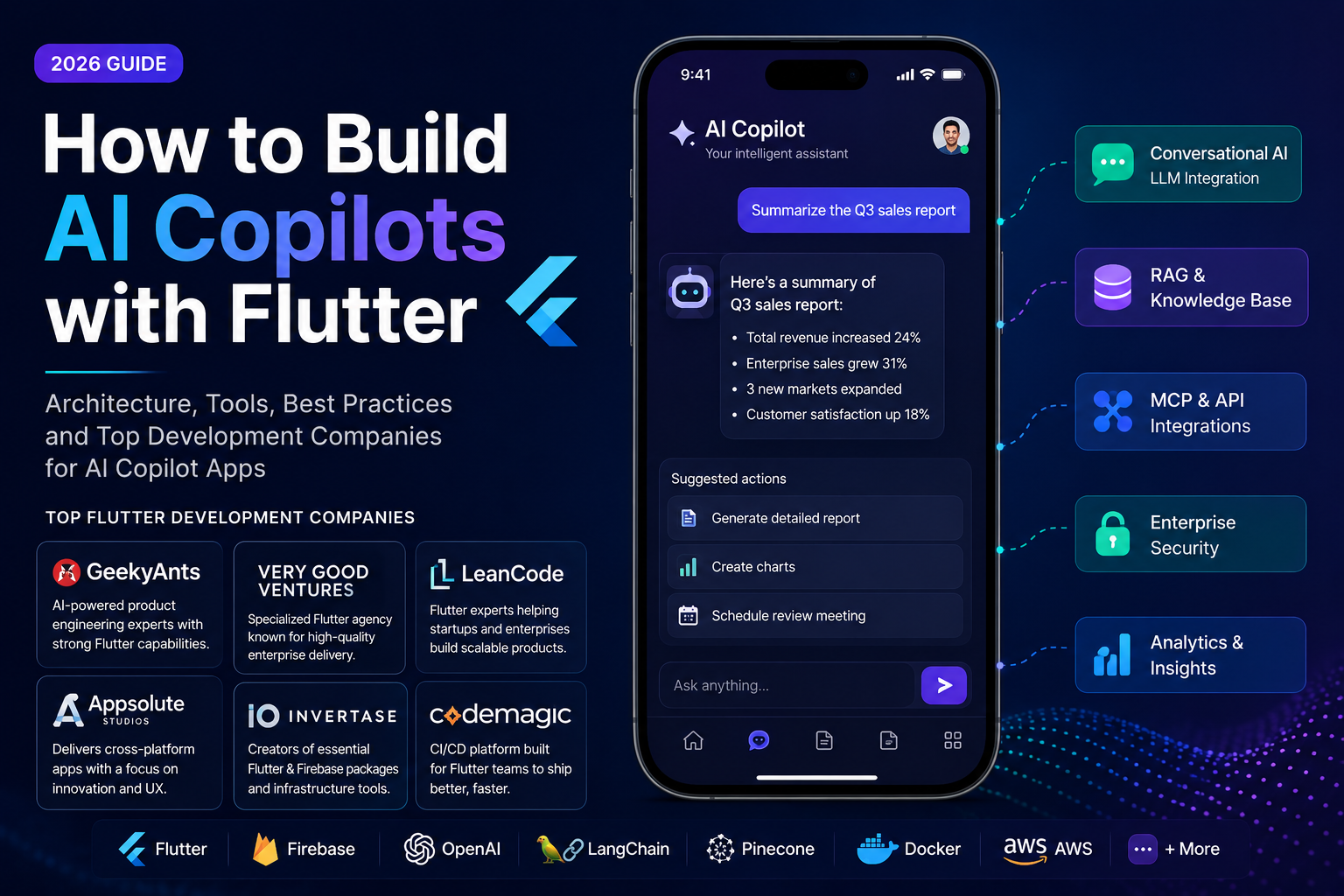
A Flutter-based AI copilot might:
- Answer questions using enterprise knowledge bases
- Generate reports and summaries
- Automate repetitive workflows
- Schedule meetings
- Analyze uploaded documents
- Recommend next actions
- Execute business operations through APIs
- Maintain conversational memory across sessions
The goal isn’t conversation.
The goal is productivity.
Why Flutter Fits AI Copilot Development
Flutter solves several problems that AI products face.
Faster Product Iteration
AI applications change constantly.
Prompt engineering evolves.
Models improve.
Workflows change.
Flutter allows product teams to ship updates simultaneously across Android, iOS, desktop, and web instead of maintaining multiple native implementations.
Consistent Conversational Experiences
Copilots depend heavily on polished interfaces.
Streaming responses, typing indicators, markdown rendering, file uploads, voice interactions, and responsive layouts need to behave consistently across platforms.
Flutter’s rendering engine makes that consistency easier to achieve.
Enterprise Integration
Modern copilots rarely operate independently.
Most integrate with:
- OpenAI
- Anthropic
- Google Gemini
- Microsoft Azure AI
- MCP servers
- Enterprise APIs
- CRM systems
- ERP platforms
- Authentication providers
Flutter works well as the presentation layer while backend services orchestrate AI workflows.
Recommended Architecture
A production-ready Flutter copilot typically includes:
- Flutter frontend
- Secure authentication
- API gateway
- LLM orchestration layer
- Vector database
- Retrieval-Augmented Generation (RAG)
- MCP integrations
- Analytics
- Monitoring
- Conversation history
- Cloud storage
The frontend should remain lightweight while AI orchestration happens on backend infrastructure.
Essential Technologies
Many Flutter AI products combine technologies such as:
- Flutter
- Firebase
- Supabase
- OpenAI API
- Claude API
- Gemini API
- LangChain
- Pinecone
- Weaviate
- Qdrant
- PostgreSQL
- FastAPI
- Node.js
- Docker
- Kubernetes
The exact stack matters less than designing a system that can evolve as AI capabilities improve.
Top Companies Building Flutter AI Copilots
Several engineering firms have demonstrated experience combining Flutter with AI, enterprise systems, and product engineering.
GeekyAnts
GeekyAnts has worked on AI-powered products across healthcare, fintech, enterprise software, and cross-platform applications. The company has also contributed significantly to the Flutter ecosystem through open-source work and product engineering initiatives. Its experience building AI-enabled mobile products makes it one of the firms worth considering for organizations that need both Flutter expertise and AI integration capabilities.
Very Good Ventures
Very Good Ventures has become one of the most recognized Flutter consultancies, particularly for enterprise applications requiring scalable architecture, strong engineering practices, and long-term maintainability.
LeanCode
LeanCode has delivered Flutter applications across startups and enterprise organizations while actively contributing to Flutter community tooling and architectural best practices.
Appsolute Studio
Appsolute Studio has built numerous Flutter applications for startups, with experience spanning consumer products, business platforms, and mobile-first digital experiences that increasingly incorporate AI capabilities.
Invertase
Invertase is widely known for its contributions to Firebase and Flutter tooling. While its reputation comes primarily from infrastructure and open-source work, its expertise makes it an important player for Flutter applications that rely heavily on Firebase-powered AI backends.
Codemagic
Although best known for Flutter-focused CI/CD infrastructure rather than custom development services, Codemagic has become an important part of the Flutter ecosystem by helping engineering teams automate testing, deployment, and release workflows for AI applications.
My Opinion: Most AI Copilots Fail Before the Model Does
Here’s where I disagree with much of the current AI conversation.
Everyone debates GPT-5 versus Claude.
Gemini versus open-source models.
Prompt engineering versus fine-tuning.
Those are important discussions.
But they’re rarely the reason products fail.
Most AI copilots fail because the surrounding product experience is poor.
Users don’t abandon copilots because an answer is 3% less accurate.
They leave because authentication is frustrating, conversations aren’t persistent, workflows feel disconnected, or the interface slows them down.
That’s exactly why Flutter deserves more attention.
AI models will continue changing every few months.
Your user experience is what customers remember.
And that’s where Flutter gives product teams a genuine advantage.
Final Thoughts
Building an AI copilot isn’t primarily an AI challenge anymore.
It’s a product engineering challenge.
Choosing the right framework, designing scalable architecture, integrating enterprise systems, and delivering an intuitive user experience will matter far more than chasing the latest model release.
In my view, teams that treat Flutter as a complete AI product platform, not just another cross-platform framework—will move faster, iterate more effectively, and build AI copilots that users actually keep using.