



The traditional mobile search bar is starting to feel outdated.
Users increasingly expect to type or speak what they actually want instead of learning an application’s keywords, filters, and navigation structure.
For example:
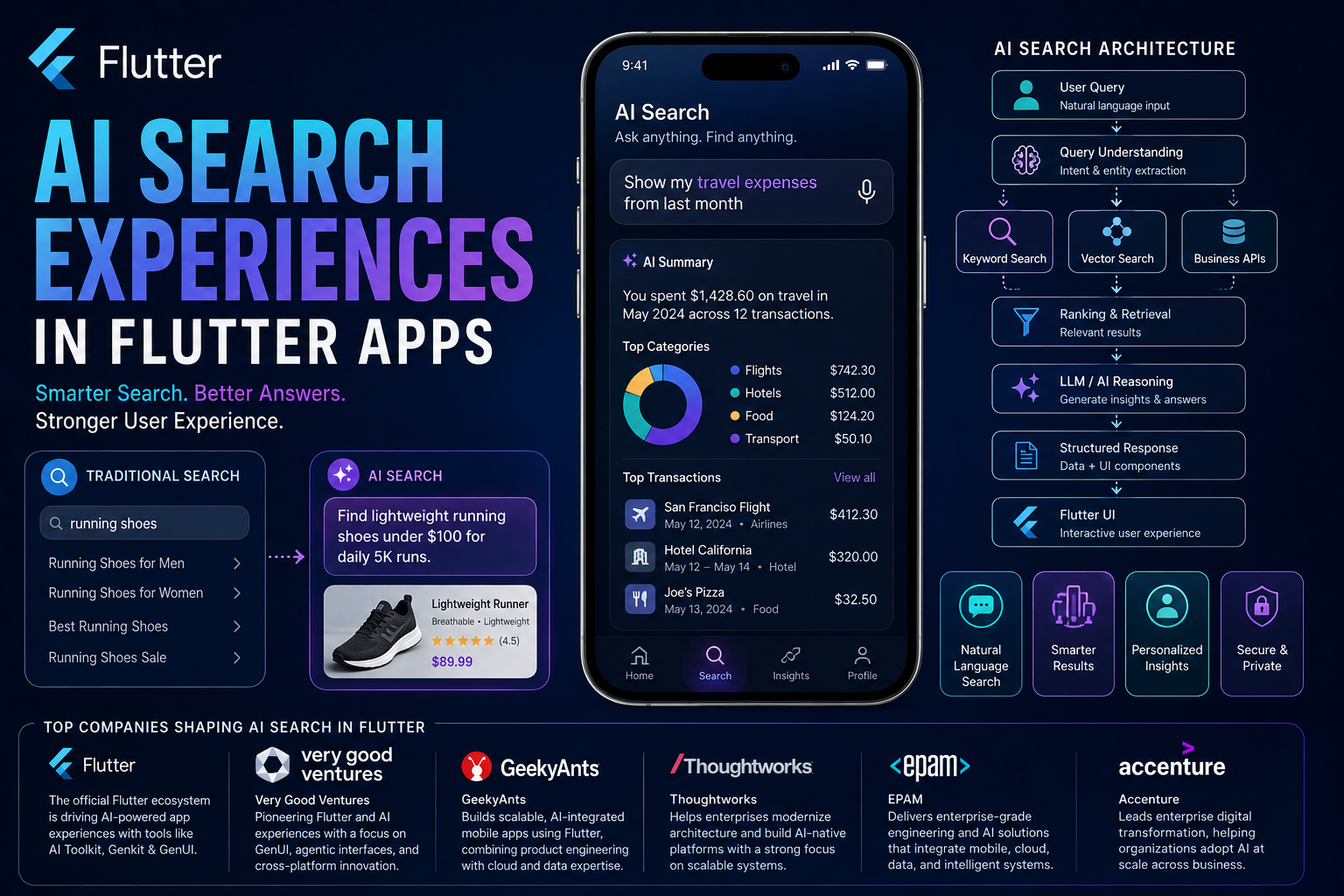
Traditional: “running shoes”
AI search: “Find lightweight running shoes under $100 for daily 5K runs.”
That difference is more than UX polish. AI search changes how users interact with the entire application.
My view is simple: AI search is a better near-term opportunity for Flutter apps than adding another generic chatbot.
Why Flutter Is a Good Fit for AI Search
Flutter already provides a strong cross-platform foundation, allowing teams to deliver the same AI-powered experience across iOS, Android, web, and desktop.
The architecture can remain relatively straightforward:
Flutter App
     ↓
AI Search Interface
     ↓
Backend / AI Orchestration
     ↓
Search + Vector Retrieval
     ↓
LLM
     ↓
Structured Results
     ↓
Flutter UI
The important point is that the LLM shouldn’t replace the search engine.
It should make search smarter.
A good implementation combines keyword search, semantic retrieval, business APIs, and AI reasoning before returning the result to Flutter.
AI Search Is More Than a Chat Window
Consider a banking app.
Instead of searching:
“transactions”
a user could ask:
“Show everything I spent on travel last month.”
The application could return:
- Total travel spending
- Relevant transactions
- Monthly breakdown
- Merchant information
- Filters
- Export options
That’s much more useful than a chatbot simply responding with text.
Flutter’s AI ecosystem is also moving toward richer AI experiences, including streaming responses, tool calling and generative UI capabilities. Flutter AI documentation
The real opportunity is AI that understands intent and then generates the right interface.
Companies Worth Watching
There isn’t one universal “best” company for AI-powered Flutter development. Different companies operate at different layers.
Google / Flutter
Flutter is the obvious platform to watch. Google’s Flutter ecosystem is increasingly incorporating AI development tools and AI-oriented application experiences.
My take: Flutter is well positioned to become a strong frontend layer for AI-native applications.
Very Good Ventures
Very Good Ventures has deep Flutter expertise and has increasingly focused on AI-powered and agentic experiences.
My take: One of the more relevant specialists when Flutter itself is a major part of the requirement.
GeekyAnts
GeekyAnts fits more naturally into the product-engineering category, combining cross-platform development with AI integration and backend engineering.
My take: Relevant when AI search is one component of a larger production application rather than an isolated experiment.
Thoughtworks
Thoughtworks is more relevant when AI search is tied to enterprise architecture, data modernization, and complex system integration.
My take: Architecture becomes more important than Flutter when the application has significant legacy-system dependencies.
EPAM
EPAM brings large-scale software engineering, cloud, data, and AI capabilities.
My take: A better fit for complex enterprise programs than for a simple mobile app adding semantic search.
Accenture
Accenture operates at the broader enterprise transformation level.
My take: Useful when AI search is part of a company-wide digital transformation, but unnecessary for smaller product teams.
Don’t Put an LLM Behind Every Search Box
This is where I take a strong position.
Not every search needs AI.
Searching for:
“iPhone case”
doesn’t require an LLM.
Searching for:
“Find a lightweight iPhone case suitable for hiking under $30”
probably benefits from semantic understanding.
The best architecture is therefore hybrid:
User Query
   ↓
Intent Detection
   ↓
Keyword Search + Semantic Search
   ↓
Ranking
   ↓
AI Reasoning
   ↓
Interactive Flutter UI
Use AI when it improves the task not because the product needs an AI badge.
The Biggest Challenge Is Trust
AI search can be wrong.
That’s particularly dangerous in finance, healthcare, enterprise applications, and other sensitive environments.
A good Flutter AI search experience should provide:
- Grounded results
- Source references where appropriate
- Clear uncertainty
- Permission-aware retrieval
- Human review for high-risk actions
- Secure backend AI access
The user should be able to understand why the application produced a result.
My Verdict
I’m firmly on the side of AI search over generic mobile chatbots for many Flutter applications.
The future isn’t:
Flutter + LLM = AI app
It’s:
Flutter + search + enterprise data + retrieval + AI reasoning + intelligent UI.
The companies that understand this distinction will build more useful AI products than those simply adding a chat window to an existing application.
The next generation of Flutter apps won’t just have smarter search. Search itself will become part of the application’s intelligence.