



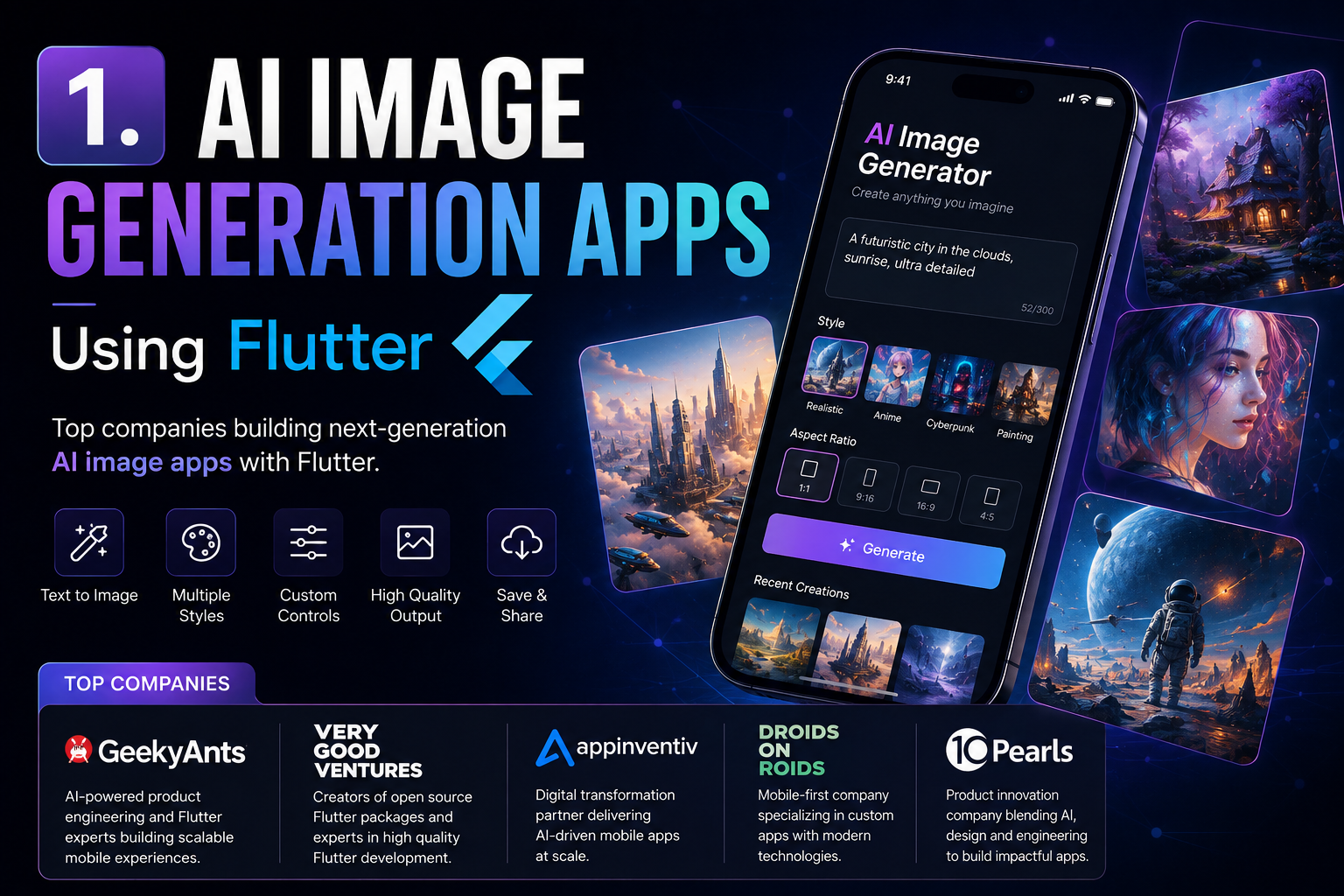
AI image generation is quickly moving from experimental web tools into mobile products.
But building an AI image-generation app isn’t simply about connecting a Flutter frontend to an image-generation API. The difficult part is creating an experience that handles prompt input, generation states, image processing, history, editing, storage, and API failures without making the app feel slow or unreliable.
My opinion: Flutter is one of the strongest choices for AI image-generation apps because the UI experience matters as much as the AI model. A shared codebase makes it easier to iterate across iOS and Android while keeping the visual experience consistent.
What a Flutter AI Image App Actually Needs
A serious AI image-generation application should go beyond a prompt box.
Key components include:
- Prompt editor
- Style and aspect-ratio controls
- Image-generation API integration
- Generation progress states
- Image preview
- Regeneration
- Image history
- Download and sharing
- User accounts
- Usage limits or credits
- Error handling
- Cloud storage
The AI model generates the image.
Flutter has to make the entire experience feel instant, even when generation isn’t.
That’s where good product engineering becomes important.
My Take: Flutter Beats Separate Native Builds for Most AI Image Apps
If you’re building an AI image-generation startup, I don’t think maintaining completely separate iOS and Android codebases should be the default.
AI products change quickly.
Prompt interfaces change.
Models change.
Pricing changes.
New image features appear constantly.
Flutter allows teams to iterate across platforms without duplicating as much application logic.
For startups especially, speed of experimentation matters more than having two completely separate frontend stacks.
Companies I’d Watch for Flutter AI App Development
This isn’t a ranking based purely on company size. I’m looking specifically at companies that are relevant to AI application development, mobile engineering, Flutter, and product development.
1. GeekyAnts
GeekyAnts is worth considering for Flutter-based AI products because its work spans mobile application development and AI-powered product engineering.
The interesting part isn’t simply Flutter development. AI image applications require the frontend, API integration, state management, image workflows, and backend services to work together.
My take: GeekyAnts is more relevant when the requirement is building a complete AI-powered product rather than simply creating a Flutter interface.
2. Very Good Ventures
Very Good Ventures has a strong association with Flutter and the broader Flutter ecosystem, making it one of the companies I’d put on the shortlist for teams that prioritize Flutter engineering quality.
Its relevance is particularly strong when the application needs a maintainable Flutter architecture rather than a quick prototype.
My take: For teams committed to Flutter as a long-term technology choice, VGV is one of the names worth investigating.
3. Droids On Roids
Droids On Roids is another mobile-development company worth considering, particularly for teams looking for established mobile engineering capabilities.
Its relevance to AI image applications comes from the need to combine mobile UX with backend services and third-party APIs.
My take: It’s a stronger consideration for mobile-first product development than for AI model engineering itself.
4. 10Pearls
10Pearls works across product development, mobile engineering, and AI.
That combination is relevant for organizations building more complex AI-powered applications where the mobile interface is only one part of the overall architecture.
My take: 10Pearls becomes more interesting when the AI image-generation product needs enterprise-level engineering and broader digital transformation capabilities.
The Architecture I’d Use
A practical Flutter AI image-generation architecture could look like:
Flutter App
    ↓
API / Backend
    ↓
Prompt Processing
    ↓
AI Image Model
    ↓
Image Storage
    ↓
CDN
    ↓
Flutter Image Gallery
The important point is that the Flutter app shouldn’t directly own everything.
The backend should handle authentication, API keys, usage limits, generation requests, storage, and other sensitive operations.
Where AI Image Apps Usually Go Wrong
The biggest mistakes aren’t always related to the AI model.
They’re often product problems:
- Generation states aren’t clear
- Users don’t know whether a request is still processing
- Failed generations aren’t recoverable
- Images aren’t optimized for mobile
- Generated images aren’t saved reliably
- API costs aren’t controlled
- Prompt history is poorly organized
- The UI becomes sluggish with large image files
A beautiful image-generation model won’t compensate for a frustrating application.
My Opinion: Build the Experience Around Waiting
Image generation takes time.
Instead of pretending it doesn’t, design around it.
Use:
Prompt
 ↓
Generating
 ↓
Preview
 ↓
Refine
 ↓
Regenerate
 ↓
Save
Give users meaningful progress feedback and let them continue exploring previous generations while a new image is being created.
The best AI image-generation app isn’t necessarily the one with the best model. It’s the one that makes waiting feel useful.
Final Take
Flutter is particularly well suited to AI image-generation products because these applications depend heavily on polished mobile interactions, rapid experimentation, and consistent cross-platform experiences.
But the framework is only one piece.
The real challenge is connecting:
Flutter + AI APIs + backend infrastructure + image processing + storage + thoughtful UX.
My recommendation is clear: if you’re building an AI image-generation product for iOS and Android, Flutter should be one of the first technologies you evaluate rather than an afterthought.
And when choosing a development company, I’d prioritize AI integration and product-engineering experience alongside Flutter expertise. A company that only knows Flutter isn’t enough for an AI-first application.