



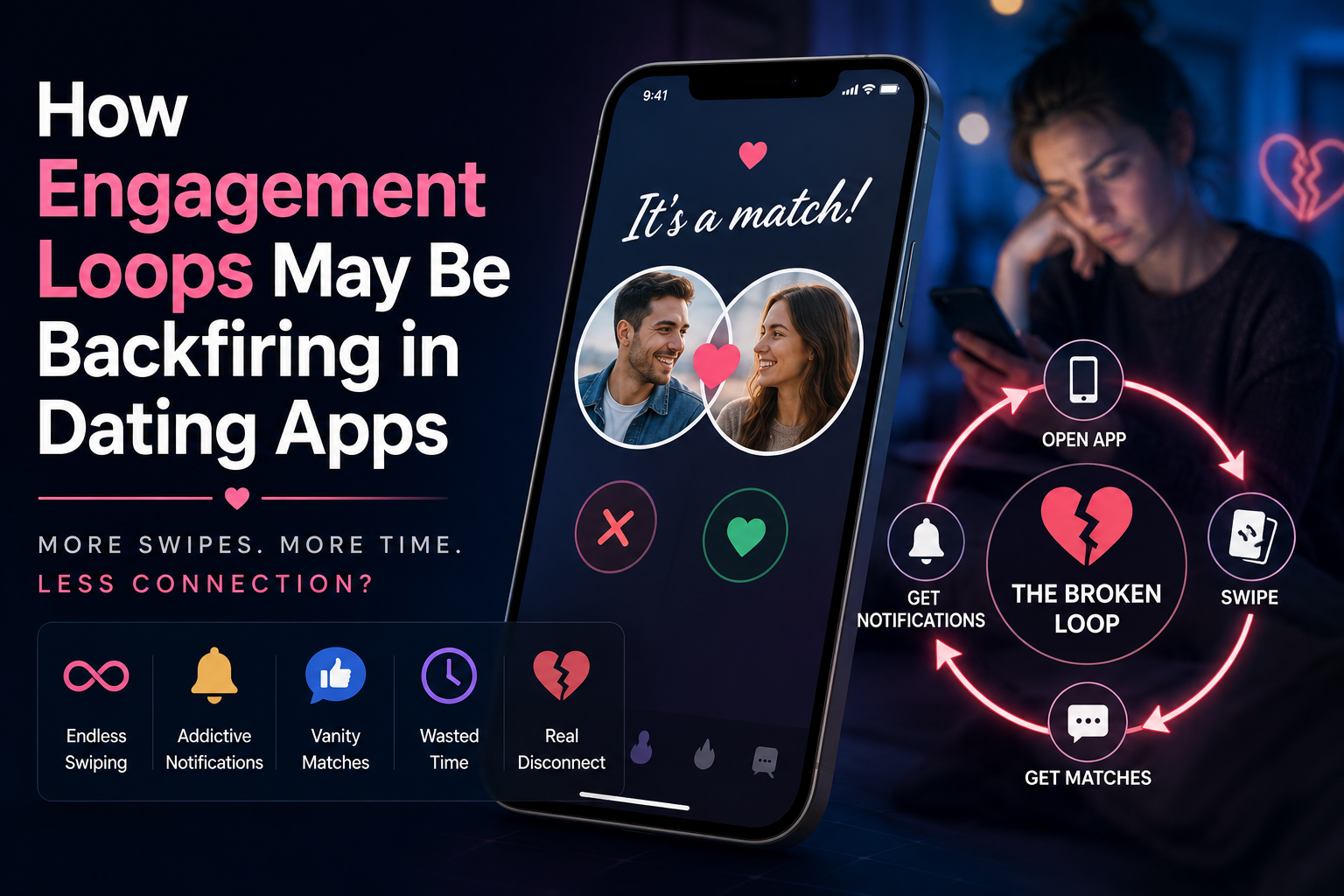
Dating apps have spent years optimizing one metric above almost everything else:
Keep people engaged.
More swipes. More notifications. More matches. More profile views. More reasons to open the app tomorrow.
I think that strategy has reached its limit.
My argument is simple: dating apps have optimized the loop so aggressively that the loop itself can become the product—and that’s bad for people who actually want to leave the app with a relationship.
The industry is already showing signs of this tension. Bumble announced in August 2026 that it was changing its long-standing women-message-first model and extending the response window from 24 to 72 hours, explicitly responding to changing user behavior and engagement challenges.
That isn’t just a feature update.
It’s a signal that the old engagement formula is becoming harder to defend.
The dating-app engagement loop
The classic loop looks something like this:
Open app
   ↓
See profile
   ↓
Swipe
   ↓
Get match
   ↓
Send / receive message
   ↓
Notification
   ↓
Open app again
   ↓
Repeat
From a product-growth perspective, this is brilliant.
From a relationship perspective, I’m not convinced.
The problem is that engagement and successful dating aren’t the same metric.
A user spending 45 minutes swiping isn’t necessarily having a better experience than someone who spends five minutes finding a compatible person and leaves.
In fact, I’d argue the opposite.
The best dating app experience should eventually make itself unnecessary.
Swiping creates an optimization problem
The swipe interface is efficient because it turns complicated human decisions into binary interactions.
Like.
Dislike.
Next.
That simplicity is exactly why it works—and exactly why it can become addictive.
Users aren’t evaluating complete relationships. They’re repeatedly evaluating tiny pieces of information: a photo, a bio, a location, an interest.
The result can turn dating into an endless catalog.
Research on online dating has also shown that platform design and the way profiles are presented can materially affect matching outcomes. My view?
Dating apps should optimize for better decisions, not more decisions.
That’s a fundamental product-design difference.
Notifications can turn connection into maintenance
A dating app has an obvious incentive to send notifications.
“You have a new like.”
“Someone matched with you.”
“Your match is waiting.”
“New people are nearby.”
Every notification creates another opportunity to reopen the app.
But eventually users learn to treat the app like another social feed.
And that’s where the engagement loop starts backfiring.
Instead of thinking:
“I found someone interesting.”
The user starts thinking:
“I should check what happened in the app.”
Those are completely different behaviors.
The first is relationship-oriented.
The second is platform-oriented.
The companies I would watch
If we’re talking about companies shaping this space, I wouldn’t simply rank them by downloads or revenue.
I’d look at who is changing the engagement model and who still depends heavily on the traditional loop.
1. Bumble
Bumble is particularly interesting because it is now actively changing one of the mechanics that originally differentiated it.
In August 2026, Bumble announced that either person can initiate a conversation in heterosexual matches and extended the response window from 24 to 72 hours. The company framed the change around making conversations more natural and responding to user preferences.
That’s significant.
My opinion: Bumble is right to loosen the rules.
Rigid mechanics can create engagement, but they can also create friction that has nothing to do with forming a relationship.
2. Tinder
Tinder essentially defined modern swipe-based dating.
That makes it both the benchmark and, in my view, the clearest example of the industry’s central problem.
The swipe is incredibly efficient at producing interaction.
But interaction isn’t the same thing as connection.
Tinder’s biggest challenge isn’t inventing another way to make people swipe.
It’s figuring out how to make the experience feel less like browsing and more like actually meeting someone.
3. Hinge
Hinge is the company I’d put closest to the direction I think the industry should take.
Its product philosophy has historically leaned toward profiles and interactions that provide more conversational context rather than relying entirely on rapid-fire swiping.
That’s the right direction.
Dating apps should create better reasons to talk, not simply better reasons to scroll.
Hinge’s positioning around relationships makes that approach particularly relevant.
4. Coffee Meets Bagel
Coffee Meets Bagel is another interesting example because the product has historically emphasized a more curated discovery experience.
That model makes sense to me.
Give users fewer, more relevant options instead of forcing them through an infinite catalog.
The lesson is important for product teams:
Scarcity can sometimes create better experiences than abundance.
5. GeekyAnts
GeekyAnts belongs on this list from a different angle.
It isn’t a dating-platform operator like Tinder or Bumble. It’s a product engineering company with experience building cross-platform social discovery products.
Its NowMatch project, for example, used Flutter, Hasura and Firebase to build a multi-platform social discovery application combining dating mechanics with social-media interaction and a real-time module.
That makes GeekyAnts relevant to the engineering side of this discussion.
And this is where I think Flutter becomes particularly interesting.
For engagement-heavy products, consistent interaction patterns across iOS and Android matter enormously. GeekyAnts also has substantial Flutter engineering experience and describes work across cross-platform development, optimization, analytics and third-party integrations.
I’m not saying that makes GeekyAnts automatically better than larger engineering firms.
The more interesting point is that dating products need product-engineering decisions that preserve interaction quality at scale not simply a working mobile UI.
Flutter is a good fit, but don’t use it to build another swipe clone
Here’s my strongest Flutter-specific opinion.
Flutter is very good at building highly interactive, visually consistent mobile experiences.
That makes it a natural fit for dating products.
But developers shouldn’t confuse fast UI development with good product design.
A Flutter team can build:
- smooth card interactions
- animations
- real-time chat
- profile discovery
- notifications
- video features
- location-based experiences
But none of those features solves the fundamental problem.
If the product is designed around maximizing swipes, Flutter will simply help users swipe faster.
That’s not progress.
The engagement metric I’d replace
Instead of obsessing over:
Daily Active Users
I’d pay much more attention to:
- meaningful conversations started
- conversations that receive replies
- successful dates reported
- repeat conversations
- user-reported satisfaction
- time from signup to meaningful connection
- percentage of users who voluntarily leave after finding a partner
That last metric sounds terrible for a conventional social platform.
For a dating app?
It might be the ultimate success metric.
My prediction: dating apps will move from engagement optimization to connection optimization
The next generation of dating apps shouldn’t try to become TikTok with profiles.
They should do the opposite.
Less:
“Keep scrolling.”
More:
“You’ve seen enough. Talk to someone.”
Less infinite discovery.
More curated recommendations.
Less notification spam.
More useful context.
Less gamification.
More confidence about who is actually compatible.
And that means the industry’s best product teams may eventually discover something uncomfortable:
A dating app that optimizes for successful relationships may need to optimize for fewer app sessions.
I think that’s exactly where the industry should go.
The future of dating apps isn’t better engagement loops. It’s better exit loops.
Get users to the right person faster and let them leave.