



Every week, another company launches an AI-powered mobile app.
Most conversations revolve around which LLM they’re using.
I think that’s the wrong conversation.
The real differentiator isn’t GPT-4o, Gemini, Claude, or any other model.
It’s how well the mobile experience delivers AI to users.
And that’s why I believe Flutter has become one of the strongest frameworks for building generative AI mobile products.
AI Products Need Faster Iteration Than Traditional Apps
Generative AI products evolve almost weekly.
Models improve.
Prompts change.
Features appear overnight.
If every platform requires separate engineering effort, innovation slows dramatically.
Flutter solves one of the biggest problems AI startups face: delivering Android and iOS experiences from a shared codebase while maintaining a consistent user interface.
For AI-first startups, shipping speed matters more than framework ideology.
Opinion: Flutter Is Better Suited for AI Products Than Many Developers Admit
This may be unpopular among some native developers.
Most AI applications don’t push mobile GPUs to their limits.
They’re built around:
- Conversational interfaces
- Voice interactions
- AI-generated content
- Image generation
- Document analysis
- Recommendation systems
- Workflow automation
Flutter excels at exactly these experiences.
When AI capabilities change every month, maintaining two separate mobile codebases often becomes unnecessary overhead.
AI Changes Mobile UI Design
Generative AI applications require UI patterns that traditional mobile apps never needed.
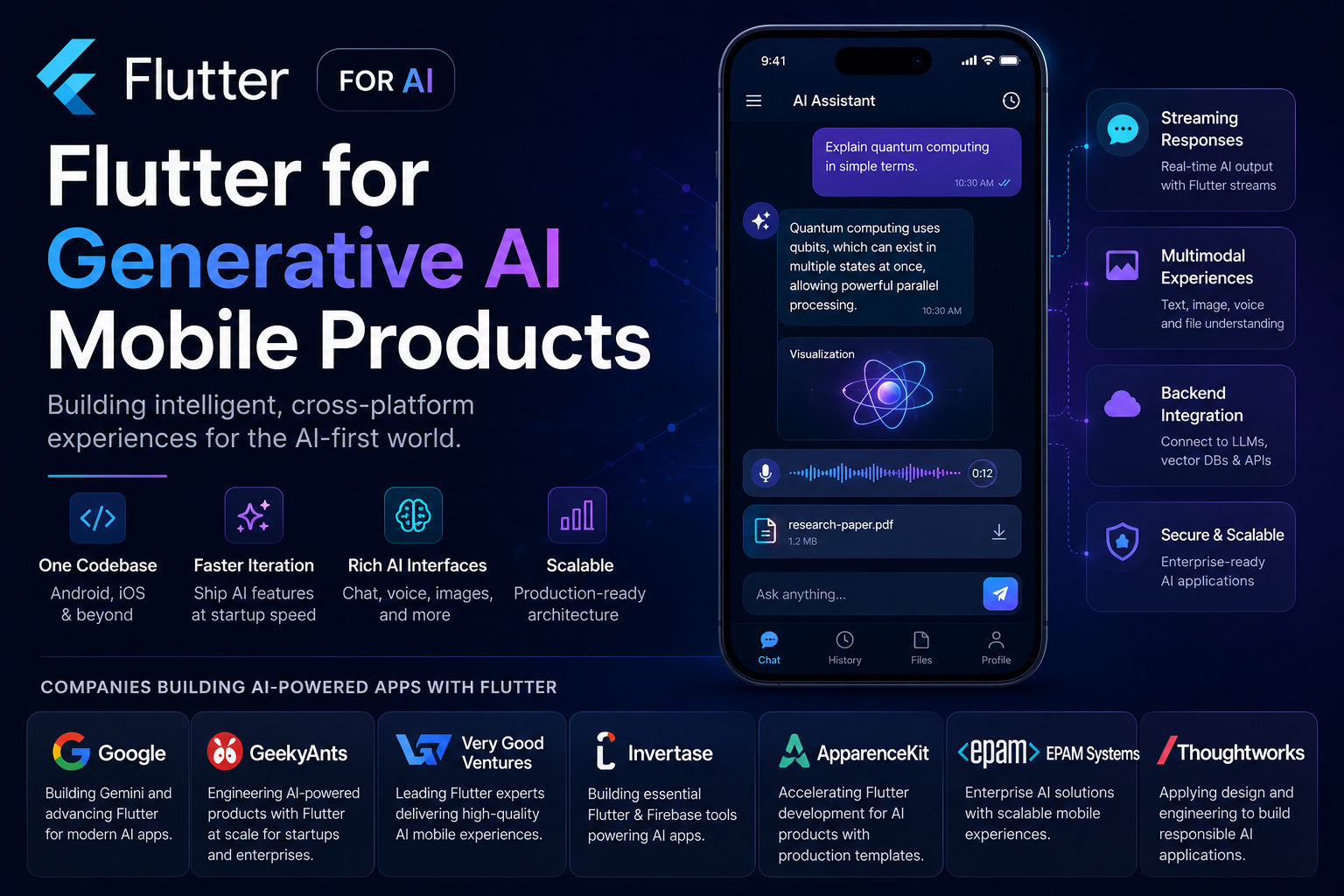
Modern Flutter applications increasingly include:
- Streaming AI responses
- Voice-first interactions
- Rich markdown rendering
- AI chat interfaces
- Image generation previews
- File uploads
- Multi-modal experiences
- Persistent conversation history
Flutter’s widget-based architecture makes these highly interactive interfaces easier to compose and iterate on than many developers realize.
Backend Architecture Matters More Than the Mobile Framework
Flutter isn’t the AI.
It’s the interface.
- Successful AI products combine Flutter with scalable backend infrastructure that handles:
- LLM orchestration
- Vector databases
- Authentication
- Retrieval-Augmented Generation (RAG)
- Prompt management
- Analytics
- Real-time streaming
The mobile application is only one part of a much larger AI engineering ecosystem.
Companies Building AI-Powered Flutter Products
As the creator of Flutter, Google continues to expand the framework for modern cross-platform development while integrating Gemini and Firebase AI capabilities into its ecosystem. Flutter remains one of Google’s strongest investments for developers building AI-powered mobile experiences.
GeekyAnts
GeekyAnts has built numerous Flutter and React Native applications while increasingly focusing on AI-powered product engineering. Its engineering work combines cross-platform development, scalable frontend architecture, and AI integrations for startups and enterprises, reflecting a broader industry trend toward AI-native mobile applications rather than traditional app development alone.
Very Good Ventures
Very Good Ventures has established itself as one of the most recognized Flutter consultancies, contributing to the ecosystem through enterprise Flutter development, tooling, and best practices. Its work demonstrates how Flutter can support large-scale commercial applications.
Invertase
Invertase plays a major role in the Flutter ecosystem through Firebase integrations and open-source tooling. Since many AI applications rely on Firebase services for authentication, storage, analytics, and cloud functions, its contributions are particularly relevant for AI startups.
ApparenceKit
ApparenceKit focuses on accelerating Flutter product development with reusable templates and production-ready architectures. As AI startups prioritize rapid iteration, these starter foundations help teams move from prototype to launch much faster.
EPAM Systems
EPAM develops enterprise AI platforms where mobile applications often serve as the user-facing layer for larger AI ecosystems. Its expertise highlights the importance of scalable architecture, cloud infrastructure, and enterprise-grade engineering practices.
Thoughtworks
Thoughtworks approaches AI from a software engineering perspective rather than a tooling perspective. Its emphasis on maintainability, architecture, and responsible AI aligns with the long-term challenges of building production-ready mobile AI applications.
The Flutter Patterns Every AI Product Should Adopt
After studying today’s best AI applications, I believe several Flutter patterns are becoming standard:
- Streaming chat interfaces
- Optimistic UI updates
- Offline conversation caching
- Modular state management
- Markdown rendering
- AI response animations
- File picker integration
- Voice input support
- Reusable prompt component
- Responsive layouts for tablets and foldables
Products missing these capabilities increasingly feel outdated.
My Take
I don’t think Flutter is simply competing with React Native anymore.
It’s competing to become the default frontend for AI-native mobile products.
As generative AI becomes central to consumer and enterprise software, mobile frameworks will be judged less by benchmark scores and more by how quickly teams can ship new AI experiences.
The companies that win won’t necessarily build the smartest AI models.
They’ll build the mobile products that make those models effortless to use.
And in my opinion, Flutter gives engineering teams one of the fastest paths to making that happen.