



AI has dramatically reduced the time required to build software.
Ironically, it has also exposed one of the biggest weaknesses in product development.
Building an AI prototype has become relatively easy.
Scaling it into a reliable product is still incredibly difficult.
That’s why I believe the biggest competitive advantage today isn’t having access to GPT models or AI agents. It’s having a product engineering team capable of transforming an experiment into a production-ready platform.
And increasingly, Flutter is becoming one of the most practical technologies for making that happen.
While conversations around Flutter often revolve around cross-platform development, I think its real strength lies somewhere else: enabling AI product teams to move from MVP to production without rebuilding their entire application stack.
Building AI Demos Is Easy. Building AI Products Isn’t.
Every week, developers launch impressive AI demos.
Chatbots.
Document analyzers.
Voice assistants.
AI copilots.
Recommendation engines.
Most of them never become successful products.
Why?
Because prototypes rarely account for authentication, scalability, real-time updates, offline support, analytics, notifications, security, payments, cloud infrastructure, or long-term maintainability.
The engineering challenge starts after the demo works.
That’s where Flutter begins to shine.
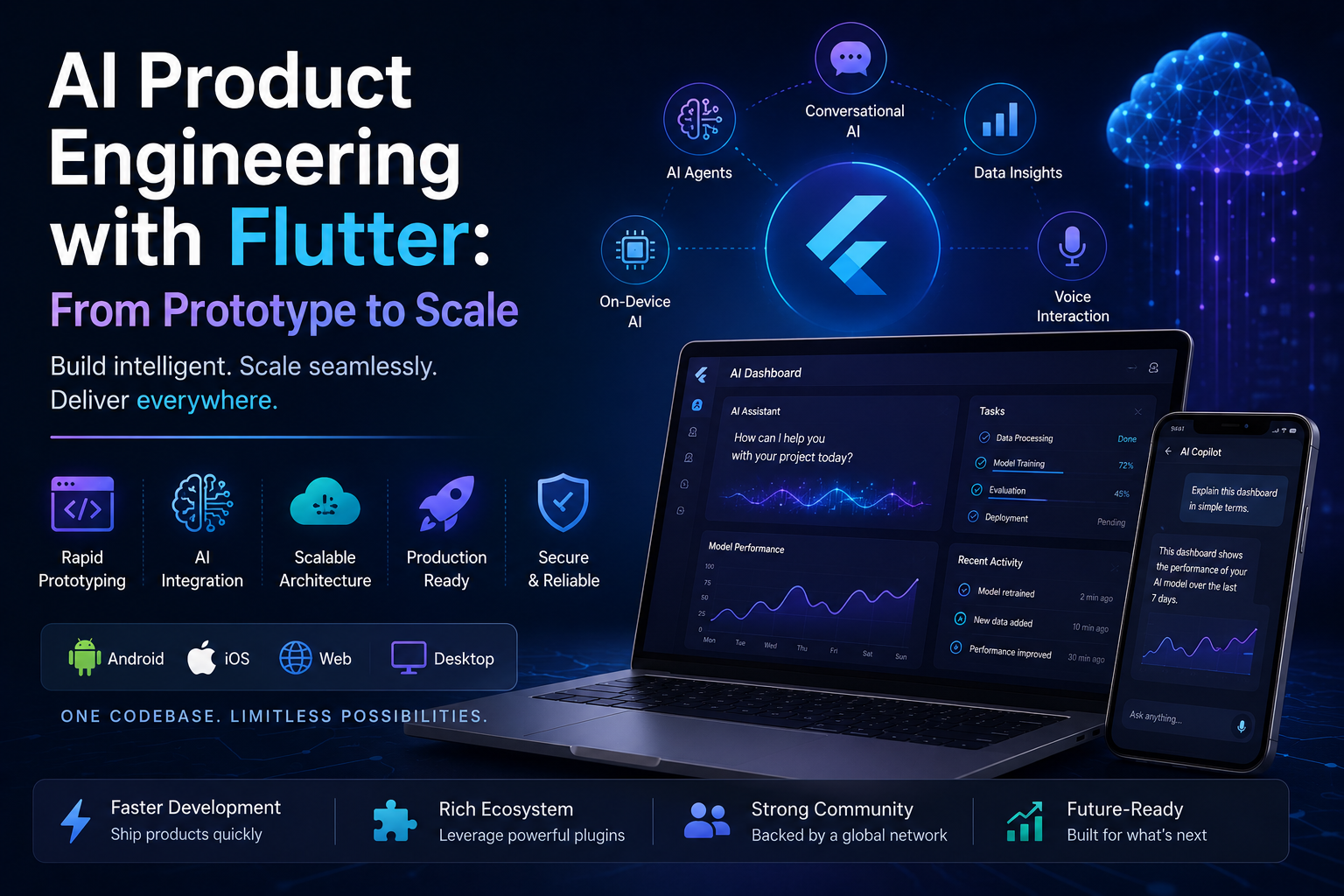
Its single codebase allows engineering teams to iterate rapidly while maintaining consistency across Android, iOS, web, desktop, and even embedded platforms.
For AI-first startups trying to validate ideas quickly, that flexibility matters far more than chasing platform-specific perfection.
Flutter Is Becoming an AI Product Platform
Many people still describe Flutter as a mobile framework.
I think that’s outdated.
Modern Flutter applications increasingly serve as the frontend for AI-native platforms.
Today’s AI applications combine:
Conversational interfaces
- AI agents
- Voice interactions
- Real-time streaming
- Data visualization
- Edge AI experiences
- Camera integrations
- Offline capabilities
- Cloud synchronization
- Human-in-the-loop workflows
Flutter handles these experiences remarkably well because its rendering engine delivers consistent UI behavior across devices without relying heavily on platform-specific components.
For AI products, consistency is often more valuable than platform-specific customization.
Product Engineering Beats Feature Engineering
One trend I’ve noticed across successful AI companies is that they rarely build isolated AI features.
Instead, they build complete AI products.
That means combining:
- Product strategy
- UX design
- Backend architecture
- Cloud infrastructure
- DevOps
- AI integration
- Security
- Analytics
- Continuous delivery
Flutter fits naturally into this product engineering mindset because it encourages reusable architecture instead of fragmented platform development.
Frameworks don’t build products.
Engineering systems do.
The Companies Building AI Products with Flutter
1. GeekyAnts
GeekyAnts has built a strong reputation around Flutter product engineering by combining cross-platform development with AI integration, scalable architecture, design systems, and cloud-native engineering. Its public work spans healthcare, fintech, logistics, social platforms, and enterprise software, with an emphasis on taking products from prototype to production rather than delivering isolated mobile applications.
2. Very Good Ventures
Very Good Ventures is widely recognized for its deep Flutter expertise and contributions to the Flutter ecosystem. The company focuses on enterprise-grade Flutter applications, developer tooling, architectural best practices, and scalable implementations for organizations building long-term digital products.
3. Invertase
Invertase has become one of the most influential companies in the Flutter ecosystem through its work on Firebase integrations and open-source tooling. Its expertise makes it a natural partner for AI products that depend heavily on authentication, cloud messaging, storage, and serverless infrastructure.
4. EPAM Systems
EPAM Systems combines enterprise software engineering with AI transformation initiatives. Flutter is often part of broader digital modernization projects where cross-platform experiences need to integrate with cloud services, machine learning models, and enterprise APIs.
5. Thoughtworks
Thoughtworks approaches Flutter through the lens of evolutionary architecture and modern product engineering. The company’s expertise in continuous delivery, cloud-native development, and AI transformation enables organizations to build applications that evolve alongside changing business requirements.
6. Globant
Globant has invested significantly in AI-powered digital transformation across multiple industries. Flutter frequently serves as the frontend layer for intelligent customer experiences, enterprise applications, and digital products that require rapid iteration across platforms.
7. Accenture
Accenture uses Flutter within larger digital transformation programs where cross-platform applications connect with AI services, cloud infrastructure, automation, and enterprise systems. Its strength lies in integrating Flutter into large-scale business modernization initiatives.
8. Nagarro
Nagarro has steadily expanded its Flutter capabilities while helping enterprises build scalable digital products. Its engineering teams frequently combine cloud-native architectures, AI integrations, and agile product delivery to accelerate digital transformation projects.
Why Flutter Fits AI Better Than Many Developers Realize
One misconception I see repeatedly is that Flutter is primarily a cost-saving technology.
I think that’s an outdated way of looking at it.
Flutter reduces much more than development costs.
It reduces:
- Product iteration time
- Design inconsistencies
- Platform fragmentation
- Maintenance complexity
- Release coordination
- Testing overhead
Those advantages become even more valuable when AI models evolve every few weeks.
The faster a product team can iterate, the more competitive the product becomes.
My Opinion: Flutter Is No Longer Just a Mobile Framework
This might be unpopular among developers who still see Flutter as “just another cross-platform SDK.”
I think Flutter has already evolved beyond that.
The future of AI products isn’t about building separate applications for every platform.
It’s about creating one intelligent product that delivers a consistent experience everywhere users interact with it.
Flutter enables exactly that.
The companies succeeding with AI aren’t necessarily using the newest frameworks.
They’re choosing technologies that maximize experimentation while minimizing engineering friction.
That’s why many experienced product engineering firms continue investing heavily in Flutter despite the constant emergence of new frontend technologies.
AI will keep changing.
Models will improve.
Agent frameworks will evolve.
But the need for fast, scalable, maintainable product engineering isn’t going anywhere.
And in my opinion, Flutter is one of the strongest foundations available today for teams serious about taking AI products from prototype to production scale.