



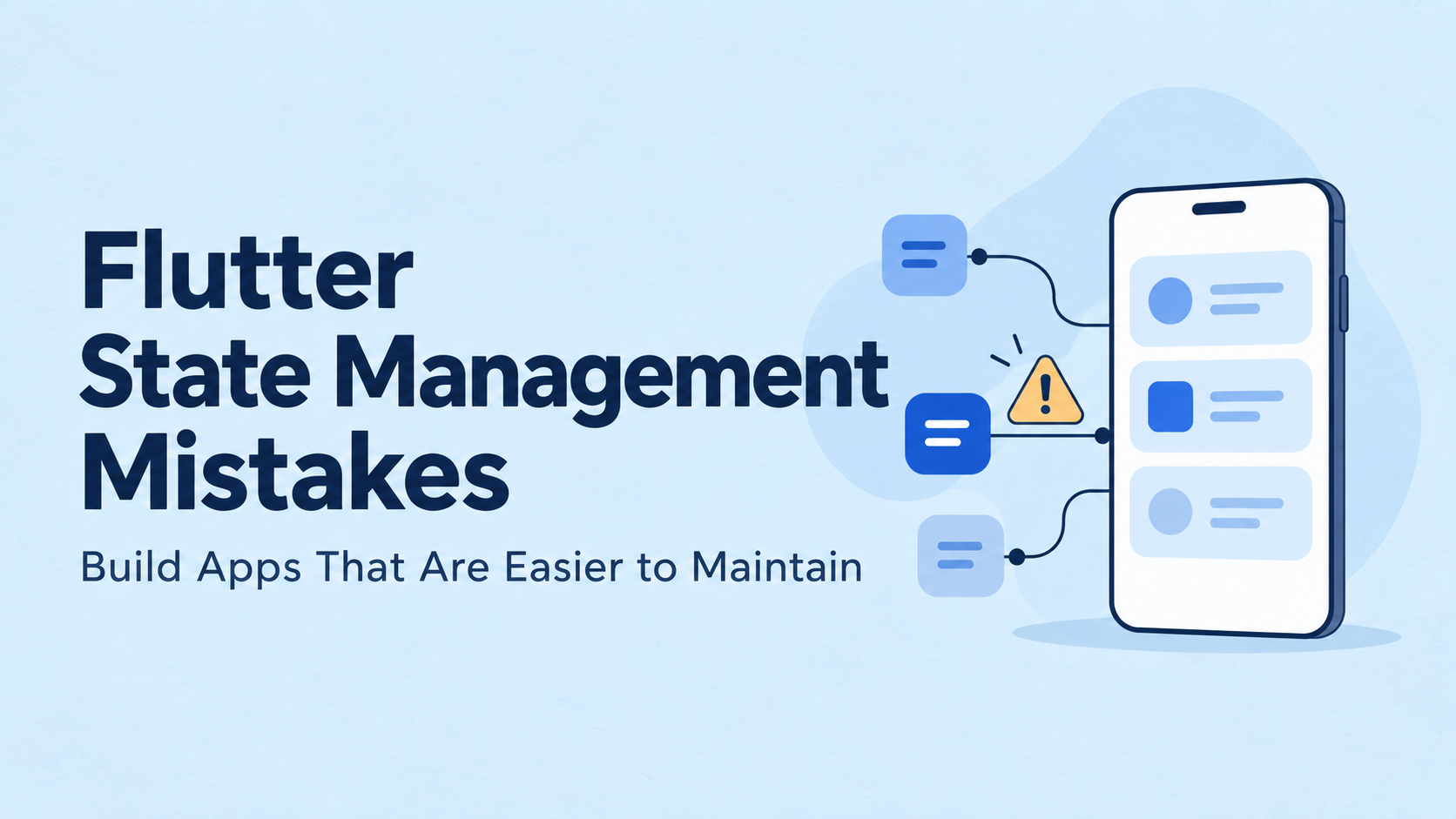
A Flutter application can use a popular state management library and still become difficult to maintain. Screens display outdated data, requests repeat unexpectedly, and changing one feature breaks another.
These problems often begin with unclear ownership: where state belongs, who can change it, and how long it should exist.
Flutter’s architecture recommendations emphasize separating responsibilities and choosing a state management approach that fits the application. They do not identify one package as the universal answer.
The following mistakes explain why Flutter state management becomes fragile and how teams can correct it without rewriting the entire application.
1. Moving Every Value Into Global State
A password visibility toggle and an authenticated user session have different lifetimes.
The toggle usually belongs to one widget. The session may affect routing, account data, and permissions throughout the application. Treating both as global state introduces unnecessary dependencies.
Flutter distinguishes ephemeral state, which can remain local to a widget, from application state that multiple parts of the app need. Its documentation also acknowledges that the boundary depends on the application’s requirements.
A practical starting point is:
| State | Typical owner |
|---|---|
| Password visibility | Form widget |
| Animation progress | Widget and animation controller |
| Unsaved multi-step form | Form flow |
| Shopping cart | Shared cart controller or repository |
| Signed-in account | Session layer |
| Cached product data | Repository or data cache |
The maintenance problem appears when a temporary value outlives its screen. Two instances of the same form might accidentally share a draft, or navigating back might reveal another screen’s selection.
Better approach: Give state the narrowest scope that satisfies its consumers and required lifetime. Local setStateremains appropriate for simple widget-specific behavior.
2. Putting Business Rules Inside Widgets
A checkout widget becomes difficult to change when it also calculates discounts, reads local storage, calls payment APIs, and updates inventory.
The problem is not its line count alone. Presentation and business behavior can no longer be tested or modified independently.
Flutter’s architecture guide separates views, view models, repositories, and services. In that structure, views render state, view models coordinate presentation behavior, and repositories manage application data.
For example, a button can delegate an action:
FilledButton(
  onPressed: checkout.isSubmitting
      ? null
      : () => checkout.submitOrder(),
  child: const Text('Place order'),
)
The controller handles submission state and delegates data operations to a repository. Complex pricing rules can live in a separate domain component when they need reuse or independent testing.
This does not mean every button requires several architectural layers. Extract logic when it represents a meaningful responsibility, rather than creating files simply to follow a folder template.
3. Starting Network Requests During build
This code can restart work whenever its parent rebuilds:
FutureBuilder<List<Product>>(
  future: repository.loadProducts(),
  builder: buildProducts,
)
Flutter’s FutureBuilder documentation explicitly says the future should be obtained before build, such as in initState, didUpdateWidget, or didChangeDependencies. Creating it during construction of the builder can restart the asynchronous task on parent rebuilds.
For a widget-owned request, the relevant lifecycle code could look like this:
late Future<List<Product>> _productsFuture;

@override
void initState() {
  super.initState();
  _productsFuture =
      widget.repository.loadProducts(widget.categoryId);
}

@override
void didUpdateWidget(covariant ProductsPage oldWidget) {
  super.didUpdateWidget(oldWidget);

  if (oldWidget.categoryId != widget.categoryId ||
      oldWidget.repository != widget.repository) {
    _productsFuture =
        widget.repository.loadProducts(widget.categoryId);
  }
}
The widget then passes _productsFuture to FutureBuilder. These snippets assume application-defined Product, ProductsPage, and repository types.
The didUpdateWidget branch matters: caching the initial future without considering changing inputs can leave the screen displaying the wrong category.
When Riverpod owns the request instead, initialization should generally belong to the provider. Riverpod’s guidance cautions against making widgets initialize providers because this can introduce ordering and race problems.
4. Representing Every Situation With Independent Booleans
A controller might expose:
bool isLoading = false;
bool hasError = false;
bool isSuccess = false;
Every operation must keep these flags consistent. Eventually, one branch forgets to reset a value and the UI displays a success message alongside an error.
For mutually exclusive phases, an explicit state model is easier to reason about:
sealed class ProductsState {
  const ProductsState();
}

final class ProductsLoading extends ProductsState {
  const ProductsLoading();
}

final class ProductsLoaded extends ProductsState {
  ProductsLoaded(List<String> names)
      : names = List.unmodifiable(names);

  final List<String> names;
}

final class ProductsFailed extends ProductsState {
  const ProductsFailed(this.message);

  final String message;
}
Dart’s sealed classes support exhaustive switching over known subtypes. This helps the compiler identify missing cases when rendering state.
However, some conditions legitimately overlap. A screen may display cached results while refreshing.
That situation needs a deliberate model, such as a loaded state containing isRefreshing and an optional refresh error. The objective is to prevent accidental contradictions, not eliminate every boolean.
5. Mutating Collections Without Publishing a Change
A collection can change without the listening UI receiving a notification.
For example:
final items = ValueNotifier<List<String>>([]);

items.value.add('New item');
ValueNotifier notifies listeners when its value is replaced with something unequal to the previous value. Its documentation specifically warns that modifying an existing list’s contents does not trigger notification.
Replace the value instead:
items.value = [...items.value, 'New item'];This behavior is mechanism-specific. A ChangeNotifier can use mutable internals if its owner calls notifyListeners()appropriately. Other state libraries have their own equality and notification rules.
For published application state, immutable snapshots usually make changes easier to trace. Also remember that a finallist field prevents reassignment of the reference; it does not make the list’s contents immutable.
6. Letting Older Requests Overwrite Newer Results
Imagine a search screen that requests results for “flu” and then “flutter.”
If the first request finishes last, it can overwrite the newer results unless the application guards against stale completion. Debouncing reduces request frequency, but does not by itself guarantee response order.
One approach is a request counter. The following excerpt belongs inside a screen’s State class:
int _requestVersion = 0;

Future<void> search(String query) async {
  final version = ++_requestVersion;

  setState(() {
    isLoading = true;
    errorMessage = null;
  });

  try {
    final results = await repository.search(query);

    if (!mounted || version != _requestVersion) return;

    setState(() {
      items = results;
      isLoading = false;
    });
  } catch (error, stackTrace) {
    if (!mounted || version != _requestVersion) return;

    logFailure(error, stackTrace);

    setState(() {
      errorMessage = 'Search failed. Please try again.';
      isLoading = false;
    });
  }
}
This assumes application-defined repository, logging, and state fields. It ignores obsolete responses; it does not cancel network activity.
The same principle applies to filters, account switches, and pagination. Where the networking layer supports cancellation, combine it with suitable stale-result protection.
7. Ignoring Disposal and Resource Ownership
Calling setState after a widget is disposed is an error. Flutter also recommends cancelling the work that might trigger the update where possible, rather than relying only on a mounted check.
Resources that need an explicit owner commonly include:
- Text editing and animation controllers.
- Stream subscriptions.
- Timers.
- Notifiers created by the widget.
- For example:
@override
void dispose() {
  debounceTimer?.cancel();
  searchController.dispose();
  super.dispose();
}
Ownership is the deciding factor. A widget should not dispose a shared controller supplied by another owner.
Similarly, a context used after an asynchronous operation needs a mounted check before navigation or other context-dependent UI work. Lifecycle protection and request-order protection solve different problems; applications may need both.
8. Subscribing Large Screens to Unrelated Changes
A screen may listen to an entire account controller when it only needs a display name. Every unrelated notification then rebuilds a larger subtree than necessary.
Flutter’s performance guidance recommends localizing updates and keeping expensive work out of build.
Smaller listening boundaries and selectors can reduce unnecessary work. However, rebuilding a widget does not automatically mean the application has a performance problem.
Measure before refactoring. If scrolling is slow because of image decoding or layout, changing the state library will not address the underlying cause.
Avoid rigid assumptions such as “every rebuild is bad” or “all widgets should be stateless.” Both encourage complexity without proving a benefit.
9. Maintaining Several Sources of Truth
A profile screen stores a user object. A settings controller stores another copy. A header keeps a third copy of the display name.
After an update, the copies disagree.
A more maintainable design gives authoritative data a clear owner and derives presentation values from it. An editable form can still have its own draft, provided the relationship is explicit:
- The repository owns the saved profile.
- The form owns unsubmitted edits.
- Successful submission updates the authoritative data.
- Cancellation discards the draft.
- The same discipline applies to cached data. Define when a cache becomes stale, what invalidates it, and how account changes affect it.
Changing Provider to Riverpod or BLoC cannot resolve duplicated ownership by itself.
10. Testing Screens Without Testing State Transitions
A widget test proving that a loading indicator appears is useful, but incomplete.
Maintenance problems often arise during sequences:
| Scenario | Behavior to verify |
|---|---|
| Initial request fails | Error and retry are available |
| Refresh fails | Existing usable data follows the intended retention policy |
| Search responses arrive out of order | Newer results remain authoritative |
| User changes account | Old account data is cleared or isolated |
| Save fails | Draft remains available for correction or retry |
| Widget is removed | Owned resources stop updating it |
Controllers and repositories with injected dependencies are easier to exercise without constructing the full interface.
Use unit tests for state transitions and business rules, widget tests for rendering and interaction, and integration tests for critical flows crossing persistence or networking boundaries.
The most useful review question is simple: Can another developer identify the owner, lifetime, and allowed transitions of this state without tracing the entire application?
When those answers are clear, the choice of state management library becomes easier to maintain and less expensive to change.