



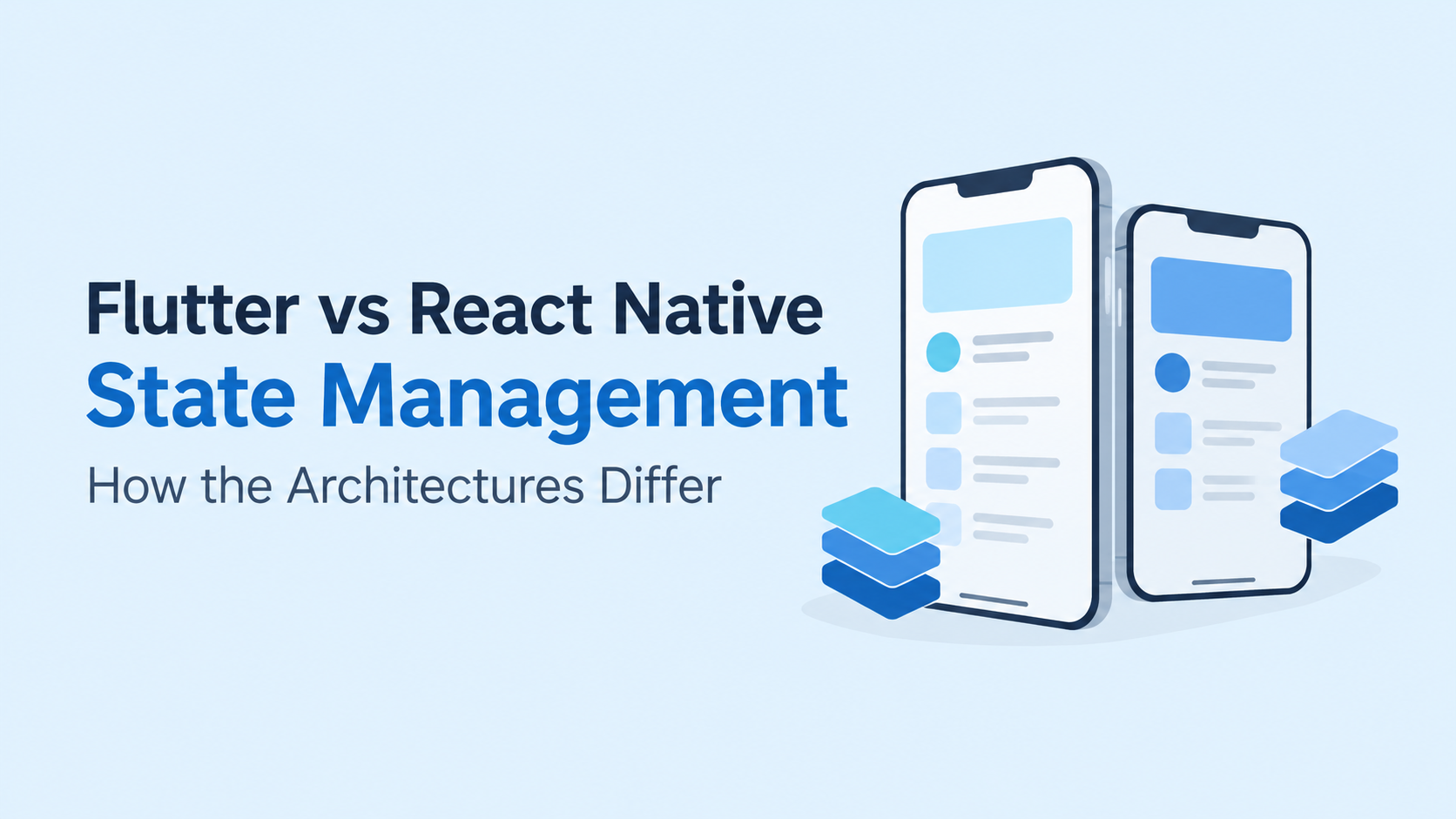
A shopping cart, a search screen, and a login flow all manage state. Yet the same feature can behave differently when implemented with Flutter’s setState or React Native’s useState.
Both frameworks use declarative interfaces: developers describe what the screen should display for a particular state. The important differences lie in how state is stored, how updates become visible, and how dependencies trigger UI work.
Understanding those differences helps Flutter developers choose appropriate boundaries without copying patterns from React Native that depend on a different execution model.
What Is the Core Architectural Difference?
Flutter separates an immutable StatefulWidget configuration from its associated mutable State object. That object holds local values and exposes them when its build method runs.
React Native uses React’s state model. In function components, hooks provide state associated with the component’s position in the tree. Each render receives a snapshot of that state, and event handlers created during that render capture its values.
| Concern | Flutter | React Native |
|---|---|---|
| Basic local state | Fields in a State object | useState or useReducer |
| Update mechanism | Mutate inside setState, then schedule a build | Request an update for a subsequent render |
| Shared state | Inherited dependencies, listenables, or packages | Lifted state, Context, or external stores |
| Business logic | Can live in view models, notifiers, or other classes | Can live in reducers, hooks, services, or stores |
| Durable storage | Requires an explicit persistence mechanism | Requires an explicit persistence mechanism |
Neither framework requires a single global store. State ownership should follow the feature’s lifetime and consumers.
Why Are setState and useState Not Equivalent?
Flutter’s setState executes its callback synchronously and then marks the element as needing a build. The callback must not be asynchronous.
Inside a Flutter State class:
int count = 0;

void increment() {
  setState(() {
    count += 1;
  });

  debugPrint('$count'); // Updated field value
}
The field changes immediately. That does not mean the screen has already completed layout and painting.
React behaves differently:
const [count, setCount] = useState(0);

function increment() {
  setCount(count + 1);
  console.log(count); // Value from this render
}
The setter requests another render. It does not replace count inside the currently executing handler.
When an update depends on previous state, React supports functional updaters:
setCount(current => current + 1);React queues these updater functions and processes them when calculating the next state. This matters when several updates occur together.
The practical lesson for developers moving between frameworks is to understand update semantics before translating code. Similar-looking APIs do not imply identical behavior.
Where Should Local and Shared State Live?
Flutter’s documentation distinguishes ephemeral state from application state. A selected tab or expanded panel may belong to one widget, while a shopping cart or signed-in user may need broader ownership. The boundary depends on the application.
React follows a comparable principle: move shared state to the closest common owner of the components that need it. Reducers and Context can then help distribute state and update actions through a larger subtree.
For a checkout feature, a useful division is:
- Keep password visibility and focus state local.
- Give the checkout draft a feature-level owner.
- Make the cart available to relevant screens.
- Keep authoritative pricing and order validation on the backend.
- Putting every value into a global store increases coupling. Keeping shared business data in isolated screens creates competing sources of truth.
The architectural question is therefore who owns the value, how long it survives, and which operations can change it.
How Do Provider, Riverpod, and BLoC Compare With React Patterns?
These tools solve overlapping problems, but they are not interchangeable equivalents.
ChangeNotifier and Provider
Flutter’s ChangeNotifier supplies a notification mechanism. A model changes its data and calls notifyListeners(). Provider can expose that model to descendants and connect consumers to updates.
React Context primarily distributes a value through the component tree. State transitions still need to live somewhere, such as useState, a reducer, or an external store.
Calling Provider “Flutter’s Redux” or Context “React’s complete state manager” obscures these responsibilities.
Riverpod
Riverpod organizes state and dependencies through providers. Its families support separate state instances keyed by parameters, such as a user ID or search query. This is useful when a screen can display multiple independent resources.
Developers should still define caching, invalidation, and ownership requirements explicitly rather than assume a package resolves every data-lifecycle decision.
BLoC and Cubit
Cubit exposes methods that emit new states. Bloc receives events and converts them into states. The library documents this distinction directly.
An event-based approach can make a workflow’s transitions explicit. However, adopting Bloc does not automatically make transitions correct or asynchronous operations race-free.
React reducers offer a comparable way to centralize transition logic, but Bloc and reducers have different APIs and execution responsibilities.
Does a Widget Rebuild Mean the Entire Screen Repaints?
No. UI description work and visible rendering work are different stages.
React Native documents a render, commit, and mount pipeline. Re-running a React component does not mean every corresponding native view is recreated.
Similarly, Flutter’s setState schedules a build; it should not be interpreted as an instruction to repaint every pixel.
The useful performance question is how much unnecessary work an update causes.
React Context consumers re-render when their provider receives a different value, compared using Object.is. Wrapping a consumer in memo does not prevent context-driven updates.
Riverpod’s select allows a consumer to observe a selected portion of state, reducing updates when unrelated fields change.
In either ecosystem, smaller subscription boundaries can help. Performance claims still require profiling representative screens and devices.
How Should Asynchronous State Be Designed?
Consider a search screen where the user enters “camera,” then quickly changes the query to “camera lens.”
If the first request finishes last, it can overwrite the newer results. Neither Flutter nor React Native prevents this simply because a state-management package is installed.
The feature needs an explicit strategy: cancel superseded requests where supported, associate results with request identifiers, or verify the active query before applying a response.
The state model should also distinguish initial loading from refreshing existing results. Replacing useful cached content with a blank spinner on every refresh is a product decision, not a framework requirement.
Flutter’s architecture guide separates UI concerns from repositories and services. That separation gives data access, caching, and business rules a clearer home outside widget rendering.
A comparable separation is possible in React Native. The framework choice does not remove the need to define data ownership.
Which Approach Should a Flutter Team Choose?
For a small local interaction, setState may be sufficient. For shared features, choose a mechanism that makes dependencies and transitions understandable to the team.
Flutter’s architecture recommendations treat ChangeNotifier as a conditional choice, not a universal requirement. The larger concern is separating responsibilities and maintaining testable boundaries.
A practical evaluation should include one demanding feature: asynchronous loading, shared edits, failure recovery, and navigation away during a request.
Test whether an older response can overwrite newer data, whether signing out clears user-specific state, and whether business logic can run without rendering a screen.
- Flutter and React Native differ in their state-update semantics and UI integration mechanisms. Reliable applications in both ecosystems depend on explicit ownership, predictable transitions, and deliberate handling of asynchronous work.