



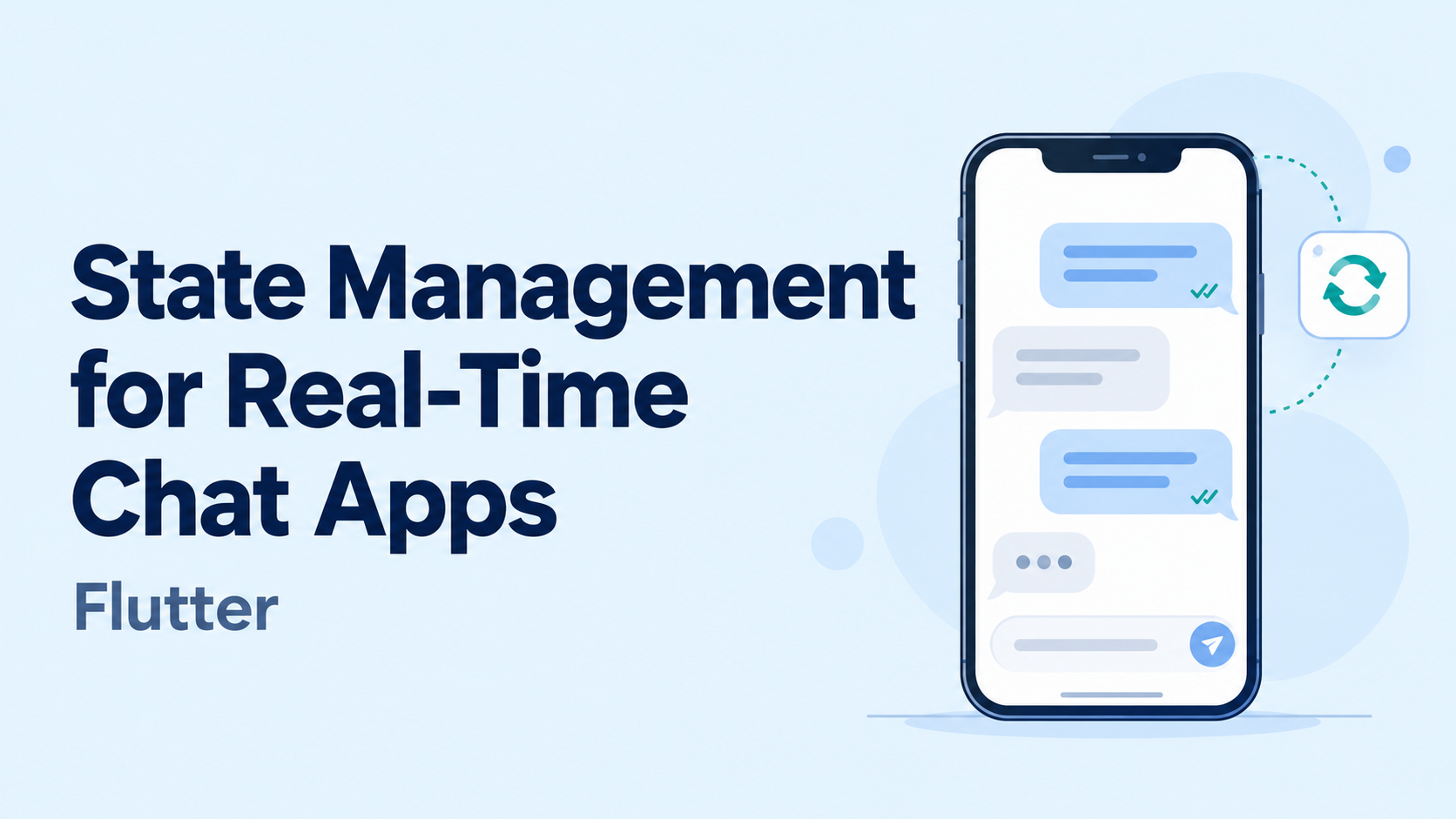
A Flutter chat screen can display messages correctly during development and still fail under everyday conditions. A connection drops after a message reaches the server. The app closes before an acknowledgement arrives. A history request returns after a newer socket event.
The result can be duplicate messages, stale conversations, or incorrect delivery indicators.
Reliable state management for real-time chat apps in Flutter requires clear rules for message ownership, synchronization, persistence, and rendering. Choosing BLoC or Riverpod helps organize those rules, but neither package replaces them.
How Should a Flutter Chat App Organize Its State?
Flutter’s architecture guide recommends separating the UI and data layers, with repositories acting as sources of truth for application data. These are adaptable guidelines rather than mandatory framework rules.
For chat, a practical implementation gives a repository responsibility for reconciling history responses, incoming events, and pending messages. A view model, Cubit, or provider exposes the resulting conversation state to widgets.
Different state categories need different lifetimes:
| State | Examples | Suggested location |
|---|---|---|
| Conversation data | Messages, edits, membership | Repository backed by cache or database |
| Pending operations | Unsent messages, retries | Persistent outbox |
| Screen state | Selected message, attachment preview | Screen controller or local widget state |
| Drafts | Unsent composer text | Local state with optional persistence |
| Ephemeral activity | Typing indicators | Memory with expiry |
| Synchronization state | Replay cursor, connection status | Repository or synchronization service |
Avoid independently maintaining the same message collection in a repository, a global provider, and a widget. Multiple writable copies create reconciliation work without adding useful functionality.
Should Chat State Use BLoC, Riverpod, or StreamBuilder?
All three can participate in a chat architecture, but they serve different purposes.
BLoC and Cubit organize state transitions outside widgets. The flutter_bloc package provides builders, listeners, and selectors. Builders render state; listeners handle effects such as showing a notification. BlocSelector can avoid rebuilding when its selected immutable value remains unchanged.
Riverpod provides another way to expose and consume application state. Its select API allows widgets to observe a particular property instead of reacting to every change in a larger object. Selected values should be immutable for reliable change detection.
StreamBuilder is useful for rendering repository snapshots. It should not be responsible for processing every message event. Flutter documents that its builder can receive a timing-dependent subsequence of stream snapshots. Essential event handling therefore belongs upstream, where it produces complete state. Streams should also be obtained before build, rather than recreated during each rebuild.
The selection should follow existing team conventions and testing needs. Delivery correctness belongs in the underlying application design.
How Should Messages Be Identified?
A message needs a stable identity before the server accepts it.
An illustrative Dart model separates the local rendering key from the server identifier:
enum SendStatus { pending, sent, failed }

class ChatMessage {
  const ChatMessage({
    required this.localKey,
    required this.conversationId,
    required this.text,
    required this.status,
    this.clientMessageId,
    this.serverId,
    this.sequence,
    this.revision,
  });

  final String localKey;
  final String conversationId;
  final String text;
  final SendStatus status;
  final String? clientMessageId;
  final String? serverId;
  final int? sequence;
  final int? revision;
}
This is a suggested data contract, not a Flutter requirement.
The client generates a unique clientMessageId when sending. The server echoes it alongside the canonical serverId. The repository then updates the existing optimistic message instead of inserting another bubble.
Server-assigned ordering metadata can establish conversation order without relying on potentially inaccurate device clocks. Revision metadata helps prevent an older response from overwriting a newer edit.
Both history responses and live events should use the same reconciliation logic.
How Should Optimistic Sending Handle Retries?
An optimistic interface displays a pending message immediately, while clearly distinguishing it from an accepted message.
For messages that must survive application termination, persist the outgoing operation before attempting delivery. The outbox record should include its identifier, payload, conversation, and retry state.
A timeout requires careful interpretation. The server may have stored the message even though the response never reached the client.
Retries should therefore reuse the original client identifier. The backend must enforce idempotency within an appropriate scope, returning the existing result when an accepted operation is repeated.
Define status semantics explicitly:
- Pending: Acceptance has not been confirmed.
- Sent: The server has acknowledged the agreed acceptance condition.
- Delivered: A recipient device has provided delivery evidence.
- Read: The application’s defined read condition has been reported.
A successful network write alone does not establish the final three states.
How Can Flutter Chat Recover After Disconnection?
Flutter’s WebSocket recipe demonstrates bidirectional communication through a stream and sink. That transport connection is only one part of a complete synchronization system.
A recommended application protocol maintains a server-issued replay cursor. On reconnect, the repository requests changes after the last safely applied cursor.
Recovery must include message edits and deletions as well as new messages. Otherwise, the conversation can appear current while containing stale content.
Persist received changes and cursor advancement atomically where possible. Saving the cursor first risks skipping unapplied changes after a crash.
Live events and replay responses can overlap. Deduplication handles repeated records, while the server protocol must define how replay transitions into live delivery without leaving a gap.
If the cursor has expired, obtain a fresh snapshot and reconcile it with the local outbox.
What Does Offline Support Require Beyond Caching?
Flutter’s offline-first guidance discusses repositories combining local and remote data, alongside explicit synchronization strategies. It also identifies the trade-offs involved in writing locally before synchronizing remotely.
For chat, offline support should cover recent history, drafts, and pending operations. It also needs account separation, storage migration, and retry policies.
A connectivity indicator should not be treated as proof that the backend is reachable. Synchronization needs actual request outcomes.
Flutter provides AppLifecycleListener for lifecycle callbacks, but its lifecycle documentation warns that applications cannot rely on receiving every notification. Persist important work when it occurs, rather than waiting for a final background or shutdown callback.
On resume, reassess authentication and synchronization. Expire typing indicators instead of restoring stale activity from disk.
How Can Chat Screens Avoid Excessive Rebuilds?
ListView.builder creates children on demand, making it appropriate for long message collections. Its documentation also describes findChildIndexCallback for preserving child mapping when ordering changes.
Use stable keys such as ValueKey(message.localKey). Replacing a temporary key with a server ID after acknowledgement can unnecessarily replace the row’s identity.
Keep composer updates separate from conversation updates. Typing one character should not require recreating every message object.
Narrow subscriptions can isolate changes to delivery status or reactions. Pagination should deduplicate overlapping results and preserve the reader’s position when older messages appear.
Profile representative conversations on physical devices before introducing complex rebuild optimizations.
Which Failure Scenarios Should Be Tested?
Repository tests should exercise duplicate events, delayed acknowledgements, stale revisions, and outbox recovery. Widget tests should verify pending, failed, empty, and reconnecting states.
Integration tests should include:
- A message accepted by the server before the connection drops.
- A live event arriving before the send response.
- History loading while new messages arrive.
- Application termination with queued operations.
- Account switching during synchronization.
- Cursor expiry and snapshot recovery
The expected outcome should be explicit: one accepted message produces one visible entity, retries preserve identity, and stale events cannot overwrite newer state.
These invariants make the architecture reliable. Flutter widgets then render a consistent conversation rather than attempting to repair competing versions of it.