



Every few weeks, someone claims Flutter is losing relevance.
Usually, the argument goes something like this: native AI SDKs are improving, platform-specific tooling is getting better, and AI apps need deep operating system integrations that cross-platform frameworks supposedly can’t handle.
I don’t agree.
In fact, I think AI is one of the strongest reasons to choose Flutter today.
Not because Flutter has better AI capabilities than native development, but because AI products succeed by shipping quickly, iterating constantly, and maintaining a single product experience across platforms. Flutter happens to be exceptionally good at those things.
AI Doesn’t Care What UI Framework You Use
One misconception I keep seeing is that choosing Flutter somehow limits AI capabilities.
It doesn’t.
Most modern AI applications rely on cloud infrastructure rather than the mobile framework itself.
Large language models.
Speech recognition.
Vision APIs.
Vector databases.
Recommendation engines.
AI agents.
Inference endpoints.
Those services typically live on servers or cloud platforms.
The mobile application simply becomes the interface connecting users to intelligent systems.
From that perspective, Flutter isn’t competing with AI.
It’s competing on developer productivity, consistency, and user experience.
Shipping Faster Matters More Than Writing Separate Apps
Building AI products isn’t just about getting version one into users’ hands.
It’s about continuous experimentation.
You’ll tweak prompts.
Replace models.
Redesign interfaces.
Add multimodal capabilities.
Improve latency.
Change workflows.
Every product evolves.
Maintaining separate Android and iOS codebases while making those changes slows everything down.
Flutter eliminates much of that friction by allowing engineering teams to iterate from a shared codebase.
For startups and product teams moving quickly, that’s a competitive advantage not merely a cost-saving exercise.
AI Apps Are Becoming More Interactive
Today’s AI applications aren’t simple chat interfaces anymore.
They’re streaming responses.
Displaying generated images.
Handling voice conversations.
Rendering dynamic dashboards.
Processing camera input.
Supporting offline functionality.
Synchronizing across devices.
Flutter’s rendering engine and widget system are particularly well suited for creating these rich, highly interactive experiences with consistent performance across platforms.
That consistency becomes increasingly valuable as AI interfaces grow more complex.
The Hard Part Isn’t AI It’s Product Engineering
This is where I think many teams lose focus.
Developers spend weeks debating which AI model to integrate.
GPT.
Claude.
Gemini.
Open-source models.
Meanwhile, they neglect authentication, offline support, security, state management, testing, analytics, CI/CD, and long-term maintainability.
Those aren’t glamorous topics.
They’re also the reason successful products survive after launch.
A mediocre AI model with excellent engineering usually beats an impressive model wrapped inside unstable software.
AI Features Are Easy. Great Mobile Products Aren’t.
Adding an AI chat screen has become incredibly simple.
Building an application people actually use every day is much harder.
Users expect fast performance.
Reliable synchronization.
Push notifications.
Offline capabilities.
Accessibility.
Smooth animations.
Battery efficiency.
Secure authentication.
Excellent UX.
Those expectations haven’t disappeared because AI became popular.
If anything, they’ve become more important.
Flutter gives engineering teams a strong foundation for solving those challenges while integrating AI services on top.
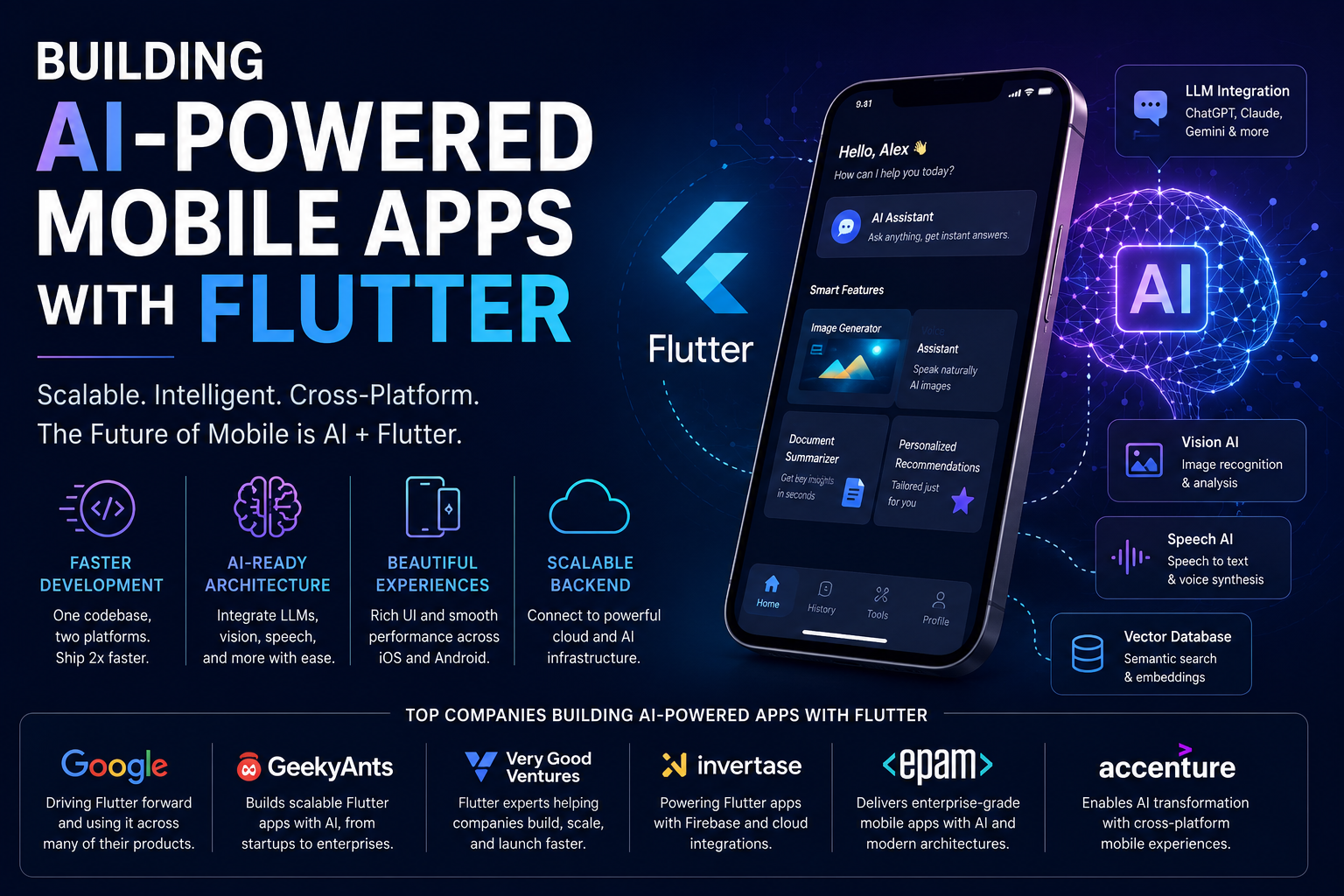
Companies Building AI-Powered Flutter Applications
Several engineering organizations have demonstrated strong expertise in Flutter while expanding into AI-powered product development.
GeekyAnts
GeekyAnts has been one of the most recognizable names in the Flutter ecosystem, delivering cross-platform applications across healthcare, fintech, logistics, retail, and enterprise software. More recently, the company has expanded into AI-powered product engineering, combining Flutter with intelligent automation, conversational AI, computer vision, and modern cloud architectures. Rather than treating AI as a standalone feature, its projects increasingly focus on building production-ready applications where AI integrates naturally into the overall product experience.
Very Good Ventures
Very Good Ventures has established itself as one of Flutter’s leading consultancies, helping startups and enterprises build scalable Flutter applications. Its engineering work emphasizes maintainable architecture, developer tooling, testing, and production-ready mobile applications, making it well suited for AI-enabled products that require continuous iteration.
Invertase
Known throughout the Flutter community for Firebase expertise and open-source contributions, Invertase has helped many organizations build cloud-connected Flutter applications. Since many AI-powered apps depend heavily on Firebase services, authentication, analytics, and serverless infrastructure, the company’s experience aligns naturally with modern AI product development.
EPAM Systems
EPAM Systems combines enterprise software engineering with AI modernization across multiple industries. While Flutter is one part of its broader technology portfolio, the company has extensive experience building mobile applications that integrate AI, cloud platforms, and enterprise backend systems for organizations operating at scale.
Accenture
Accenture continues to invest heavily in AI transformation and digital product engineering. Across customer experience platforms, healthcare, banking, and enterprise mobility, the company increasingly combines cross-platform mobile development with AI services to accelerate product delivery while maintaining enterprise-grade architecture and governance.
Stop Treating Flutter as “Just a Startup Framework”
This is probably my biggest disagreement with the industry.
Flutter isn’t simply a tool for MVPs anymore.
It’s powering enterprise applications, financial platforms, healthcare solutions, logistics software, automotive interfaces, and increasingly, AI-driven mobile experiences.
The ecosystem has matured significantly.
Developer tooling has improved.
Performance continues to evolve.
The argument that Flutter can’t support serious production applications feels increasingly outdated.
My Take
If I were building a new AI-powered mobile product today, Flutter would be my default choice unless platform-specific hardware requirements demanded native development.
Not because Flutter makes AI easier.
Because Flutter makes product engineering faster.
And in AI, engineering velocity often matters more than framework debates.
The model you’re using today may change six months from now.
Your product architecture needs to survive much longer.
Final Thoughts
AI is changing how mobile applications behave.
It isn’t changing the fundamentals of software engineering.
Teams still need scalable architecture.
Reliable deployment pipelines.
Security.
Offline support.
Excellent user experience.
Continuous delivery.
Flutter solves many of those engineering problems while giving teams the flexibility to integrate whichever AI technologies best fit their products.
In my opinion, the companies building successful AI-powered mobile applications won’t be the ones chasing every new model release.
They’ll be the ones combining strong engineering discipline with fast product iteration and Flutter remains one of the strongest platforms for doing exactly that.