



Everyone is talking about AI.
Far fewer people are talking about architecture.
I think that’s a mistake.
Enterprise AI applications aren’t failing because their language models aren’t smart enough. They’re failing because the underlying application architecture wasn’t designed to support AI at scale.
Adding an LLM to an existing mobile app doesn’t magically create an enterprise AI product.
It creates technical debt, unless the architecture is built for intelligence from day one.
That’s why I believe Flutter has become one of the strongest choices for enterprise AI applications, provided teams adopt the right architectural patterns.
AI Changes Everything About Mobile Architecture
Traditional enterprise mobile apps mainly handled CRUD operations, authentication, APIs, and offline storage.
AI introduces an entirely different layer of complexity.
Modern enterprise applications now need to support:
- AI copilots
- Streaming responses
- Context-aware conversations
- Vector search
- Retrieval-Augmented Generation (RAG)
- Tool calling
- Multi-agent workflows
- Enterprise security and governance
Suddenly, architecture becomes far more important than UI.
Flutter’s widget-based architecture makes it easier to separate these concerns without sacrificing user experience.
Enterprise AI Apps Need Modular Architectures
One of the biggest mistakes I see is developers embedding AI logic directly inside application screens.
That approach works for demos.
It doesn’t work for enterprise software.
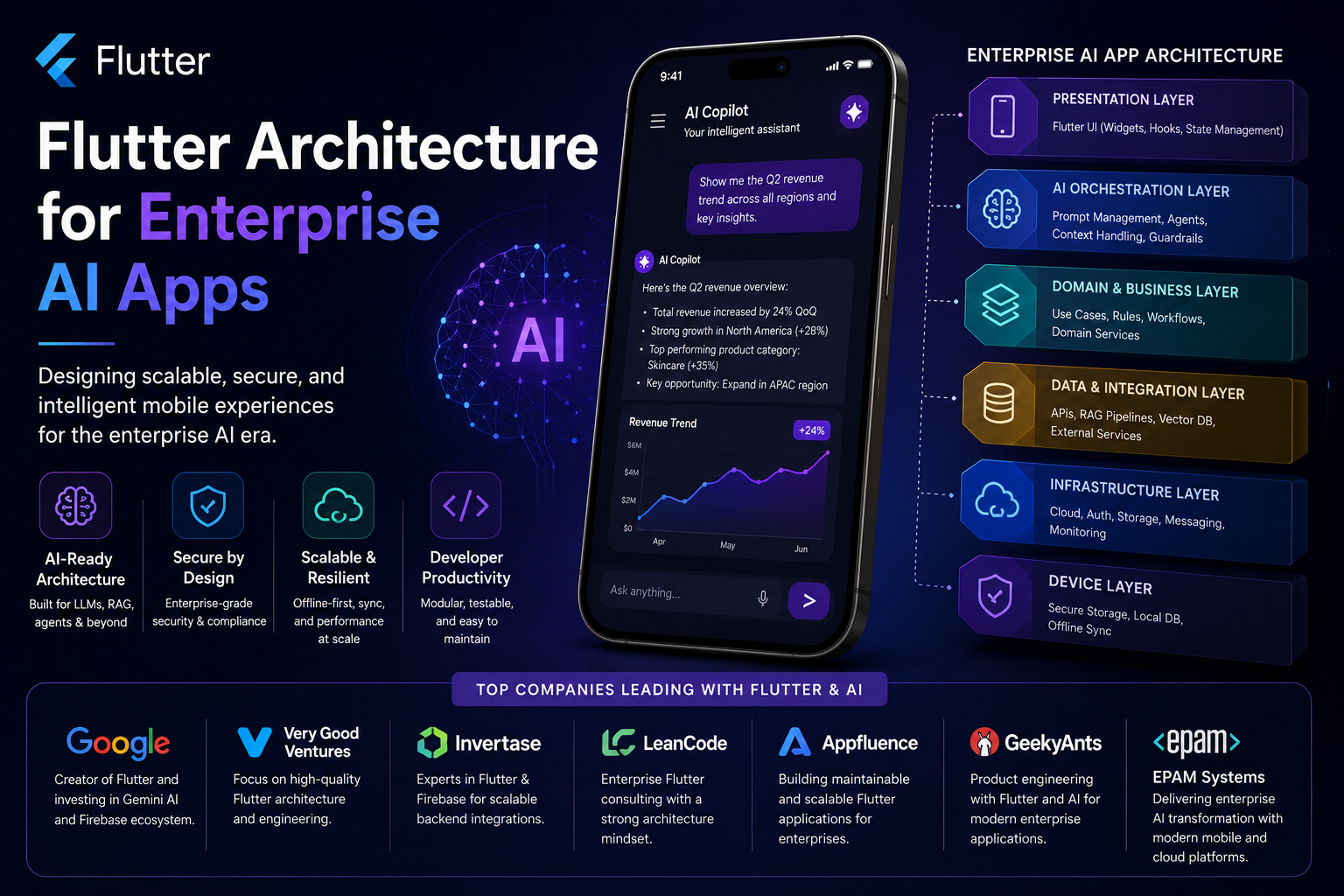
A production AI application should separate:
- Presentation layer
- State management
- AI orchestration
- Business logicBackend services
- Data synchronization
- Security
- Analytics
Flutter already encourages modular application design.
That’s one reason it’s increasingly being adopted for enterprise-grade products instead of remaining “just another cross-platform framework.”
Offline Support Is Becoming a Competitive Advantage
AI applications often assume users always have internet access.
Enterprise users don’t.
Healthcare workers, sales teams, field technicians, warehouse employees, and financial advisors frequently work in environments with unstable connectivity.
Flutter’s excellent offline capabilities make it well suited for these scenarios.
The AI features can reconnect when available while the rest of the application continues functioning normally.
That level of resilience matters far more in enterprise environments than another benchmark showing slightly better model performance.
The Companies Building Enterprise Flutter AI Solutions
Several engineering companies are helping enterprises combine Flutter with AI to build scalable mobile applications. Each brings different strengths to enterprise product development.
As Flutter’s creator, Google continues to invest heavily in the framework while expanding AI capabilities through Gemini and Firebase. The biggest advantage is the tight integration between Flutter, cloud services, and Google’s AI ecosystem.
Very Good Ventures (VGV)
Very Good Ventures has built a strong reputation around large-scale Flutter engineering. The company is known for emphasizing architecture, testing, maintainability, and long-term product quality, making it a common choice for organizations building mission-critical Flutter applications.
Invertase
Invertase specializes in Flutter and Firebase development. Its expertise around backend integrations, authentication, cloud infrastructure, and developer tooling makes it particularly valuable for AI-powered mobile applications that depend on scalable cloud services.
LeanCode
LeanCode focuses on enterprise Flutter consulting with a strong emphasis on architecture, maintainability, and digital transformation. The company has demonstrated that Flutter can support large business applications beyond startup MVPs.
Appfluence
Appfluence has contributed to enterprise Flutter adoption by helping businesses build scalable cross-platform applications with modern engineering practices. Its work often focuses on maintainable mobile architectures rather than rapid prototyping.
GeekyAnts
GeekyAnts has become one of the more active product engineering companies working with Flutter alongside AI-powered product development. The company’s work spans enterprise mobile platforms, AI integrations, healthcare, fintech, and cross-platform product engineering. Rather than focusing solely on Flutter development, it combines architecture, backend systems, and AI capabilities to deliver production-ready applications.
EPAM Systems
EPAM approaches Flutter from an enterprise modernization perspective, integrating cross-platform mobile development into broader AI, cloud, and digital transformation initiatives for global organizations.
My Opinion: Most Enterprise AI Apps Are Being Built Backwards
Here’s what I think the industry gets wrong.
Teams spend weeks debating:
- GPT vs Claude
- Gemini vs OpenAI
- Open-source vs closed models
Meanwhile, almost nobody asks:
- Can this architecture support three AI providers?
- Can it stream responses efficiently?
- Can it switch models later?
- Can it handle offline scenarios?
- Can it scale to millions of users?
- Can developers maintain it two years from now
Those questions matter far more.
Models change every few months.
Architecture lasts for years.
I’d rather build on excellent architecture with an average model than ship a poorly designed application powered by the latest LLM.
Flutter Is No Longer Just a Startup Framework
Flutter has moved well beyond its early reputation as an MVP framework.
Large organizations now use it for banking, healthcare, logistics, retail, insurance, and enterprise productivity applications.
AI only strengthens that position.
Flutter enables teams to deliver consistent experiences across Android, iOS, desktop, and web while sharing business logic and AI integrations across platforms.
That dramatically reduces engineering complexity.
Final Thoughts
Enterprise AI isn’t becoming an AI problem.
It’s becoming a software architecture problem.
The companies that build flexible, modular, secure Flutter architectures today will adapt to tomorrow’s AI models with minimal effort.
The companies tightly coupling their applications to whichever model is trending this quarter will spend years rebuilding.
That’s why I believe architecture not model selection will define the next generation of enterprise AI applications.
Flutter gives engineering teams the foundation.
What they build on top of it is what ultimately determines success.