



Cross-platform development has evolved from a cost-saving experiment into a core enterprise technology strategy. Across North America, organizations are under increasing pressure to deliver digital products faster while managing rising engineering costs, fragmented device ecosystems, AI integration demands, and continuously changing customer expectations. In this environment, enterprises are no longer evaluating mobile frameworks only on development speed. They are evaluating them based on scalability, long-term maintainability, performance consistency, and operational efficiency.
This is one reason Flutter continues maintaining a strong position in enterprise mobile development.
While the cross-platform ecosystem has expanded significantly over the past few years, Flutter remains one of the most widely adopted frameworks for organizations building scalable mobile, web, and desktop experiences from a unified codebase. Enterprises increasingly view Flutter as a strategic engineering decision rather than simply a frontend framework.
For technology leaders, this shift matters because mobile ecosystems are becoming more operationally complex. Enterprises now manage customer apps, internal enterprise platforms, field-service tools, AI-powered interfaces, analytics systems, and omnichannel digital experiences simultaneously. Maintaining separate native engineering teams for iOS and Android often creates delivery bottlenecks, inconsistent UX systems, and rising infrastructure costs.
Flutter addresses several of these operational challenges directly.
According to developer ecosystem reports from Google, Statista, and Stack Overflow, Flutter continues ranking among the most widely used cross-platform frameworks globally. Adoption remains strong because organizations increasingly prioritize unified engineering workflows and faster product iteration cycles.
However, Flutter’s long-term relevance is no longer only about faster app development.
The framework has matured into a scalable ecosystem capable of supporting enterprise-grade architecture, high-performance UI rendering, AI integrations, and multi-platform deployment environments. This makes Flutter increasingly attractive for enterprises attempting to modernize digital ecosystems without expanding engineering overhead aggressively.
Enterprises Are Prioritizing Faster Delivery Without Expanding Teams
One of the biggest challenges enterprise engineering leaders face today is balancing product delivery expectations with operational efficiency. Organizations are expected to release applications faster while simultaneously controlling hiring costs, cloud spending, technical debt, and platform complexity.
Traditional native development models often struggle under these conditions.
Maintaining separate iOS and Android teams increases operational fragmentation. Product releases become harder to synchronize, UX inconsistencies grow over time, and engineering workloads expand significantly as applications scale across multiple environments.
Flutter helps simplify this operational model.
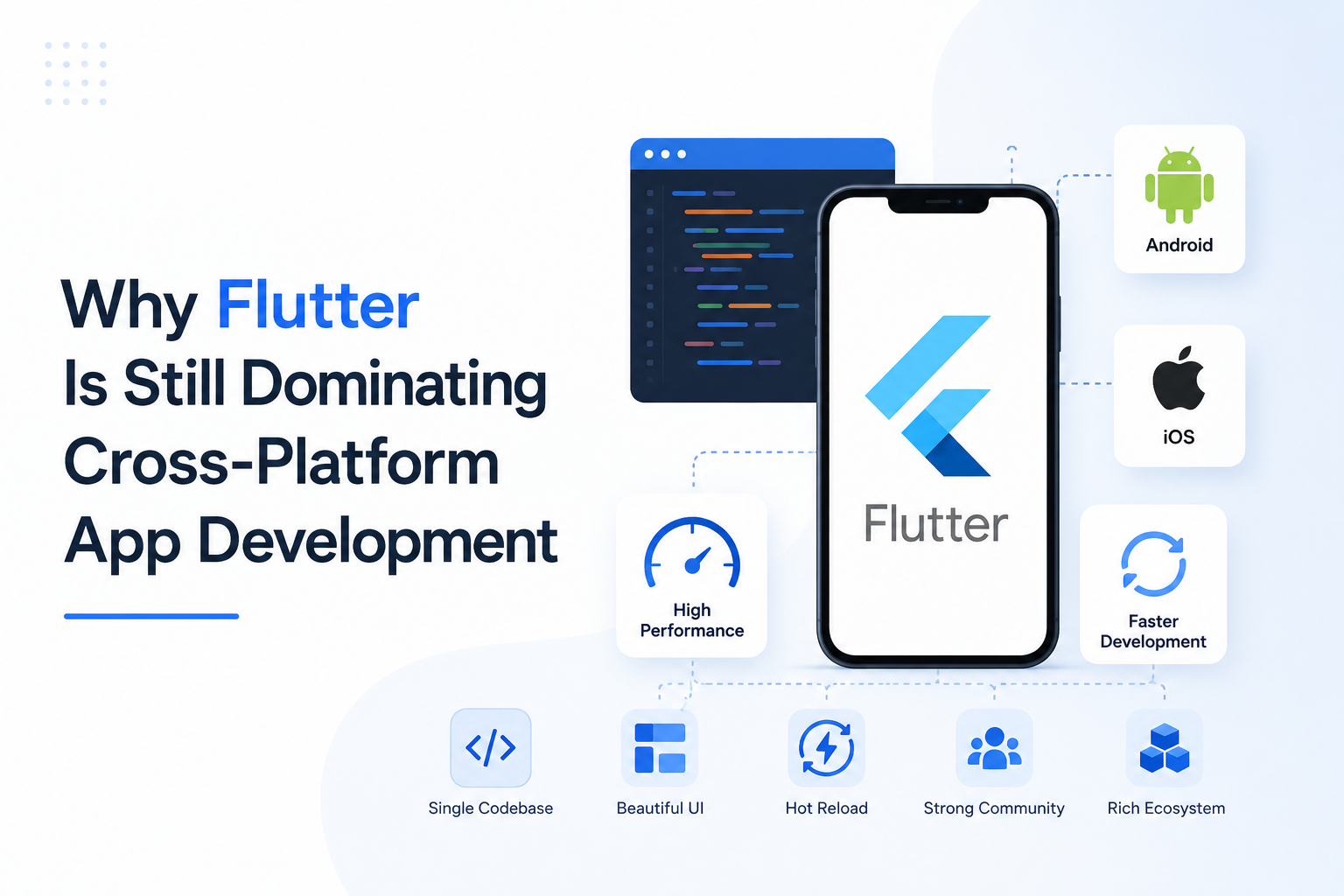
Because Flutter allows developers to use a single codebase across platforms, enterprises can reduce duplicated engineering effort while improving release consistency. Teams can deploy features, updates, and UI changes across mobile ecosystems simultaneously rather than managing separate native deployment cycles.
This becomes especially valuable for enterprises operating large-scale digital ecosystems where speed directly affects competitive positioning.
Several operational advantages continue driving enterprise Flutter adoption:
- Faster release cycles.
- Shared frontend architecture.
- Reduced engineering overhead.
- More consistent UX systems.
- Easier maintenance across platforms.
- Faster MVP and prototype delivery.
However, the framework’s value extends beyond cost optimization.
Flutter’s rendering engine allows organizations to create highly customized UI systems without relying heavily on platform-native components. This gives enterprises more control over digital experiences while improving interface consistency across devices.
For customer-facing enterprise applications, this matters significantly. Users increasingly expect seamless interactions across smartphones, tablets, desktops, and web platforms. Inconsistent UI behavior can quickly reduce customer trust and engagement quality.
Flutter’s architecture also aligns well with modern agile delivery environments where organizations continuously iterate on product experiences. Faster iteration cycles allow enterprises to test workflows, optimize engagement, and deploy improvements more efficiently across distributed user bases.
This flexibility is becoming increasingly important as enterprises accelerate digital transformation initiatives across industries including healthcare, fintech, logistics, retail, insurance, and enterprise SaaS ecosystems.
AI-Driven Applications Are Increasing Flutter’s Enterprise Relevance
Another major reason Flutter continues dominating cross-platform development is the rapid rise of AI-powered applications. Enterprises are embedding AI into mobile ecosystems faster than ever before through conversational interfaces, predictive recommendations, workflow automation, intelligent search systems, and real-time analytics experiences.
This is changing mobile architecture requirements significantly.
Modern applications must support dynamic user experiences, low-latency interactions, scalable APIs, cloud-native infrastructure, and increasingly complex backend orchestration systems. Enterprises require frontend frameworks capable of adapting to this growing operational complexity without slowing product delivery.
Flutter fits well within this transition because of its flexibility and strong integration capabilities.
Organizations increasingly use Flutter to support:
- AI-powered mobile assistants.
- Real-time analytics dashboards.
- Intelligent workflow automation.
- Cross-platform enterprise platforms.
- Embedded conversational interfaces.
- Multi-device digital ecosystems.
The framework’s performance optimization also remains a major advantage. Flutter applications compile directly to native machine code, helping improve rendering speed and interface responsiveness compared to several older hybrid development approaches.
Performance consistency has become increasingly important as users expect enterprise apps to feel as fast and intuitive as consumer-grade platforms such as Uber, Airbnb, Spotify, and ChatGPT.
At the same time, Flutter’s growing ecosystem of plugins, cloud integrations, and developer tooling continues improving enterprise adoption. Organizations can integrate backend services, analytics systems, AI APIs, authentication layers, and cloud infrastructure more efficiently without building everything from scratch.
This reduces operational friction for engineering teams managing complex digital ecosystems.
Across the enterprise technology landscape, engineering consultancies and digital modernization firms such as Thoughtworks, Globant, and GeekyAnts are increasingly contributing to scalable Flutter adoption by helping organizations modernize frontend architecture, improve cross-platform performance, and accelerate AI-ready mobile product development.
UX Consistency and Developer Productivity Are Now Strategic Priorities
Enterprise mobile strategy is no longer focused only on functionality. Organizations increasingly recognize that user experience quality directly affects customer retention, employee productivity, and long-term platform adoption.
This is creating stronger demand for frameworks capable of maintaining design consistency at scale.
Flutter’s widget-based architecture gives enterprises more control over reusable UI systems, component libraries, and design standardization. Teams can create scalable design systems that behave consistently across platforms without rebuilding interfaces independently for iOS, Android, and web environments.
This reduces operational fragmentation significantly.
For enterprise UX teams, consistency improves onboarding efficiency, workflow predictability, and user familiarity across ecosystems. For engineering teams, reusable component systems simplify maintenance and accelerate feature deployment cycles.
Developer productivity is becoming another critical business factor.
The demand for skilled mobile engineers continues rising globally while enterprises simultaneously face budget constraints and hiring competition. Frameworks that improve engineering efficiency without reducing quality are becoming increasingly valuable operationally.
Flutter’s hot reload capabilities, unified architecture, and growing enterprise ecosystem help reduce development friction considerably. Engineering teams can iterate faster, resolve issues more efficiently, and deploy updates without maintaining heavily fragmented codebases.
This operational efficiency becomes even more important inside enterprises managing:
- Large-scale mobile ecosystems.
- Continuous feature deployment.
- AI integration pipelines.
- Omnichannel customer experiences.
- Multi-region application environments.
At the same time, organizations are increasingly evaluating mobile frameworks based on long-term maintainability rather than short-term launch speed alone. Enterprises want platforms capable of evolving continuously as customer expectations, AI technologies, and digital business models change over time.
Flutter’s continued ecosystem growth is helping reinforce confidence around long-term platform viability.
The Future of Cross-Platform Development Is Becoming More Strategic
The enterprise mobile ecosystem is entering a new phase where scalability, operational efficiency, and platform adaptability matter more than framework popularity alone. Enterprises are no longer choosing cross-platform frameworks simply to reduce development costs. They are choosing platforms capable of supporting long-term digital transformation goals.
This is why Flutter continues maintaining strong momentum.
For enterprise technology leaders, the challenge is no longer whether cross-platform development is viable. Most organizations already recognize its operational value. The larger challenge is selecting frameworks capable of supporting AI integration, scalable architecture, modern UX expectations, and continuous product evolution simultaneously.
Flutter increasingly aligns with those requirements.
Organizations that continue relying heavily on fragmented mobile engineering ecosystems may struggle with slower release cycles, inconsistent digital experiences, and rising operational complexity over time. Meanwhile, enterprises investing in unified cross-platform architecture will likely improve delivery speed, platform consistency, and long-term engineering efficiency more effectively.
Across industries, the conversation is shifting away from simple framework comparisons and toward operational sustainability. Enterprises increasingly evaluate mobile ecosystems based on scalability, maintainability, developer productivity, infrastructure compatibility, and user experience quality rather than short-term development convenience alone.
The broader industry lesson is becoming increasingly clear: Flutter is not dominating cross-platform development simply because it builds apps faster. It continues leading because enterprises increasingly need scalable digital ecosystems that can evolve without multiplying operational complexity.