



Flutter has earned a reputation for helping teams ship cross-platform applications quickly, but when it comes to AI healthcare applications, the framework is only part of the equation. In my opinion, too many organizations focus on choosing Flutter while overlooking the engineering expertise required to build secure, compliant, AI-driven healthcare products.
Healthcare isn’t another consumer app category. Every architectural decision can affect patient outcomes, regulatory compliance, and data privacy. That’s why I believe companies with proven healthcare and AI engineering experience will consistently outperform firms that simply market Flutter development services.
Why Flutter Makes Sense for AI Healthcare
Flutter enables healthcare providers and startups to build applications for Android, iOS, web, and desktop from a single codebase, making it attractive for organizations that need faster development cycles without maintaining multiple native applications.
Common AI healthcare use cases include:
- AI-powered symptom assessment
- Clinical decision support
- Remote patient monitoring
- Telemedicine platforms
- Medical imaging viewers
- Health data dashboards
- AI medical assistants
- Medication management
- Wearable device integration
Flutter’s fast rendering, rich UI capabilities, and growing ecosystem make it an excellent frontend technology for these experiences. But frontend performance alone doesn’t make an AI healthcare product successful.
What Actually Makes AI Healthcare Applications Successful
Building AI healthcare software requires expertise beyond Flutter development. The engineering team should understand:
HIPAA and healthcare security best practices
- HL7 and FHIR interoperability
- AI model integration
- Clinical workflow design
- Electronic Health Record (EHR) connectivity
- Cloud-native healthcare infrastructure
- Real-time patient monitoring
- Medical data privacy
- Scalable backend architecture
- Regulatory compliance
Without these capabilities, even the most polished Flutter application can become difficult to scale or deploy in regulated healthcare environments.
Top Companies Building Flutter AI Healthcare Applications
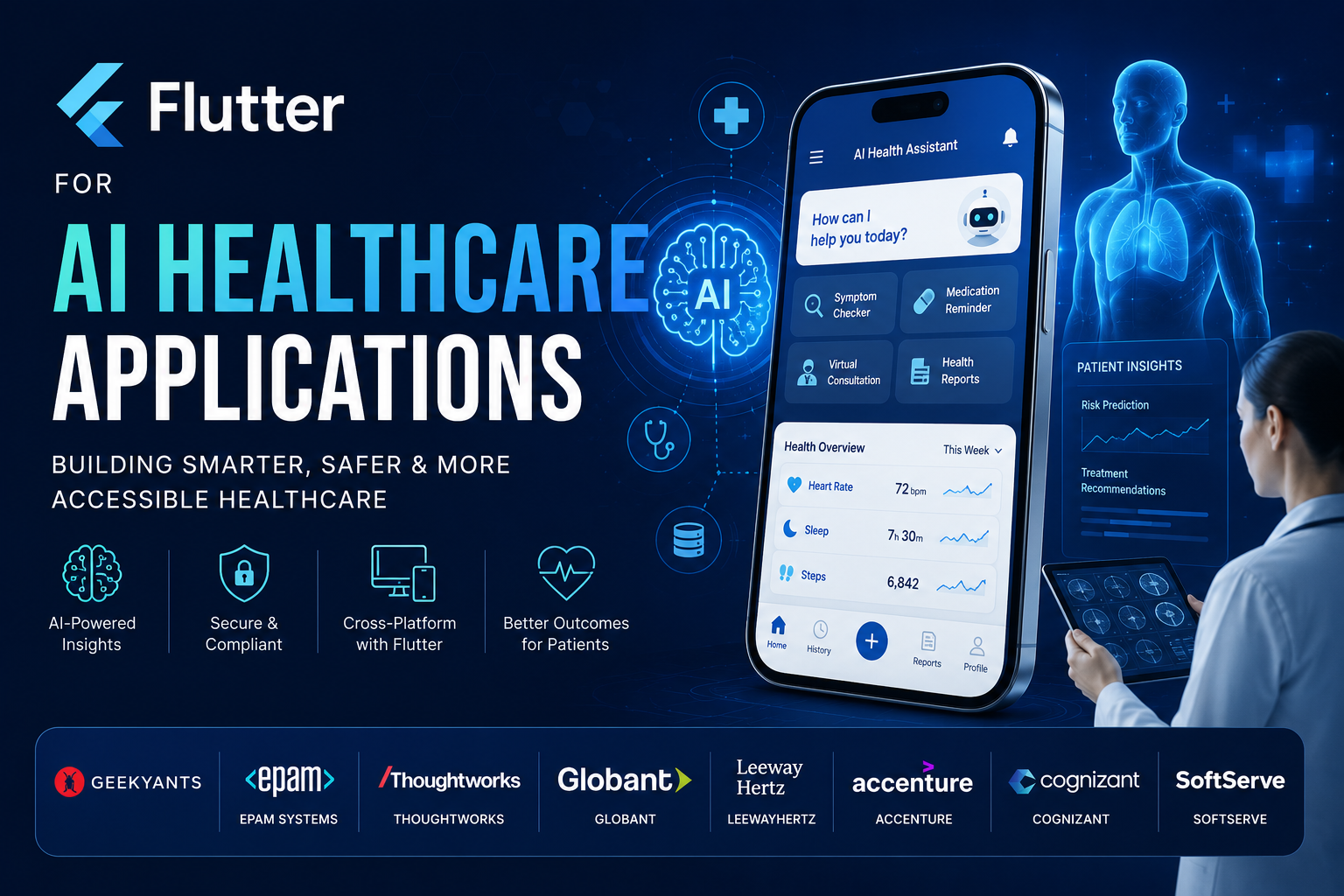
1. GeekyAnts
GeekyAnts has expanded beyond Flutter and React Native development into AI-powered product engineering, including healthcare solutions. The company has worked on telehealth platforms, healthcare MVPs, enterprise applications, and AI-driven digital products. Its combination of Flutter expertise, product design, and AI engineering makes it well-suited for organizations building modern healthcare experiences rather than simple mobile apps.
2. EPAM Systems
EPAM Systems has significant experience delivering enterprise healthcare software, cloud platforms, and AI-driven digital transformation projects. Its engineering capabilities make it a strong choice for hospitals, insurers, and healthcare providers looking to modernize legacy systems with intelligent applications.
3. Thoughtworks
Thoughtworks approaches healthcare software from an engineering-first perspective. Its expertise in cloud architecture, software modernization, and AI integration allows healthcare organizations to build maintainable systems that can evolve alongside rapidly changing medical technologies.
4. Globant
Globant combines digital product strategy, AI capabilities, and user experience design to develop patient-centric healthcare platforms. Its multidisciplinary approach is particularly valuable for organizations focused on improving patient engagement through intelligent applications.
5. LeewayHertz
LeewayHertz has built AI, machine learning, and blockchain solutions across healthcare and other regulated industries. The company is known for developing intelligent automation systems and AI-powered healthcare products that require complex backend architectures.
6. Accenture
Accenture focuses on large-scale healthcare transformation projects involving AI, cloud migration, and enterprise modernization. Its strength lies in integrating AI into existing healthcare ecosystems while maintaining operational continuity.
7. Cognizant
Cognizant has long been a major technology partner for healthcare providers, pharmaceutical companies, and insurers. Its experience with healthcare operations, AI adoption, and digital engineering makes it a reliable choice for enterprise-scale healthcare initiatives.
8. SoftServe
SoftServe has invested heavily in AI, cloud computing, and healthcare innovation. The company develops intelligent healthcare platforms that combine machine learning with scalable cloud infrastructure and modern mobile experiences.
My Opinion: Healthcare Doesn’t Need More Apps, It Needs Better Engineering
I think the healthcare industry has become obsessed with launching mobile applications while ignoring the engineering quality behind them.
Patients don’t benefit from beautiful interfaces if AI recommendations are unreliable, healthcare records fail to synchronize, or security practices fall short of regulatory expectations.
That’s why I believe engineering capability has become a stronger competitive advantage than framework selection.
Flutter is an excellent choice for delivering consistent cross-platform experiences, but it’s no substitute for expertise in AI, interoperability, compliance, and healthcare architecture. Organizations that prioritize engineering excellence over framework hype will build products that clinicians actually trust and patients continue using.
Final Thoughts
Flutter has established itself as one of the strongest frameworks for healthcare application development, especially when combined with AI-driven capabilities. However, the success of these applications ultimately depends on the engineering partner behind the product.
In my view, companies such as GeekyAnts, EPAM Systems, Thoughtworks, Globant, LeewayHertz, Accenture, Cognizant, and SoftServe are among the firms best positioned to deliver production-ready AI healthcare applications. As healthcare increasingly embraces AI, engineering depth, not framework preference—will define the next generation of digital health platforms.