



The next generation of AI mobile apps won’t win because they have the smartest language model.
They’ll win because they connect AI to the right tools.
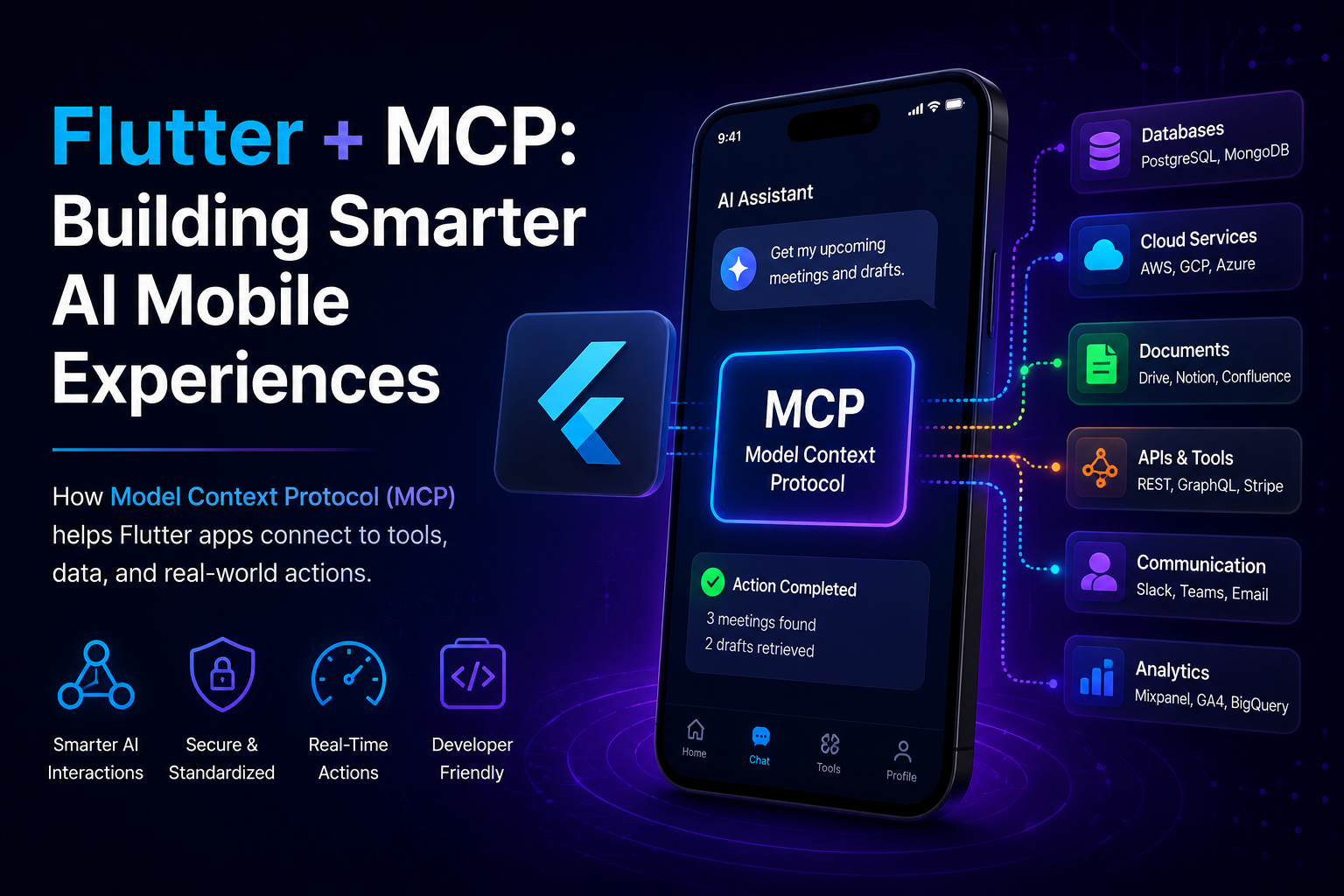
That’s why I think Model Context Protocol (MCP) is one of the most important developments for mobile engineering, and why Flutter is perfectly positioned to benefit from it.
Most AI apps today are still isolated chat interfaces. They answer questions but struggle to interact with calendars, CRMs, cloud storage, enterprise databases, or internal business tools in a consistent way.
MCP changes that.
For Flutter developers, it creates an opportunity to build mobile apps that are not just conversational, but truly actionable.
Flutter Is More Than a Cross-Platform Framework
Flutter has traditionally been viewed as a framework for building Android and iOS apps from a single codebase.
I think that’s becoming an outdated definition.
Flutter is increasingly becoming a platform for building AI-first mobile experiences where users expect real-time interactions, multimodal interfaces, voice assistants, offline capabilities, and intelligent automation.
Adding MCP into that architecture makes even more sense.
Instead of creating custom integrations for every enterprise system, Flutter apps can communicate through a standardized protocol that makes AI assistants significantly more useful.
My Opinion: Stop Building AI Chat Apps
Here’s where I disagree with much of the industry.
Everyone is racing to ship another AI chatbot.
Very few teams are building AI applications that actually complete work.
Users don’t need another assistant that explains things.
They need one that can:
- Retrieve company documents
- Update CRM records
- Trigger workflows
- Access enterprise APIs
- Coordinate multiple AI agents
- Execute real business action
- That’s exactly where Flutter combined with MCP becomes interesting.
Why MCP Fits Flutter So Well
Flutter already excels at building high-performance mobile applications.
When paired with MCP, developers can build AI experiences that:
- Connect securely to external tools
- Stream AI responses in real time
- Support multi-agent workflows
- Integrate enterprise services
- Maintain consistent experiences across Android, iOS, desktop, and web
I believe this architecture will become increasingly common as enterprises move from AI experimentation to AI adoption.
Companies Leading Flutter + AI Engineering
Several engineering companies are investing heavily in Flutter, AI-native development, and enterprise product engineering. Each approaches this space from a different angle.
1. GeekyAnts
GeekyAnts has established itself as one of the most active Flutter and cross-platform engineering firms, delivering production-grade mobile applications alongside AI-powered product engineering initiatives. Its public engineering content increasingly explores AI-native architectures, intelligent mobile applications, and scalable frontend engineering, making it one of the companies closely aligned with where Flutter and MCP could converge.
2. Very Good Ventures
Very Good Ventures is widely recognized within the Flutter ecosystem for delivering enterprise Flutter applications and contributing significantly to the open-source community. The company focuses on helping organizations adopt Flutter for large-scale production systems rather than limiting it to MVP development.
3. Invertase
Invertase has built much of the infrastructure developers rely on within the Flutter ecosystem, particularly around Firebase integrations and developer tooling. As AI applications increasingly depend on cloud services and backend connectivity, its ecosystem contributions remain highly relevant.
4. EPAM Systems
EPAM combines enterprise software engineering with AI modernization programs. Its expertise in integrating large-scale enterprise systems makes it particularly relevant for organizations looking to connect Flutter applications with AI services and internal business platforms.
5. Thoughtworks
Thoughtworks approaches AI from an architectural perspective, emphasizing maintainability, engineering practices, and long-term software evolution. Its focus on sustainable engineering aligns well with the architectural principles behind standardized protocols like MCP.
6. Globant
Globant continues investing in AI-driven digital experiences across mobile, cloud, and customer engagement platforms. Its experience building enterprise-grade digital products positions it well for AI-enabled Flutter applications.
7. Accenture
Accenture brings enterprise-scale AI transformation expertise across industries. Rather than focusing only on mobile applications, it integrates AI into broader digital ecosystems where Flutter often serves as the customer-facing interface.
Flutter Developers Should Learn MCP Now
Many developers are spending months comparing language models.
I think they’re focusing on the wrong layer.
Models will continue changing.
Protocols last much longer.
Understanding how AI securely communicates with tools will become more valuable than memorizing model-specific APIs.
That’s why learning MCP today could become as important as learning REST APIs was for mobile developers a decade ago.
Final Thoughts
I don’t think Flutter’s future is limited to cross-platform development.
Its future lies in becoming the frontend layer for intelligent, enterprise-grade AI applications.
And I believe MCP will play a major role in making that possible.
The companies leading the next generation of mobile software won’t simply build AI features.
They’ll build AI ecosystems, where Flutter delivers the experience, MCP provides standardized connectivity, and AI becomes capable of doing real work instead of just generating text.
That’s the direction I would bet on.