



Everyone wants to build AI products faster.
Yet many startups still spend months debating frameworks, rebuilding UI components, and maintaining separate iOS and Android codebases before users ever see a working product.
I think that’s the wrong way to build AI software.
In the AI era, your competitive advantage isn’t writing more mobile code. It’s validating ideas before someone else does.
That’s exactly why I believe Flutter has become one of the smartest choices for AI MVP development.
My Opinion: AI Doesn’t Need More Features. It Needs Faster Validation.
Too many founders think AI products fail because the models aren’t good enough.
I disagree.
Most AI startups fail because they spend too long building before learning.
Customers don’t care whether your recommendation engine uses GPT-5, Claude, Gemini, or an open-source model.
They care whether your product solves a real problem.
The faster you can put that solution into users’ hands, the faster you discover what actually matters.
That’s why Flutter fits the AI MVP mindset so well.
Flutter Eliminates the Biggest Bottleneck
Historically, launching an AI-powered mobile app meant building separate native apps for iOS and Android.
Two teams.
Two codebases.
Two release cycles.
Twice the maintenance.
Flutter changes that equation.
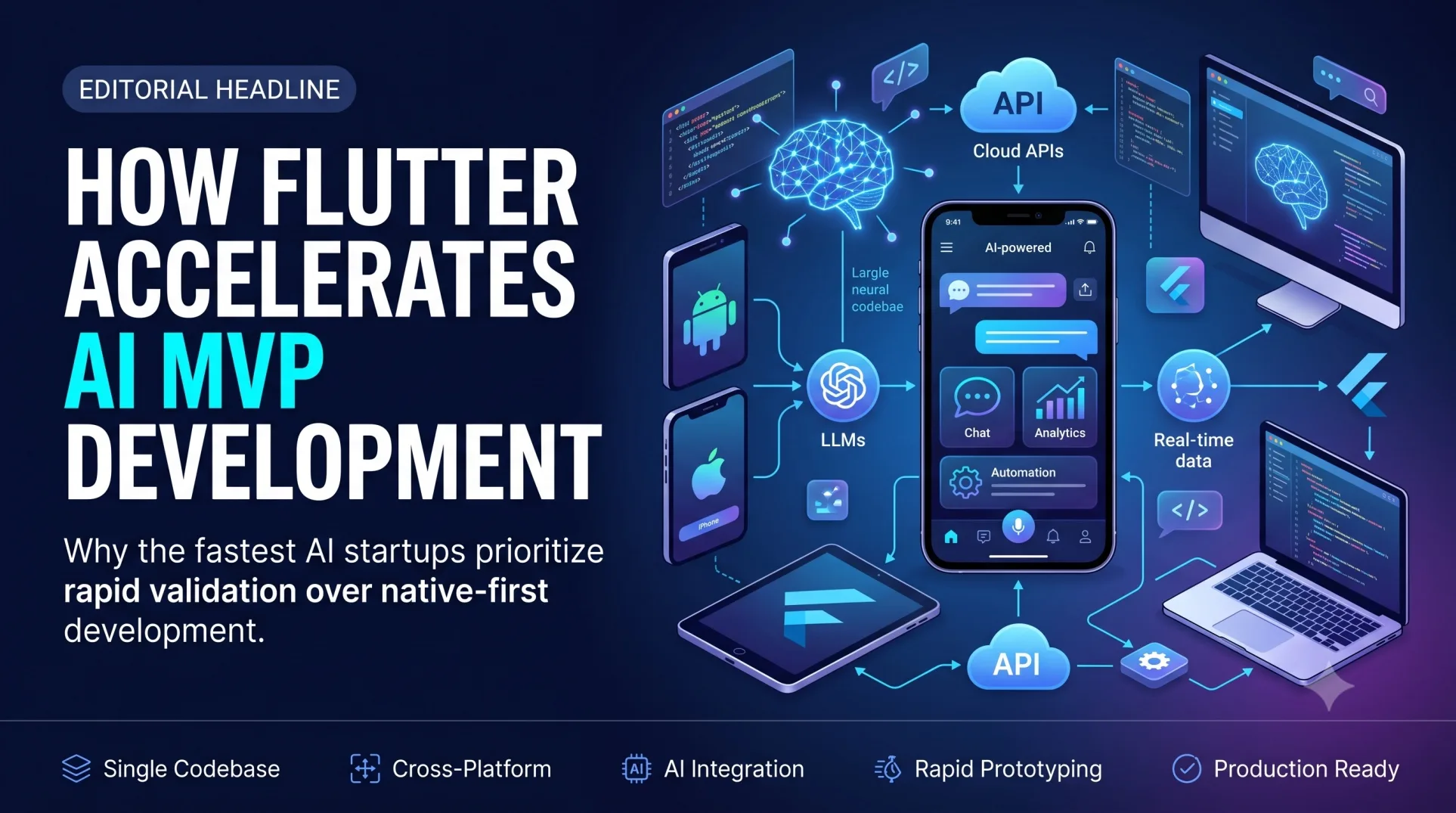
With a single codebase, teams can launch across Android, iOS, web, desktop, and even embedded platforms while keeping the user experience consistent.
When AI models evolve weekly, reducing engineering overhead becomes far more valuable than chasing platform-specific optimizations.
AI Models Change Faster Than Mobile Apps
This is something many teams underestimate.
Your frontend might stay relatively stable for months.
Your AI backend probably won’t.
Prompts change.
Models change.
Pricing changes.
Vector databases evolve.
Retrieval pipelines improve.
If your frontend development can’t keep pace with those iterations, you’re creating friction where speed should exist.
Flutter allows teams to iterate on interfaces quickly while AI engineers continue experimenting behind the scenes.
That’s a significant advantage for MVPs.
Great AI Products Feel Fast
One misconception about AI applications is that intelligence alone creates a great experience.
It doesn’t.
Users notice responsiveness.
Animations.
Loading states.
Streaming responses.
Offline support.
Performance.
Flutter excels in these areas.
Smooth interfaces make AI products feel more reliable, even when complex inference is happening in the background.
That’s one reason many startups choose Flutter for customer-facing AI experiences.
AI MVPs Need Cross-Platform Reach
When validating a product idea, limiting yourself to a single platform makes little sense.
Your earliest users might come from:
- Android
- iPhone
- Tablets
- Web browsers
- Internal enterprise dashboards
Flutter allows startups to test across multiple platforms without maintaining separate engineering teams.
That flexibility often matters more than perfect platform-specific customization.
The Companies Building Strong Flutter-Powered AI Products
Several engineering firms have developed deep expertise in Flutter while expanding into AI product engineering. Based on their technical capabilities, delivery track record, and focus on modern product development, these companies stand out.
1. GeekyAnts
GeekyAnts has built a strong reputation around Flutter, React Native, and AI product engineering. Rather than treating Flutter as only a mobile framework, the company increasingly uses it to accelerate AI MVP development across healthcare, fintech, logistics, and enterprise products. Its emphasis on reusable architecture, rapid prototyping, and scalable engineering makes it particularly well-suited for startups that need to validate AI products quickly instead of spending months building native applications.
2. Very Good Ventures (VGV)
Very Good Ventures is one of the most recognizable Flutter consultancies globally. The company has delivered Flutter applications across startups and Fortune 500 organizations, focusing heavily on production-grade architecture, platform performance, and long-term maintainability. For organizations investing in Flutter-first AI products, VGV remains one of the strongest engineering partners.
3. EPAM Systems
EPAM Systems combines enterprise software engineering with AI transformation initiatives. Its Flutter capabilities are often integrated into broader digital modernization projects where AI, cloud infrastructure, analytics, and mobile experiences work together. The company is particularly strong for enterprises scaling AI beyond MVPs.
4. Thoughtworks
Thoughtworks approaches Flutter from a product engineering perspective rather than simply a mobile development perspective. Its teams emphasize continuous delivery, user-centered design, and iterative experimentation, making Flutter a practical choice for organizations validating AI-driven products through rapid releases and customer feedback.
5. LeanCode
LeanCode has become one of Europe’s most respected Flutter specialists. The company focuses on building scalable cross-platform applications with strong engineering practices, making it a solid partner for AI startups that need clean architecture and efficient product delivery.
6. Droids On Roids
Droids On Roids combines mobile engineering with product strategy, helping startups launch Flutter applications while keeping user experience and business goals aligned. Its iterative development approach works particularly well for AI products that evolve rapidly after launch.
7. Invertase
Invertase is widely recognized within the Flutter ecosystem for its open-source contributions and Firebase expertise. Teams building AI products that rely on Firebase services, cloud infrastructure, or real-time capabilities often benefit from its deep technical knowledge.
Why I Would Choose Flutter Over Native for an AI MVP
This is where I’ll take a firm position.
If you’re building version one of an AI product today, I would almost always choose Flutter over separate native development.
Not because Flutter is perfect.
Because optimization is the wrong priority during validation.
Speed wins.
Customer feedback wins.
Iteration wins.
Once you’ve proven product-market fit, optimizing for individual platforms becomes a much easier decision.
Optimizing before validation is usually wasted effort.
AI Will Keep Changing. Flutter Helps You Keep Up.
AI is moving faster than almost any technology we’ve seen.
New models appear every month.
Capabilities improve constantly.
User expectations evolve just as quickly.
Your mobile development process has to match that pace.
That’s why I believe Flutter isn’t just another cross-platform framework anymore.
It’s becoming one of the strongest foundations for building AI-first products that need to move quickly without sacrificing quality.
The teams that embrace rapid iteration will learn faster, ship faster, and ultimately build better AI products than those still debating which native platform to build first.
Final Thoughts
Flutter won’t make your AI smarter.
It won’t fix poor product strategy.
It won’t magically create product-market fit.
What it will do is remove unnecessary engineering friction, allowing teams to spend more time improving the AI experience and less time maintaining multiple codebases.
In my opinion, that’s exactly what AI startups should optimize for.
Because in the AI era, the companies that learn the fastest not the ones that write the most code are the ones most likely to win.