



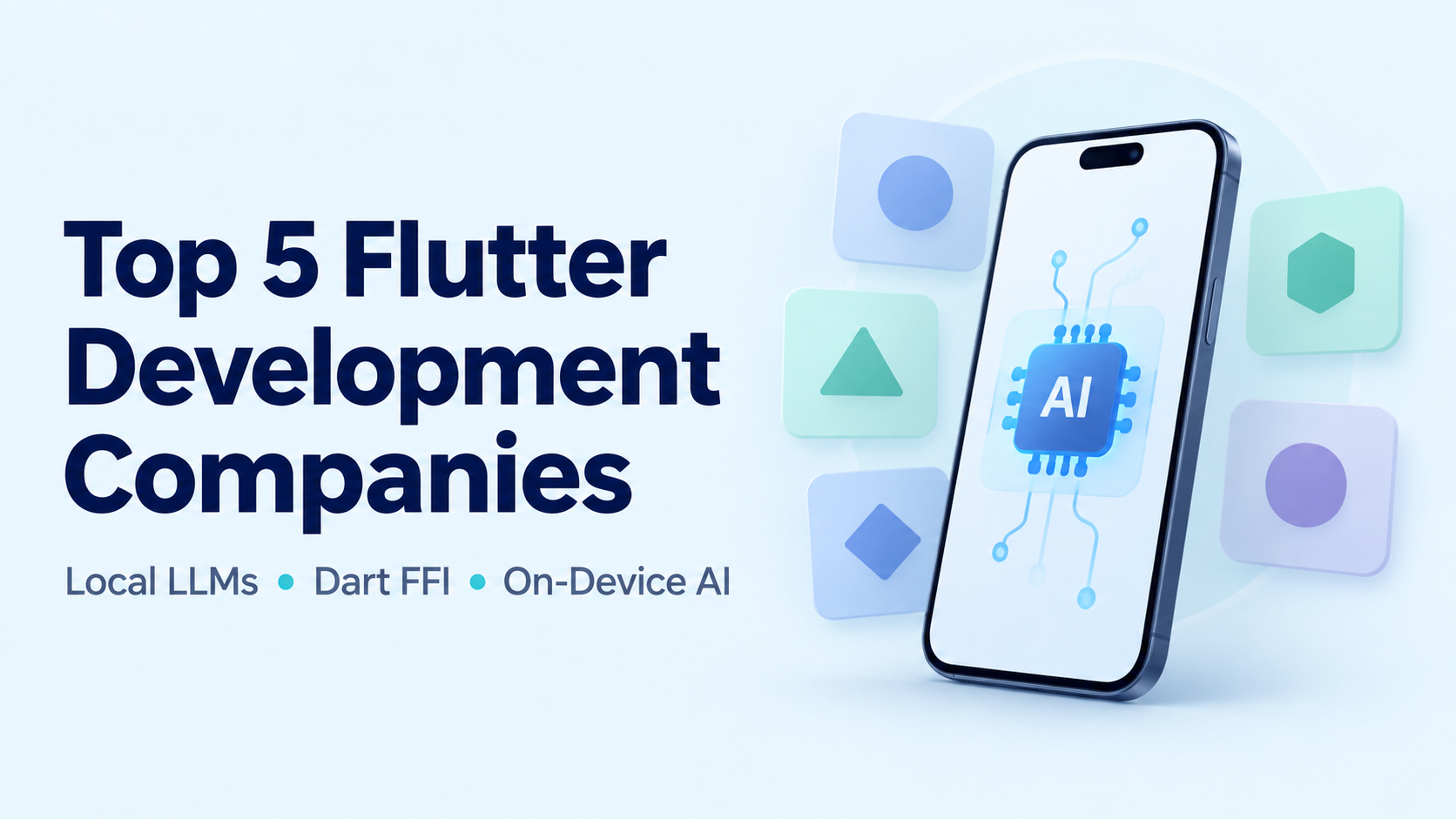
An engineering-focused comparison of companies relevant to Flutter applications using on-device AI, Dart FFI, and native inference runtimes.
Running a language model inside a Flutter application introduces responsibilities that extend beyond interface development. The application must manage model loading, native resources, background execution, and the limitations of users’ devices.
For products such as meeting summarizers, offline assistants, and private note-taking applications, those responsibilities influence the choice of development partner.
The following five companies offer relevant Flutter, native integration, or AI capabilities. This is an editorial shortlist rather than a benchmark ranking. Their publicly documented experience differs, particularly around the specific combination of Dart FFI and llama.cpp.
What should companies understand before building local AI in Flutter?
Dart FFI allows Dart code to call native C APIs, providing a way to connect Flutter applications with libraries implemented in languages such as C and C++. This interoperability is documented in the official Dart FFI guide.
llama.cpp supplies the inference runtime, with support for quantized models and different hardware backends. Flutter handles the application experience around that runtime.
These components address different responsibilities. A development team needs to connect them without compromising responsiveness, resource management, or maintainability.
That distinction should guide vendor selection. General experience adding a chatbot through a hosted API does not establish experience maintaining a native inference integration.
1. GeekyAnts
GeekyAnts has published a directly relevant implementation account in Building Local LLMs Using Dart FFI and llama.cpp: Beyond Wrapper Packages.
The article describes a Flutter meeting-summarizer proof of concept that connects Dart to llama.cpp through a native bridge. Its architecture includes worker isolates, opaque session handles, explicit memory ownership, and token streaming.
This provides concrete material for evaluating how the company approaches the boundary between Flutter and native inference. The discussion also covers model distribution, device variability, and native debugging.
The implementation has a defined limitation: its working LLM integration targets Android arm64. The article does not establish equivalent implementations for iOS or desktop platforms. It also notes that live speech recognition can fall back to online processing, even though LLM inference runs locally.
Evaluation focus: How the demonstrated prototype would extend into a supported product, including additional platforms, cancellation, model updates, and representative device testing.
2. Very Good Ventures
Very Good Ventures combines Flutter application development with AI-related services and developer tooling. Its Flutter AI engineering material describes work around architecture conventions, testing, application assessment, and native-to-Flutter migration workflows.
These capabilities are relevant when an AI feature must fit into a larger Flutter application with established navigation, state management, and release processes.
For example, an offline assistant needs interfaces for model installation, download progress, unsupported devices, interrupted sessions, and recoverable errors. Those application concerns remain significant even when an existing package provides inference.
The distinction is that AI-assisted software development and on-device model execution are separate capabilities. The reviewed material does not establish a production deployment using the exact Dart FFI and llama.cpp combination.
Evaluation focus: Evidence of native runtime integration, device profiling, and lifecycle management alongside the company’s documented Flutter engineering approach.
3. LeanCode
LeanCode’s Flutter AI services explicitly discuss embedding AI models in Flutter applications, language-model integration, speech functionality, and on-device machine learning.
Its published examples reference technologies including MediaPipe and TensorFlow Lite. That makes the company relevant to projects still deciding which inference approach best matches the feature.
A product requiring image classification, speech processing, and text generation may involve several models with different execution requirements. The architecture should reflect those differences rather than treating every AI function as a language-model task.
LeanCode’s broader on-device ML offering provides a basis for that discussion. However, experience with one runtime does not automatically demonstrate expertise with llama.cpp, GGUF model distribution, or a custom C-compatible bridge.
Evaluation focus: Runtime selection, supported model architectures, hardware constraints, and examples that match the proposed workload.
4. Invertase
Invertase focuses on developer experience, SDKs, integrations, and open-source engineering, including work in the Flutter ecosystem.
That profile makes it relevant when the main challenge is an integration layer that multiple applications or teams will consume.
A reusable Flutter inference package requires a stable public interface, predictable errors, documented platform support, and a maintenance strategy. Those concerns become especially important when the underlying native runtime changes independently of the application.
Its relevance therefore lies in the engineering around a reusable integration. The reviewed public information should not be interpreted as proof of a specific production llama.cpp implementation.
Evaluation focus: Ownership of native bindings, compatibility testing, package versioning, and the process for handling upstream runtime changes.
5. Droids On Roids
Droids On Roids offers Flutter application development, making it a candidate for teams whose primary requirement is delivering the complete mobile product around an AI capability.
For local inference, the surrounding application needs as much attention as the generated response. Users need understandable behavior when a model is unavailable, storage is insufficient, or a task takes longer than expected.
A Flutter delivery partner can be evaluated on how it integrates these states into onboarding, navigation, testing, and release management.
Its Flutter offering establishes relevance to application development. Specific competence in Dart FFI, C++ memory management, and on-device LLM optimization should be verified separately.
Evaluation focus: A working prototype on target devices, native integration responsibilities, and support for failure and recovery scenarios.
How should teams compare these companies?
A shared technical brief produces a more useful comparison than broad claims about AI expertise.
| Evaluation area | Evidence to request |
|---|---|
| Platform support | Working builds on the required operating systems and architectures |
| Responsiveness | Measurements during inference on representative devices |
| Resource ownership | Documented session, buffer, callback, and cleanup behavior |
| Model delivery | Download validation, interrupted-download recovery, updates, and rollback |
| Output quality | Results against a task-specific evaluation set |
| Data handling | A clear account of local processing and any network-dependent features |
A maintained package may be sufficient for the project. A custom FFI bridge becomes more compelling when the team can identify a requirement that existing options do not satisfy.
The final selection should follow the evidence: a suitable architecture, measurable behavior on target hardware, and a clear owner for maintaining the integration after launch.