



A Flutter chatbot should not need a paid model request every time a developer checks its loading indicator. A document assistant should not depend on an external provider being available to verify its retry button.
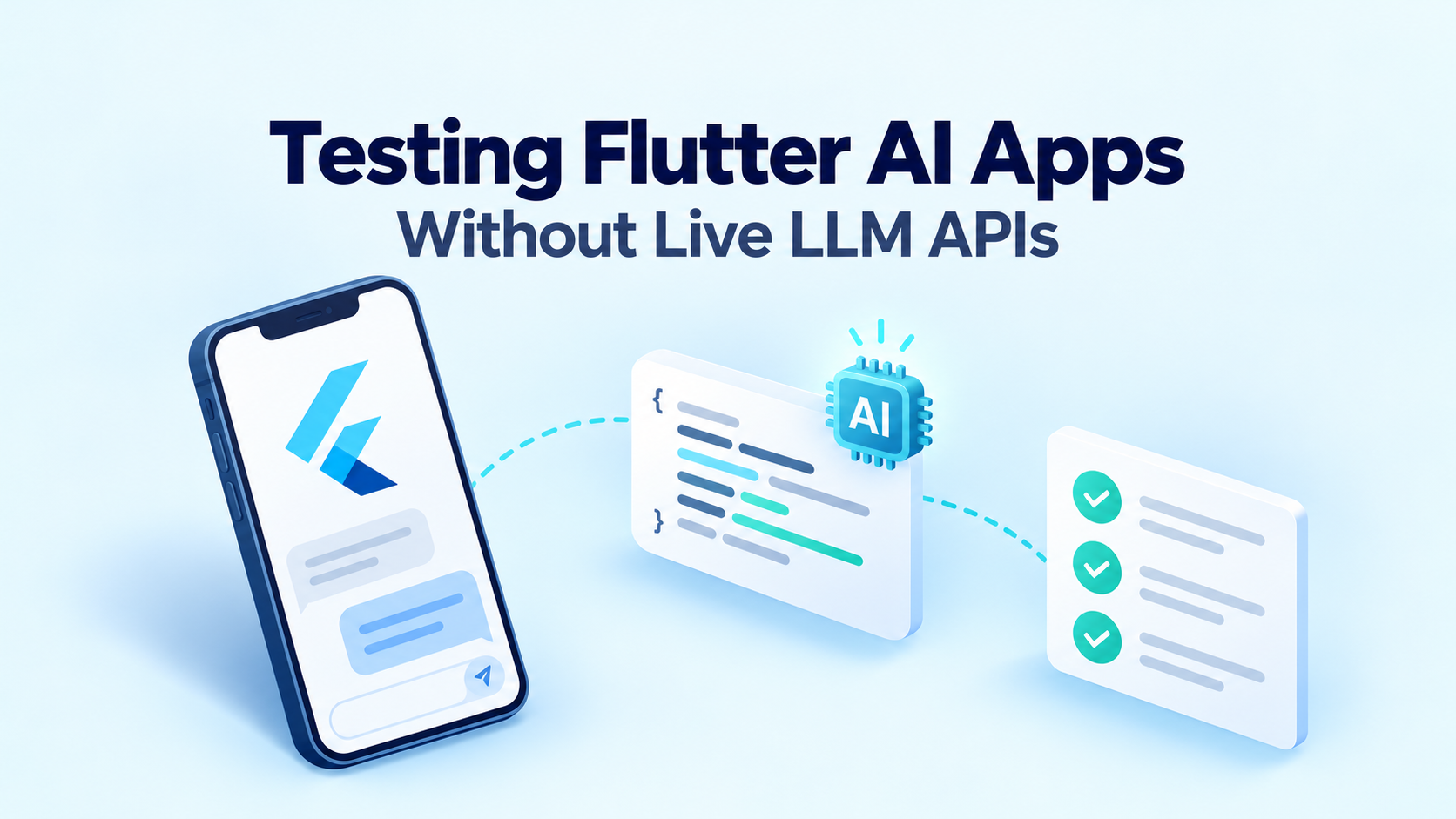
Flutter AI applications can be tested without live LLM APIs by injecting fake AI services, replaying response fixtures, mocking HTTP clients, and controlling streams. These techniques let teams verify application behavior repeatedly, including failures that are difficult to reproduce against a real provider.
The boundary matters: offline tests can establish how an application handles an answer. They cannot establish whether the production model will consistently generate accurate answers.
A useful testing strategy makes that distinction explicit.
Why Should Flutter Teams Avoid Live LLM Calls in Routine Tests?
Flutter’s official testing guidance identifies three problems with live dependencies: slower execution, unpredictable results, and difficulty reproducing all success and failure scenarios. It recommends substituting dependencies with controlled implementations. These concerns apply directly to AI integrations.
Consider a test that submits a question and expects a particular sentence. The application might work correctly while the provider returns an equally valid answer with different wording. Alternatively, a test that merely checks for nonempty text could accept an incorrect answer.
Live requests also introduce costs and external availability into otherwise local checks.
A better approach is to define the behavior being tested:
| Test objective | Appropriate substitute |
|---|---|
| Verify loading and error states | Fake AI repository |
| Check request serialization | Mock HTTP client |
| Validate response parsing | Versioned JSON fixtures |
| Exercise incremental output | Controlled Dart stream |
| Test navigation and persistence | App integration test with a fake AI boundary |
| Assess actual model accuracy | Separate model evaluation, outside the offline suite |
This keeps routine tests focused on observable application behavior.
Where Should the AI Dependency Be Replaced?
The most useful replacement point is usually an application-owned interface.
Widgets should depend on a repository or service abstraction rather than construct a provider SDK directly. Production code supplies the real implementation; tests supply a controlled substitute.
Flutter’s architecture guidance demonstrates this principle through fake repositories used to test view models and their dependencies.
An illustrative interface might look like this:
abstract interface class AiGateway {
  Stream<String> generate(String prompt);
}

class ScriptedAiGateway implements AiGateway {
  ScriptedAiGateway(this.chunks);

  final List<String> chunks;
  final List<String> receivedPrompts = [];

  @override
  Stream<String> generate(String prompt) async* {
    receivedPrompts.add(prompt);

    for (final chunk in chunks) {
      yield chunk;
    }
  }
}
A test can inject:
final gateway = ScriptedAiGateway([
  'The document ',
  'contains three recommendations.',
]);
This fake provides repeatable text chunks without credentials or network access. It is suitable for basic consumption tests, but it does not simulate realistic timing, cancellation, or transport behavior.
Those need additional scenarios rather than a more elaborate success fixture alone.
How Should Streaming Responses Be Tested?
A completed answer hides many of the states that users experience.
A Flutter AI interface may move through idle, loading, streaming, completed, canceled, and failed states. Tests should verify the transitions between them.
For precise control, a test can supply a StreamController<String> through the injected gateway. It can then emit one chunk, inspect the widget tree, emit another chunk, and finally close the stream.
That allows assertions such as:
- The first chunk becomes visible before completion.
- Later chunks append to the same message.
- A partial answer remains clearly marked if generation fails.
- Canceling prevents subsequent chunks from modifying the conversation.
- Leaving the screen cancels the relevant subscription.
- A late response does not appear in a different conversation.
Why Can pumpAndSettle() Cause Problems?
Flutter documents that pumpAndSettle() waits until no frames remain scheduled. An indefinitely animated progress indicator can therefore cause it to time out.
For a loading or streaming test, explicit pump() calls are often more appropriate. Advance only the frames or simulated time required for the state under inspection.
Also distinguish stopping the UI subscription from aborting upstream work. An offline widget test can verify that canceled content is ignored. It does not prove that a remote inference request stopped consuming resources.
How Can HTTP Responses Be Mocked?
When the objective is to test serialization, status handling, or parsing, replace the HTTP client rather than the entire repository.
The Dart http package provides MockClient, which handles requests without sending real HTTP traffic. It also provides a streaming constructor.
The following illustrates a mocked application-backend response. The JSON schema is an example, not a provider-specific format:
import 'dart:convert';

import 'package:http/http.dart' as http;
import 'package:http/testing.dart';

final client = MockClient((request) async {
  if (request.method != 'POST' ||
      request.url.path != '/ai/chat') {
    throw StateError('Unexpected request');
  }

  final body =
      jsonDecode(request.body) as Map<String, dynamic>;

  if (body['prompt'] != 'Summarize this document') {
    throw StateError('Unexpected prompt');
  }

  return http.Response(
    jsonEncode({
      'answer': 'The document describes three priorities.',
      'sources': ['document-123'],
    }),
    200,
    headers: {'content-type': 'application/json'},
  );
});
Inject this client into the real API adapter. The test should assert what the adapter returns or which application error it produces.
Separate fixtures should cover invalid JSON, missing fields, empty responses, authorization failures, rate limits, and server errors.
For streaming parsers, also split events across arbitrary byte boundaries. A network chunk is not guaranteed to contain one complete event or one complete text character.
Which Offline Scenarios Should Be Included?
A useful suite extends beyond a successful prompt and answer.
| Scenario | Expected application behavior |
|---|---|
| Empty or invalid input | Validation appears before submission |
| Slow first response | Loading state appears and cancellation remains available |
| Error after partial output | Partial content is distinguished from a completed answer |
| Repeated submission | Duplicate messages or actions are prevented |
| Malformed structured output | Parsing fails safely with a recoverable state |
| Missing citation | The interface does not invent a source link |
| Conversation switch | Responses remain associated with their original conversation |
| Tool proposal | Required approval appears before execution |
| Rejected tool action | No action is performed |
| Screen disposal | Subscriptions and callbacks are cleaned up |
These are application tests. Returning a fake “access denied” response verifies error handling, not real authorization enforcement.
Permissions need complementary backend tests using realistic identities and resources.
How Should Fixtures Be Maintained?
Fixtures should represent a deliberate contract, not arbitrary text copied into tests.
Store them with descriptive names such as:
test/fixtures/ai/
  answer_with_sources.json
  missing_required_field.json
  refusal.json
  rate_limit.json
  partial_stream.txt
Use synthetic or sanitized data. Recorded responses can contain personal information, tokens, document content, or identifiers that should not enter source control.
Track which contract or adapter version each fixture represents. When the backend changes its schema, update both the implementation and the relevant fixtures through review.
Offline tests remain useful only while their assumptions match the system they represent.
Can Integration Tests Also Avoid Live Models?
Yes. Flutter’s integration_test package supports tests that exercise an application on devices or emulators. The AI boundary can still be replaced while navigation, state management, and selected persistence layers remain real.
A test could open a conversation, submit a prompt, receive scripted output, save it, restart the relevant screen, and verify persistence.
Report that boundary accurately: it is an application integration test with a substituted AI service, not a complete production-provider test.
Native dependencies also need attention. Speech input, file selection, and secure storage may use platform-specific implementations. Flutter documents options including wrapping plugins and substituting their public or platform interfaces in tests. For CI jobs intended to make no external requests, use test implementations, omit provider credentials, and restrict outbound network access where practical. Missing credentials alone do not guarantee that no request is attempted.
How Are Five Companies Approaching Related Testing Challenges?
Published evidence varies. Very Good Ventures provides directly relevant Flutter testing guidance, while the other companies publish complementary practices in AI evaluation, automation, or failure analysis. The sources do not establish that all five use this exact offline Flutter architecture.
GeekyAnts: Separating Test Results From AI Diagnosis
GeekyAnts’ Playwright failure-analysis article proposes keeping pass/fail decisions in the test framework while AI examines failure evidence.
Although this example concerns web testing, the principle transfers to Flutter: deterministic assertions should decide whether expected behavior occurred.
An external AI diagnostic step may itself call an LLM. Teams requiring completely offline execution would need to disable that step or run it separately.
Very Good Ventures: Flutter Testing and Dependency Substitution
Very Good Ventures publishes Flutter testing guidance and maintains an AI Flutter development plugin whose testing guidance includes unit, widget, golden, and Mocktail-based tests.
This provides direct evidence of Flutter-focused testing practices. The relevant application is replacing external dependencies while testing behavior at appropriate layers. It does not establish a specific customer’s offline LLM implementation.
QA Wolf: Separating Output Structure From Suitability
QA Wolf discusses predictable assertions for variable AI output, including structured checks and external judges.
For offline Flutter tests, structured fixtures can validate rendering and parsing. Any external judge belongs in a separate evaluation path if it requires a live model call.
EPAM: Test Evidence and Human Review
EPAM’s quality engineering offering describes agent-assisted testing, execution evidence, and human-in-the-loop controls.
The applicable lesson is to preserve evidence that explains failures rather than accept an automated conclusion without inspection. Its public offering does not document a universal no-network Flutter testing setup.
Globant: Visual Validation and AI Quality
Globant describes visual testing through MagnifAI alongside broader AI-system evaluation.
Flutter teams can apply the distinction through golden tests for stable visual states and separate evaluation of answer quality. A matching screenshot establishes visual consistency, not factual correctness. What Can Offline Tests Actually Prove?
Offline tests can verify request construction, state transitions, parsing, rendering, retries, cancellation handling, and behavior around proposed actions.
They cannot prove current provider compatibility, production latency, factual accuracy, or resistance to every adversarial prompt.
The practical goal is to make ordinary application testing independent of live inference while clearly documenting what remains untested. A reliable Flutter AI suite should make failures reproducible and make its ow
limits visible.