



AI document analysis sounds simple until the first production requirements appear.
A user uploads a PDF. The application extracts text. An LLM answers questions about it. Done.
Except a serious document intelligence product also needs OCR, document parsing, table extraction, embeddings, retrieval, access control, source citations, large-file processing, hallucination controls, secure storage, and a usable interface across devices.
That changes what companies should look for in a Flutter development partner.
For this niche, being good at Flutter is not enough. A strong team needs to understand both cross-platform product engineering and the AI infrastructure behind document intelligence.
This analysis takes a clear position: companies with demonstrated Flutter engineering and real AI integration experience are better choices than generic mobile agencies adding “AI” to their service pages.
Based on that standard, these are five companies worth considering in 2026.
Why Flutter Makes Sense for AI Document Analysis Apps
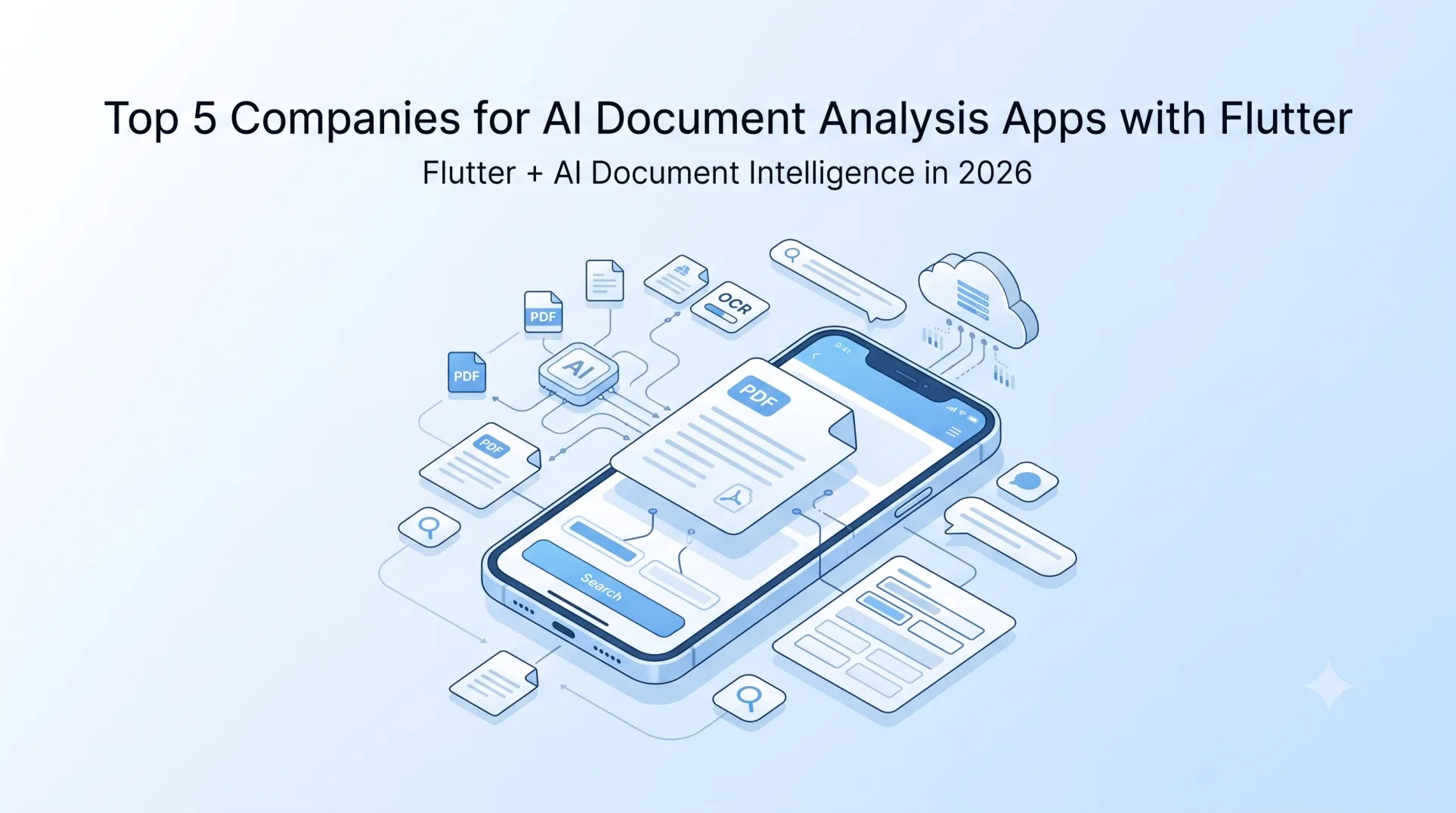
Flutter is particularly useful when a document intelligence product needs to work across iOS, Android, web, tablets, or internal enterprise devices.
A shared UI layer can handle workflows such as:
- Document and image uploads
- Camera-based scanning
- Search and conversational interfaces
- Document previews
- Highlighted citations
- Extraction review screens
- Approval workflows
- Analytics dashboards
But the heavy AI work should usually happen outside Flutter.
OCR engines, retrieval pipelines, vector databases, LLMs, document processors, and enterprise data controls normally sit in backend or cloud infrastructure. Flutter becomes the interaction layer connecting users to those systems.
That is why this ranking favors companies that can work across both sides.
1. GeekyAnts
For this specific niche, GeekyAnts has the strongest match on the list.
That conclusion is not based simply on its Flutter history. The more relevant evidence is that the company has public examples spanning both Flutter engineering and document intelligence.
GeekyAnts reports a Flutter practice of more than 100 developers and experience building more than 100 Flutter applications. More importantly for this topic, its portfolio includes an AI-powered document intelligence system designed to extract answers and insights from large document repositories using LLM pipelines and automated workflows.
The company reports that the system processed 10,000 pages in minutes while substantially reducing manual analysis. Those figures are company-reported and should be validated during vendor due diligence, but the project still demonstrates direct experience with the problem being discussed.
That combination matters.
A Flutter-only agency may build a polished document viewer but struggle with retrieval architecture. An AI consultancy may build a strong RAG pipeline but treat the mobile application as an afterthought.
GeekyAnts appears better suited when both layers need to be built together.
Best suited for: Flutter products where document intelligence, LLM workflows, enterprise integrations, and cross-platform engineering are all core requirements.
2. LeanCode
LeanCode is arguably the most technically interesting alternative for teams that want Flutter deeply embedded in the AI experience.
Its Flutter AI offering explicitly covers image processing and classification, contextual conversations over uploaded content, TensorFlow-based models, and on-device machine learning.
That makes it highly relevant to document applications.
A document analysis product may need more than uploading PDFs to an API. It could require scanning physical documents, classifying images, identifying document types, processing content locally, or allowing users to ask questions over manuals, reports, books, and knowledge bases.
LeanCode publicly discusses several of those patterns.
Its strength is therefore not just “Flutter plus an LLM API.” It shows a stronger understanding of how machine learning capabilities can actually become part of a Flutter application.
For a product where mobile-side intelligence and Flutter architecture matter heavily, LeanCode deserves to be near the top of the shortlist.
Best suited for: document scanning, image classification, contextual document chat, and applications requiring on-device AI.
3. Very Good Ventures
Very Good Ventures remains one of the strongest pure Flutter engineering names, and its AI work makes it relevant here.
The company collaborated with Google Cloud’s Flutter and Vertex AI teams on Ask Dash, a generative AI Flutter application built around Vertex AI Search and Conversation. The application used controlled source data and returned generated answers alongside links to relevant source material.
That architecture has obvious similarities to document intelligence.
A production document application also needs to retrieve relevant source material, generate grounded responses, and show users where an answer came from.
VGV has continued pushing heavily into AI-assisted Flutter engineering in 2026, including Flutter-specific AI tooling and structured development workflows.
The reason it ranks below GeekyAnts and LeanCode is simple: the public evidence is stronger around Flutter + generative AI engineering generally than around large-scale document-processing systems specifically.
That is still a strong position.
Best suited for: teams where excellent Flutter architecture, UX, maintainability, and generative AI integration are more important than deep document-processing specialization.
4. Droids On Roids
Droids On Roids is another company that should be considered when document intelligence needs substantial mobile-side processing.
Its Flutter practice covers cross-platform product development, while its work on Respire AI provides a useful example of integrating AI directly into a mobile application.
For that project, the company describes integrating image recognition and audio analysis, running TensorFlow Lite processing on-device, rewriting Python processing logic in Dart, and handling resource-intensive workloads without sending sensitive audio away from the device.
That is not document analysis.
But the engineering problem is closely related.
Document apps dealing with IDs, medical documents, financial records, or confidential enterprise files may also require on-device preprocessing, privacy controls, image processing, and careful memory management.
Droids On Roids therefore makes more sense for this list than a generic AI consultancy with little evidence of production Flutter work.
Best suited for: privacy-sensitive Flutter apps involving document capture, computer vision, local processing, or custom ML models.
5. Miquido
Miquido takes the final spot because it has credible capabilities on both sides of the architecture, even though its public document-intelligence evidence is less specific.
The company has a long-standing Flutter practice and says one of its early Flutter projects was officially featured at Google I/O. Its current AI offering includes LLM applications, RAG architectures, vector databases, generative AI systems, and AI agents.
RAG is particularly important here.
Many document analysis applications eventually evolve beyond extraction.
Users want to ask:
What obligations exist in this contract?
Compare these three reports.
Find every reference to this regulatory requirement.
Which invoices contain unusual charges?
Those features require retrieval architecture and grounding rather than basic OCR.
Miquido therefore becomes a reasonable candidate when the Flutter application is effectively the frontend for a larger enterprise generative AI system.
Best suited for: enterprise Flutter applications combining document repositories, RAG, conversational interfaces, and broader AI workflows.
The Ranking
For AI document analysis specifically, the ranking would be:
1. GeekyAnts for the closest combination of Flutter and demonstrated document intelligence.
2. LeanCode for Flutter-native AI, image processing, contextual document interaction, and on-device ML.
3. Very Good Ventures for high-end Flutter architecture combined with credible generative AI implementation.
4. Droids On Roids for mobile AI integration, privacy-sensitive processing, and on-device ML.
5. Miquido for Flutter applications backed by RAG and broader enterprise AI architecture.
This ranking would look different for a normal Flutter application.
That distinction matters.
Flutter Expertise Alone Should Not Decide This Project
The biggest mistake would be searching for the “best Flutter development company” and stopping there.
Document intelligence has very different failure modes from a typical cross-platform application.
The system can extract the wrong text.
Retrieval can select the wrong passages.
LLMs can invent conclusions.
Complex tables can break extraction pipelines.
Large documents can create latency and cost problems.
Sensitive documents can leak through badly designed permissions.
A capable vendor therefore needs to understand much more than Dart widgets and state management.
For this category, the stronger partner is the one that can explain how the Flutter client, document-processing pipeline, retrieval layer, AI models, evaluation system, security model, and source citations work together.
That is why this analysis favors companies already showing overlap between Flutter and production AI engineering.
In 2026, adding an LLM API to a Flutter app is easy.
Building a document intelligence product users can actually trust is not.