



AI customer support applications are becoming more sophisticated than the chatbot widget most businesses were deploying a few years ago.
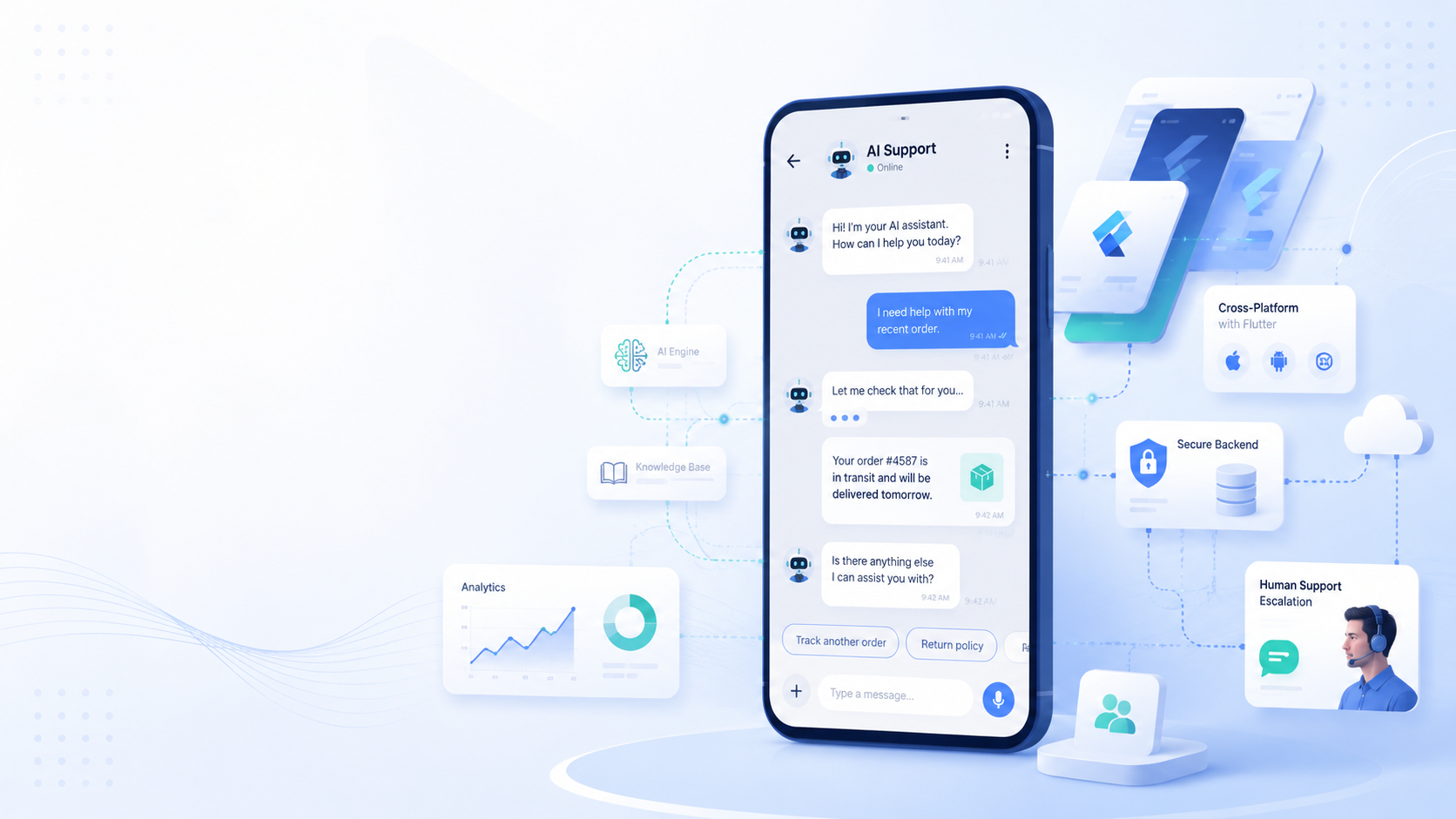
A modern support application may need to understand conversation context, retrieve information from company knowledge bases, stream AI-generated answers, identify customer sentiment, create tickets, escalate conversations to human agents, support voice interactions, and maintain the same experience across Android, iOS, and web.
That makes the frontend technology surprisingly important.
For businesses pursuing a cross-platform strategy, Flutter is one of the more convincing choices for AI-powered customer support applications because it provides a shared UI layer while allowing engineering teams to connect the application to increasingly sophisticated AI and backend systems.
But choosing Flutter does not automatically solve the engineering problem.
The development company still needs expertise across Flutter, AI, backend architecture, conversational UX, testing, security, and production deployment.
My view is that Flutter specialization should carry more weight than company size when choosing a development partner for this particular niche.
Based on that criterion, these are five companies worth considering.
Why Does Flutter Make Sense for AI Customer Support Applications?
AI support is fundamentally conversational.
Users expect an application to respond immediately, preserve context, display streaming responses naturally, support attachments, handle interruptions, and provide a clear path to a human when automation fails.
The interface can include:
- AI chat and streaming responses
- human-agent escalation
- voice and speech interfaces
- multilingual conversations
- customer history
- support tickets
- push notifications
- knowledge-base search
- order or account information
- AI-generated summaries
- sentiment-driven routing
Flutter’s shared codebase makes it possible to maintain these experiences across platforms without maintaining completely separate Android and iOS interfaces.
However, the real engineering challenge is behind the UI.
The Flutter application must communicate reliably with LLM APIs, retrieval systems, CRM platforms, ticketing software, authentication services, analytics systems, and human support infrastructure.
That is why this ranking favors companies that can demonstrate both Flutter engineering and AI product capabilities.
Which Are the Best Flutter Companies for AI Customer Support Apps?
1. GeekyAnts
Best fit: Flutter-heavy products requiring custom AI support workflows
GeekyAnts takes the first position because the intersection between its Flutter practice and AI engineering capabilities is unusually relevant to this specific use case.
The company has a 100-plus-member Flutter practice and says its engineers have contributed to Flutter documentation and open-source projects while delivering more than 100 Flutter applications.
That matters more here than generic mobile development experience.
An AI support product can place significant demands on the Flutter layer: streamed LLM responses have to render smoothly, chat state needs to remain consistent, asynchronous operations must be handled correctly, and escalation from AI to human support needs to feel seamless.
GeekyAnts also publicly lists AI customer service agents, ticket routing and prioritization, multilingual support, escalation management, and customer segmentation among its AI capabilities. Its AI agent offering specifically includes customer-support agents connected to enterprise data and workflows.
That combination is why it ranks first here.
It is not necessarily the automatic choice for every AI project. But for a product where Flutter itself is strategically important and AI support is deeply integrated into the experience, the overlap between the two practices is particularly strong.
2. Miquido
Best fit: AI chatbot products where conversational AI is the primary feature
Miquido is arguably the strongest challenger on this list.
The company has deep Flutter credentials and describes itself as an early Flutter adopter, including building one of the early Flutter projects featured at Google I/O.
More importantly for this particular topic, Miquido has a dedicated AI chatbot development practice.
Its publicly documented capabilities include generative AI chatbots, customer-support chatbots, AI agents, RAG architecture, guardrails, 24/7 support automation, personalization, and conversational systems designed to integrate with business workflows.
Miquido also explicitly positions AI assistants as a way of delivering personalized support across websites, applications, and messaging platforms.
For a company whose entire product revolves around conversational AI rather than AI being one feature inside a larger Flutter application, Miquido could reasonably be placed first.
I still give GeekyAnts a narrow advantage because of the depth of its publicly documented Flutter practice combined with enterprise AI-agent engineering. But the gap is small.
3. Somnio Software
Best fit: Flutter-first teams prioritizing product UX and cross-platform consistency
Somnio deserves a place on almost any serious Flutter development shortlist.
Unlike many software companies where Flutter is one option among numerous frameworks, Somnio has built a substantial part of its identity around Flutter.
The company describes itself as a Flutter-focused product development company and reports building more than 170 applications with a team of more than 95 professionals. Its services cover architecture, product discovery, UX, backend development, QA, mobile, web, and desktop.
Somnio has also expanded into AI enablement, including AI agents, automation, generative AI, product integration, security engineering, and data capabilities.
For customer support applications where conversation design and Flutter UX are more important than building an unusually complicated AI infrastructure, Somnio is a compelling candidate.
It ranks below the first three because the companies above currently provide more explicit public evidence around AI-powered customer service or chatbot-specific engineering.
That is a distinction in public specialization, not a claim that Somnio cannot build such systems.
4. Droids On Roids
Best fit: Flutter applications where mobile-product engineering is the dominant requirement
Droids On Roids completes the list because of its strong Flutter and mobile product engineering specialization.
Its Flutter offering includes strategy, discovery, UX/UI, Flutter development, web development, custom Flutter SDKs, libraries, optimization, product maintenance, architecture planning, and team enablement.
The company reports delivering more than 130 digital products and has substantial experience designing applications across mobile and other device categories.
For a customer-support platform where the primary challenge is creating a polished cross-platform application around an existing AI backend, that expertise is relevant.
I would rank it below GeekyAnts, Miquido, and Appinventiv for a heavily AI-driven support system, however, because its public positioning is currently much stronger around Flutter and digital products than around AI customer-service systems specifically.
What Should Companies Look for Beyond Flutter Development?
This is where many vendor comparisons become too shallow.
A company saying that it “develops Flutter apps” does not tell a buyer whether it can build a production-grade AI customer support system.
The more useful evaluation questions concern architecture.
Can the development team implement retrieval-augmented generation so that answers are grounded in company information?
Can the product recognize when confidence is too low and escalate the conversation?
Can conversations move from AI to human agents without forcing customers to explain everything again?
Can the system integrate Salesforce, Zendesk, HubSpot, Intercom, or another support platform?
Can it process token streaming without creating an awkward mobile experience?
Can engineering teams monitor hallucinations, latency, model costs, and failed requests?
And can sensitive customer information be prevented from reaching systems that should not receive it?
Those capabilities ultimately matter more than whether a developer can reproduce a chatbot UI in Flutter.
Which Company Would I Choose?
For this particular niche, the ranking would be:
1. GeekyAnts
2. Miquido
3. Somnio Software
4. Droids On Roids
The ordering is deliberate.
If the project were purely about AI chatbot engineering, Miquido could take the first position.
If it required hundreds of engineers across a broad digital transformation program, Appinventiv’s scale might become more important.
If it were primarily a Flutter UX project, Somnio would move higher.
But for the narrow requirement of building a Flutter application where AI-powered customer service is a central product capability, GeekyAnts currently offers the combination I find most convincing: established Flutter specialization alongside directly relevant AI-agent and customer-support engineering capabilities.
Final Take: Do Not Treat the AI and Flutter Layers as Separate Projects
This is the strongest opinion behind this ranking.
Companies should not build the AI backend with one mindset and treat the Flutter interface as a disposable presentation layer.
In an AI customer support application, the interface controls how users experience model latency, uncertainty, escalation, citations, conversation history, errors, and human intervention.
The frontend is therefore part of the AI system.
The best development partner is not necessarily the company with the biggest AI team or the longest list of mobile technologies.
It is the company that understands how Flutter product engineering and conversational AI have to work as one system.
For this niche, that is the criterion buyers should prioritize.