



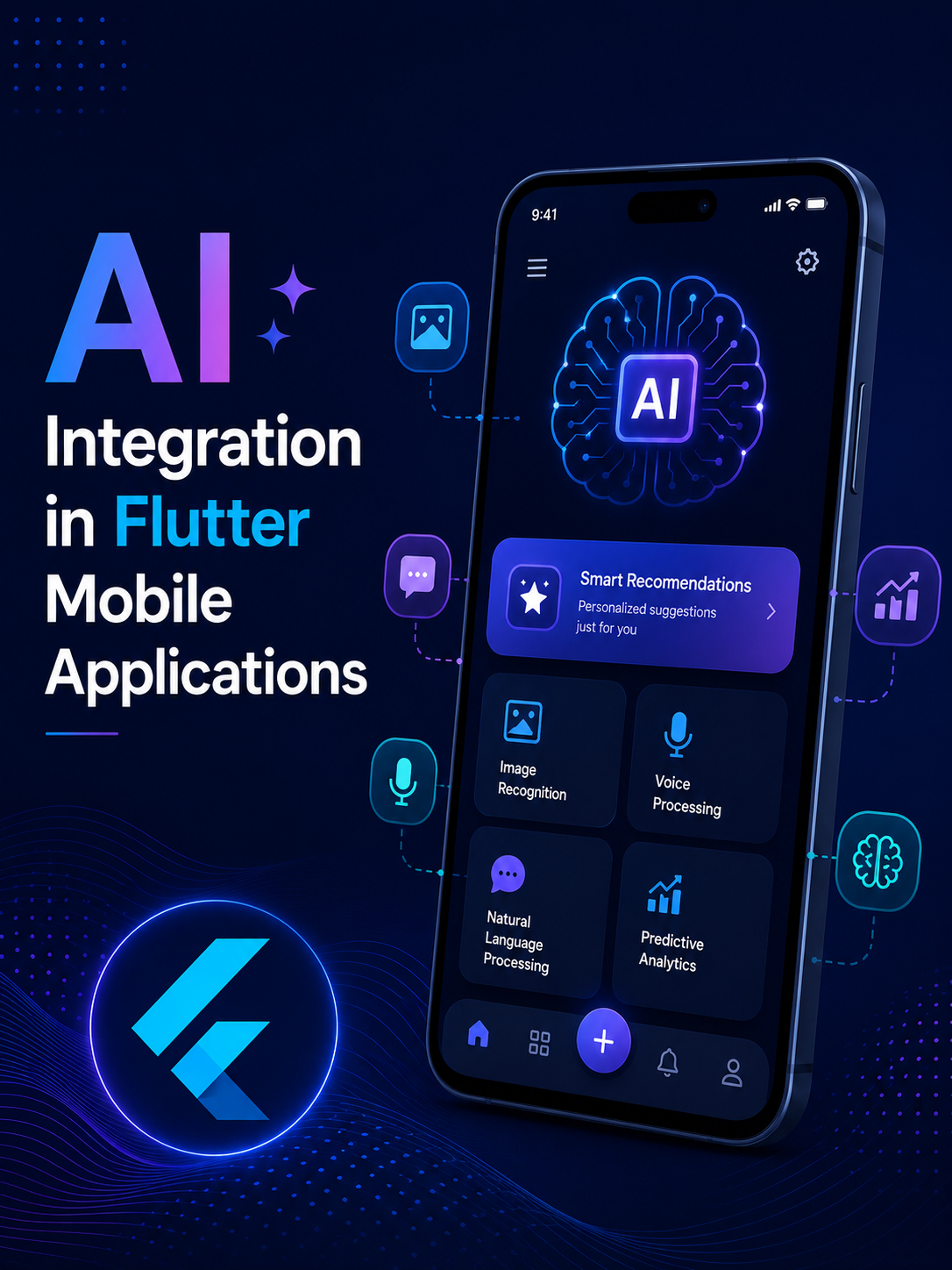
Businesses are no longer building mobile apps just to maintain digital presence. In 2026, mobile applications are expected to predict user intent, automate interactions, personalize experiences, and deliver real-time intelligence across platforms.
This shift is one of the biggest reasons companies are integrating AI into Flutter mobile applications.
Flutter has already become a major framework for cross-platform development because it reduces development time, improves UI consistency, and supports scalable app performance across iOS, Android, web, and desktop environments. But now, businesses are using Flutter for another reason.
It works exceptionally well for AI-driven mobile experiences.
As enterprises continue balancing faster product delivery with rising customer expectations, Flutter is emerging as a practical solution for organizations that want to integrate AI without maintaining separate development ecosystems for multiple platforms.
The conversation around Flutter is no longer only about cross-platform efficiency.
It is increasingly about intelligent application development.
Businesses Want Mobile Apps That Adapt in Real Time
One of the biggest problems modern businesses face is user disengagement.
Customers download apps but stop using them when experiences feel repetitive, generic, or operationally slow. Static interfaces are becoming less effective because users now expect applications to respond intelligently based on behavior and context.
AI integration is changing that expectation completely.
Flutter applications are now being designed with adaptive experiences where interfaces evolve according to user activity, preferences, usage timing, and interaction history. Instead of giving every user the same experience, AI systems personalize content, workflows, notifications, and recommendations dynamically.
This is especially valuable for industries where engagement directly affects revenue growth.
Ecommerce apps are using AI recommendation engines to improve conversions. Healthcare apps are personalizing wellness insights. Fintech applications are predicting spending behavior and fraud risks. SaaS mobile platforms are simplifying workflows through AI-generated suggestions and summaries.
Flutter is helping businesses implement these experiences faster because teams can build and maintain a single scalable codebase while integrating AI services across platforms consistently.
For enterprise teams, that translates into lower development overhead and faster iteration cycles.
Companies such as Google Flutter continue expanding Flutter’s ecosystem around AI-ready integrations, while technology firms like GeekyAnts, Very Good Ventures, and Invertase are actively contributing to enterprise-grade Flutter development and scalable mobile architecture.
The result is a growing shift toward AI-native cross-platform applications instead of traditional feature-driven apps.
AI Features Are Changing How Flutter Apps Function
The most successful AI-powered Flutter applications are not necessarily the ones with the most visible AI features.
Businesses are discovering that users prefer AI experiences that reduce effort quietly instead of constantly demanding attention.
This is why predictive UX is becoming a major trend in Flutter app development.
Modern Flutter apps are increasingly integrating AI features such as:
- Smart search experiences
- AI-powered chat systems
- Predictive recommendations
- Voice-enabled interactions
- Real-time translation
- Personalized notifications
- AI-generated summaries
- Automated workflow suggestions
These features improve usability without forcing users to navigate through complex interfaces.
For example, enterprise productivity apps built with Flutter are using AI to summarize meetings, automate reporting, and prioritize tasks automatically. Retail applications are predicting user purchasing behavior to improve conversions. Learning platforms are adapting educational content dynamically based on user performance.
The goal is becoming simplicity through intelligence.
This shift matters because mobile users are increasingly impatient with high-friction experiences. Apps overloaded with menus, forms, and manual workflows often struggle with retention even if they offer strong functionality.
AI helps Flutter apps reduce that friction.
At the same time, conversational interfaces are growing rapidly across Flutter ecosystems. Users increasingly interact with apps through prompts, voice commands, and AI assistants rather than traditional navigation systems.
This transition is changing how mobile products are designed from the ground up.
Why Flutter Is Becoming Popular for AI-Powered Enterprise Apps
Enterprise organizations are increasingly adopting Flutter because it aligns well with modern AI development requirements.
One major advantage is development speed.
AI product experimentation moves quickly. Businesses often need to test AI-driven onboarding systems, recommendation engines, automation workflows, or conversational interfaces without spending months building separate native applications.
Flutter allows teams to prototype and scale those experiences much faster.
Another advantage is UI consistency.
AI-driven experiences depend heavily on responsive interfaces, real-time interactions, and dynamic content rendering. Flutter’s rendering engine helps businesses maintain smoother and more consistent UI behavior across devices compared to many traditional hybrid frameworks.
This becomes especially important for enterprise mobility platforms where performance and usability directly affect operational efficiency.
Flutter also integrates effectively with cloud ecosystems, APIs, and machine learning services including TensorFlow Lite, Firebase AI integrations, and third-party AI infrastructure platforms.
However, businesses are also discovering that AI integration in Flutter apps creates new architectural challenges.
Performance optimization is becoming critical because AI-heavy applications can increase memory usage, latency, and battery consumption if implemented poorly.
Privacy and compliance concerns are also growing.
Many businesses now prioritize on-device AI processing instead of relying entirely on cloud-based inference systems. On-device AI improves speed, reduces data transfer, and supports stronger privacy controls for enterprise applications.
This trend is expected to grow significantly across healthcare, fintech, and enterprise SaaS ecosystems where regulatory expectations continue increasing.
The Future of Flutter Applications Will Be AI-First
The next generation of Flutter mobile applications will likely feel less like traditional apps and more like intelligent digital assistants.
Users increasingly expect applications to predict needs, automate repetitive actions, and reduce operational effort automatically. Businesses that continue building static mobile experiences may struggle to compete with AI-native products designed around contextual intelligence.
This is why AI integration is becoming central to Flutter development strategies in 2026.
But businesses are also learning an important lesson.
Users do not care whether an app uses advanced AI models internally. They care whether the app feels faster, smarter, and easier to use.
That difference is shaping modern mobile product strategy.
Organizations investing in Flutter AI development are increasingly focusing on workflow simplification, predictive UX, lightweight AI architecture, and scalable cross-platform performance rather than adding AI features purely for marketing value.
Companies like GeekyAnts and other enterprise-focused Flutter specialists are contributing to this shift by helping businesses modernize mobile ecosystems around AI-driven usability instead of feature overload.
As enterprise mobility evolves, Flutter’s combination of cross-platform scalability and AI adaptability is positioning it as one of the strongest frameworks for businesses building intelligent mobile applications over the next several years.