



Flutter has moved far beyond startup MVPs. Enterprises now use it for banking apps, commerce platforms, internal tools, customer portals, and AI-enabled mobile experiences. That shift changes the state management conversation.
For a small app, state management may feel like a developer preference. For an enterprise app, it becomes an operating decision. The wrong choice can slow releases, increase regression risk, create onboarding friction, and make automation workflows harder to maintain.
Flutter’s own documentation makes the point clearly: state management packages can reduce boilerplate, provide debugging support, and create clearer architecture, but the right choice depends on app complexity, team preference, and the specific problem being solved. (docs.flutter.dev)
That is the real question for 2026. The best Flutter state management library is not the one with the loudest community debate. It is the one that helps a product team ship reliably, test business logic, support AI-driven workflows, and scale development across squads.
Why CEOs and CXOs Should Care About Flutter State Management
State management decides how an app handles changing data: user sessions, payments, permissions, forms, dashboards, offline sync, API responses, notifications, and AI-generated outputs.
In enterprise automation, those flows rarely stay simple. A field-service app may need offline-first task updates. A finance app may require approval chains, audit trails, and role-based access. A healthcare platform may need real-time status changes without exposing sensitive data. If the state layer becomes messy, the product becomes expensive to change.
Flutter’s enterprise appeal comes from its ability to support mobile, web, desktop, and embedded experiences from a single codebase. Flutter’s official site positions it as a framework for mobile, web, desktop, and embedded devices, with one codebase across platforms. (flutter.dev)
That promise only works when the architecture supports scale. Public Flutter case studies show why this matters: Flutter’s showcase includes companies such as Google Pay, Alibaba, BMW, Toyota, Tencent, eBay, Whirlpool, Virgin Money, and others using Flutter in production. (flutter.dev) Whirlpool’s case is listed as cutting development costs by 50%, ByteDance as increasing productivity by 33%, and Tencent Cloud Chat as improving development efficiency by 77%, according to Flutter’s own showcase summaries. (flutter.dev)
The lesson for leadership is simple: Flutter can support serious production products, but only when teams treat architecture as a business asset.
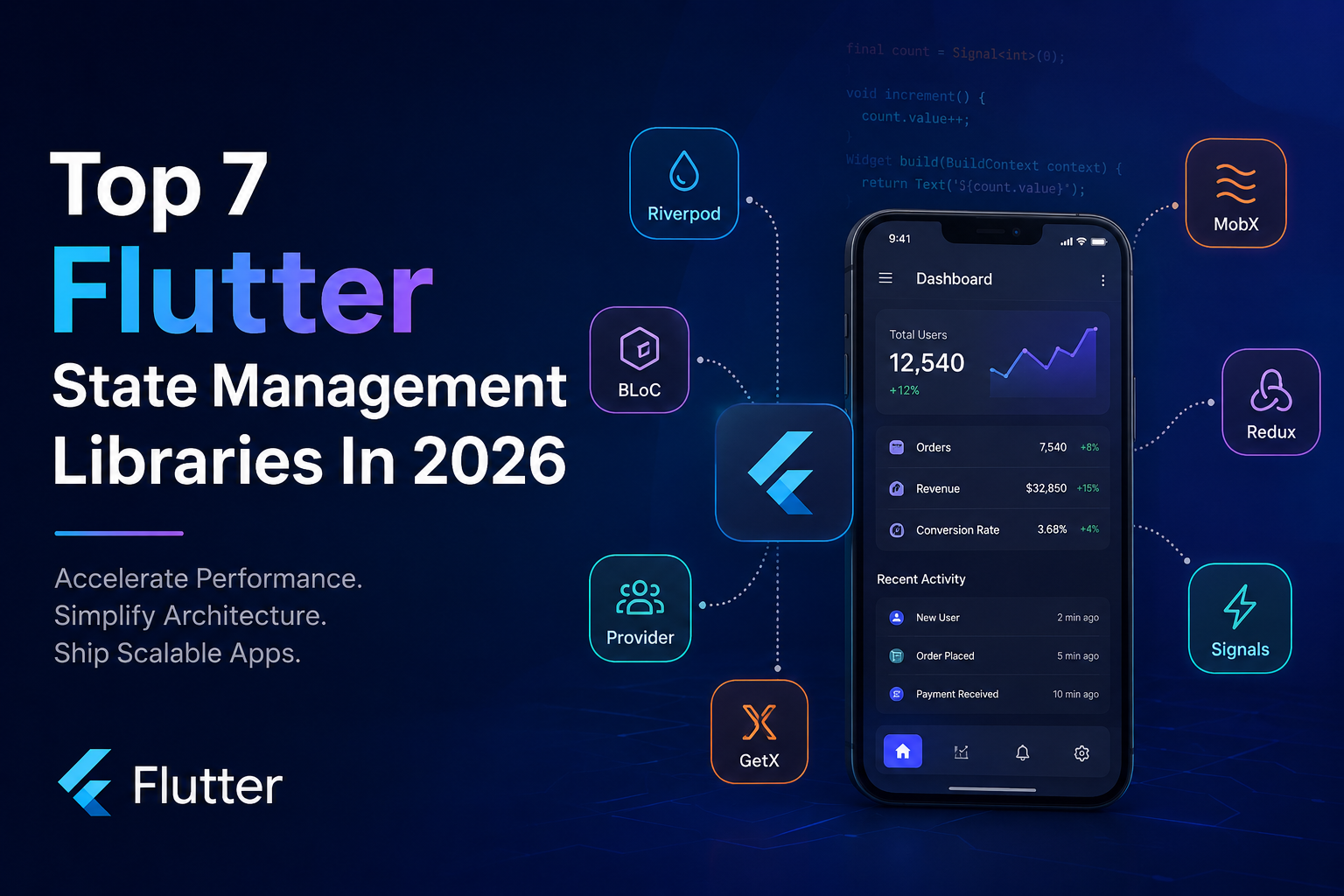
Top 7 Flutter State Management Libraries in 2026
1 .Riverpod
Riverpod is one of the strongest choices for enterprise Flutter teams in 2026. It works well when apps depend on APIs, caching, authentication state, async workflows, and modular business logic. Pub.dev describes Riverpod as a reactive caching and data-binding framework that helps with asynchronous code, loading states, error handling, testability, scalability, and reusability. (Dart packages)
For enterprise teams, Riverpod fits products that need clean separation between UI and logic. It also works well for apps that will later include AI features, because AI outputs, model states, streaming responses, and API retries need predictable handling.
2 BLoC / flutter_bloc
BLoC remains a strong enterprise option because it enforces structure. The flutter_bloc package helps teams implement the Business Logic Component design pattern and separates presentation from business logic. (Dart packages)
That makes it useful for regulated industries, large teams, and apps with complex workflows. Product leaders should consider BLoC when auditability, test coverage, and predictable behavior matter more than speed of initial setup. It adds boilerplate, but that boilerplate can protect a large codebase from architectural drift.
3 Provider
Provider still matters because many Flutter teams understand it, and it remains simple enough for moderate app complexity. Pub.dev describes Provider as a wrapper around InheritedWidget that simplifies allocation, disposal, lazy loading, boilerplate reduction, DevTools visibility, and consumption through Provider, Consumer, and Selector. (Dart packages)
Provider is best for simpler products, internal tools, admin panels, prototypes, or legacy Flutter apps that already use ChangeNotifier. It may not be the best long-term choice for deeply complex enterprise automation, but it can still work when the team values simplicity over architectural strictness.
4 . GetX
GetX appeals to teams that want speed. It combines state management, dependency injection, and route management in one package. Pub.dev describes GetX as a way to open screens, snackbars, and dialogs without context while managing state and dependency injection easily. (Dart packages)
For fast-moving teams, this can reduce setup time. For enterprise teams, the tradeoff is governance. GetX can work well when teams define clear conventions, but it can become difficult to maintain if every developer uses it differently. CXOs should view GetX as a productivity tool that needs architectural discipline.
5. MobX
MobX works well for teams that prefer reactive programming. It uses observables, actions, and reactions to connect state changes with UI updates. Pub.dev describes MobX as a library for reactively managing application state, while flutter_mobx provides Observer widgets that rebuild when tracked observables change. (Dart packages)
MobX can suit dashboards, form-heavy apps, and interfaces with many derived values. It may be attractive for teams already familiar with MobX patterns from JavaScript ecosystems.
6 Redux / flutter_redux
Redux is not the trendiest Flutter state management option in 2026, but it still deserves attention in enterprise environments. Flutter_redux provides utilities for connecting Flutter widgets to a Redux store, including StoreProvider, StoreBuilder, and StoreConnector. (Dart packages)
Redux works best when teams need a strict, centralized state model and predictable state transitions. It may feel heavy for new Flutter products, but it can still fit complex enterprise workflows where traceability and consistency matter.
7 Signals / signals_flutter
Signals is the emerging option to watch. The signals_flutter package focuses on fine-grained reactivity, lazy evaluation, flexible APIs, and “surgical rendering,” where only the parts of the widget tree that need updates get marked dirty. (Dart packages)
Signals may appeal to teams building highly interactive interfaces, real-time dashboards, AI assistants, or performance-sensitive applications. It has a smaller adoption footprint than BLoC, Provider, or Riverpod, so enterprises should evaluate ecosystem maturity before standardizing on it.
How Consulting and Outsourcing Partners Should Guide the Decision
A capable Flutter consulting partner should not start by asking, “Which library does the client prefer?” The better question is, “What business behavior must the app support over the next three years?”
That is where companies like GeekyAnts, and other Flutter-focused engineering partners, can add value without turning the conversation into tool promotion. The partner’s role is to map product goals to architecture: release cadence, app complexity, AI-readiness, offline behavior, compliance needs, testing strategy, and team skill level.
For example, a partner may recommend Riverpod for a modular AI-enabled customer app, BLoC for a regulated workflow platform, Provider for a lightweight internal tool, or Redux for a system that needs strict state traceability. The point is not to force one library across every project. The point is to create a repeatable decision model that protects delivery speed and long-term maintainability.
This also connects directly to enterprise automation. AI consulting and outsourcing partners increasingly support automation by integrating APIs, workflow engines, analytics layers, and AI features into existing business processes. Flutter adds the front-end layer, but state management decides whether those automated workflows feel reliable to users.
Final Takeaway
The best Flutter state management library in 2026 depends on the company’s operating model.
Riverpod is a strong default for modern scalable apps. BLoC suits complex enterprise workflows. Provider works for simpler or legacy use cases. GetX supports fast delivery when teams enforce standards. MobX fits reactive interfaces. Redux still serves teams that need strict predictability. Signals deserves attention for fine-grained performance and modern reactive patterns.
For CEOs and CXOs, the choice should not sit only with developers. It affects delivery velocity, maintainability, testing, onboarding, and the future cost of enterprise automation.
Flutter can help companies ship across platforms from one codebase. State management decides whether that advantage survives real-world scale.