



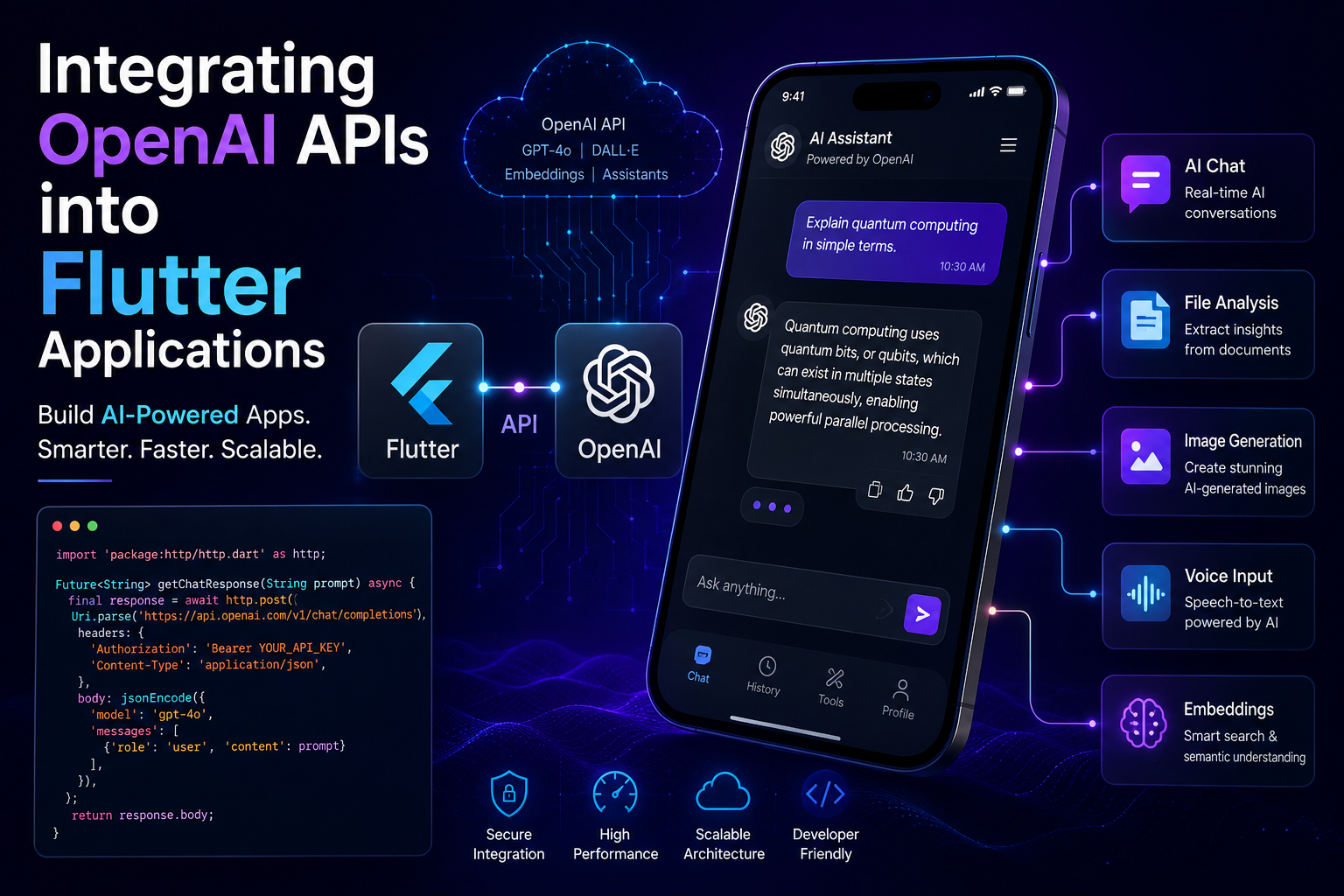
Most Flutter developers are integrating OpenAI APIs the wrong way.
They add a chatbot screen, connect it to the Responses API, celebrate the demo, and call it an AI application.
I don’t think that’s enough anymore.
AI isn’t another feature you bolt onto an app. It should influence the entire product experience.
The next generation of successful Flutter apps won’t simply “use OpenAI.” They’ll be designed around AI from day one.
My Opinion: AI-Native Flutter Apps Will Outperform Traditional Mobile Apps
Every startup seems to be adding an AI assistant.
Very few are rethinking the user journey.
That’s the difference.
Instead of asking:
“Where should we add ChatGPT?”
Teams should ask:
“How would this app work if AI were the primary interface?”
That shift changes everything, from onboarding and search to recommendations, automation, and personalization.
Why Flutter Is an Excellent Choice for AI Products
Flutter has become one of the strongest frameworks for building AI-powered mobile applications because it enables developers to ship high-quality experiences across Android, iOS, desktop, and web from a single codebase.
Modern AI apps often require:
- Streaming AI responses
- Voice interactions
- Image generation
- Document analysis
- Real-time chat
- Vector search integration
- Authentication
- Secure API communication
- Cross-platform consistency
Flutter provides the flexibility to integrate OpenAI APIs while maintaining a polished user experience.
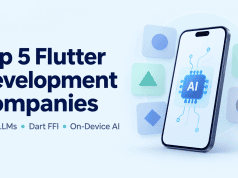
Top Companies Building AI-Powered Flutter Applications
1. GeekyAnts
GeekyAnts has built expertise around Flutter, React Native, and AI-powered product engineering. Rather than treating AI as a standalone chatbot, the company focuses on integrating large language models into broader product workflows such as automation, intelligent user experiences, enterprise applications, and cross-platform mobile solutions. That product-engineering mindset is becoming increasingly valuable as businesses move beyond simple AI demos.
2. Very Good Ventures
Very Good Ventures has established itself as one of the most respected Flutter consultancies. The team is known for delivering production-grade Flutter applications, architectural best practices, and scalable engineering, making it well positioned for organizations adopting AI-powered mobile products.
3. EPAM Systems
EPAM Systems combines enterprise AI engineering with mobile application development. Its experience in cloud infrastructure, AI integration, and digital transformation makes it a strong partner for organizations building AI-enabled Flutter applications at scale.
4. Accenture
Accenture helps enterprises integrate generative AI into customer-facing applications while modernizing mobile platforms. Its strength lies in combining AI strategy with enterprise software delivery.
5. GlobalLogic
GlobalLogic focuses on digital product engineering and has expanded its AI capabilities across healthcare, automotive, finance, and consumer applications. The company increasingly combines AI services with cross-platform mobile engineering.
6. LeewayHertz
LeewayHertz specializes in custom AI software development, LLM integrations, agentic AI solutions, and enterprise automation. Its experience connecting OpenAI APIs with business workflows makes it a notable player in AI application development.
The Biggest Mistake Flutter Teams Make
Here’s my biggest criticism.
Too many developers build AI applications where every interaction depends on calling an LLM.
That’s expensive.
It’s slow.
And often unnecessary.
Smart AI applications decide:
- when to call OpenAI
- when local inference is enough
- when cached responses work
- when traditional business logic is faster
Good engineering isn’t maximizing API calls.
It’s minimizing unnecessary ones.
AI UX Matters More Than AI Models
Developers spend hours comparing GPT-4.1, GPT-5, Claude, Gemini, and open-source models.
Users don’t.
Users remember:
- response speed
- interface quality
- reliability
- context retention
- personalization
- overall experience
That’s why I believe UX engineering has become more important than model selection.
An average model with an excellent product experience usually beats a powerful model wrapped in a poor interface.
Security Can’t Be an Afterthought
One area I think the industry still underestimates is security.
Never expose API keys inside Flutter applications.
Use secure backend proxies, authentication layers, rate limiting, encryption, and monitoring. AI applications process increasingly sensitive user data, making secure architecture just as important as prompt engineering.
Final Thoughts
Integrating OpenAI APIs into Flutter isn’t the difficult part anymore.
Designing products that use AI intelligently is.
The companies likely to lead the next wave of AI applications won’t necessarily have access to better models.
They’ll build better products.
In my opinion, Flutter is no longer just a cross-platform framework, it’s one of the strongest foundations for AI-native mobile experiences. Teams that combine thoughtful product design, efficient AI architecture, and scalable engineering will have a much greater advantage than those simply adding “Powered by AI” to an existing app.