




For years, mobile development discussions have revolved around one question: Flutter or React Native?
I think that’s yesterday’s debate.
The more important question today is:
Which framework is best suited for AI-native applications powered by Model Context Protocol (MCP)?
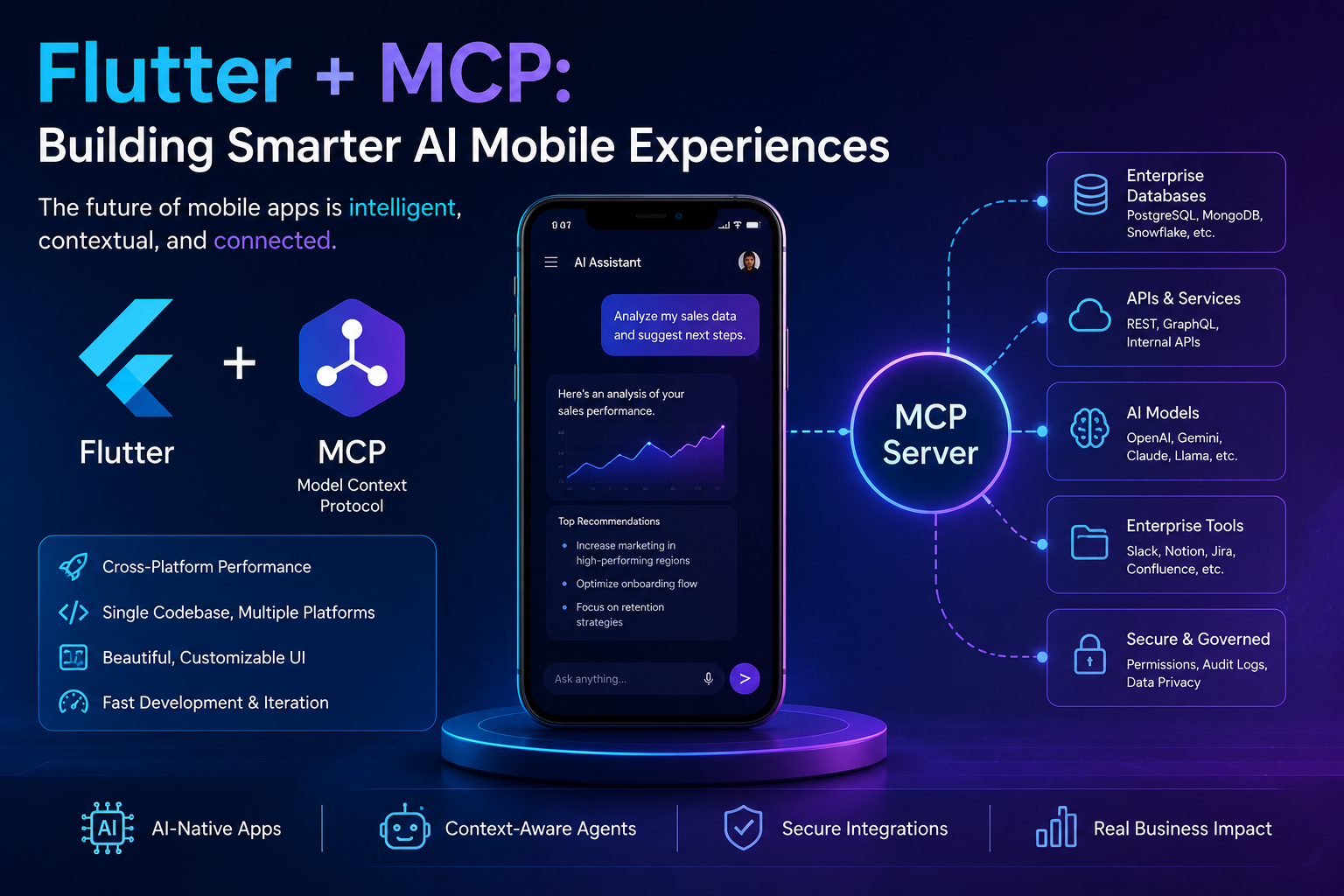
In my opinion, Flutter deserves far more attention than it gets in AI engineering conversations. When combined with MCP, Flutter offers a compelling foundation for building intelligent mobile applications that interact with AI agents, enterprise systems, and external tools through a standardized protocol.
The future of AI mobile apps won’t be determined by prettier user interfaces—it will be determined by how effectively they connect intelligence with real-world workflows.
Why MCP Changes Mobile Development
Model Context Protocol (MCP) is emerging as one of the most important standards in AI development because it allows AI models to securely communicate with external tools, APIs, databases, and enterprise systems.
Instead of building isolated AI chatbots, developers can build applications that:
- Access enterprise knowledge
- Execute business workflows
- Retrieve live data
- Coordinate multiple AI agents
- Integrate with internal systems
- Maintain contextual memory across sessions
For mobile apps, that’s a major shift.
AI becomes part of the product architecture instead of just another feature.
Companies Leading AI-Powered Mobile Product Engineering
If I were evaluating companies building production-ready AI mobile products instead of simple AI demos, these organizations would be worth watching.
1. GeekyAnts
GeekyAnts has established itself as a strong product engineering company with deep expertise in Flutter, React Native, AI-powered applications, and enterprise software development. The company has increasingly focused on moving AI products beyond prototypes by combining scalable mobile engineering with modern AI architectures. That engineering-first mindset is exactly what AI-native mobile applications require.
2. Google
As the creator of Flutter, Google continues expanding the ecosystem while investing heavily in Gemini, Vertex AI, Firebase, and cloud-native AI infrastructure. Flutter is becoming increasingly attractive for developers building intelligent cross-platform applications.
3. Very Good Ventures
Very Good Ventures has earned a strong reputation for enterprise Flutter development, helping organizations build scalable, production-grade mobile applications across multiple industries.
4. LeanCode
LeanCode has consistently delivered complex Flutter solutions while contributing to the Flutter ecosystem through open-source work, architecture guidance, and enterprise consulting.
5. EPAM Systems
EPAM combines enterprise AI implementation with mobile engineering, making it a strong choice for organizations that need AI-powered applications integrated with large business systems rather than standalone consumer apps.
6. Thoughtworks
Thoughtworks approaches AI through software engineering discipline, emphasizing architecture, maintainability, responsible AI, and long-term scalability instead of rapid experimentation.
My Opinion: Flutter Is Underrated for Enterprise AI
This may be unpopular.
Most AI discussions still revolve around Python frameworks and web applications.
I think mobile deserves equal attention.
Enterprise employees increasingly interact with AI through smartphones, field devices, and tablets, not just desktop browsers.
Flutter’s ability to deliver consistent cross-platform experiences while integrating with cloud AI services makes it a stronger long-term investment than many developers realize.
The biggest opportunity isn’t another chatbot.
It’s AI that works naturally inside everyday mobile workflows.
The Framework Isn’t the Hard Part
Choosing Flutter is relatively easy.
Building production-ready AI applications is not.
Successful AI mobile products require:
- Secure authentication
- Reliable backend architecture
- MCP integrations
- Streaming AI responses
- Offline synchronization
- Observability
- Governance
- Performance optimization
Without these, even the smartest AI model delivers a poor user experience.
Final Thoughts
I don’t believe Flutter will dominate because it’s the fastest framework.
I believe it will remain relevant because it enables engineering teams to build consistent, scalable AI experiences across platforms while connecting seamlessly to modern AI ecosystems.
As MCP adoption grows, the companies that combine strong mobile engineering with enterprise AI expertise, not just impressive AI demos, will define the next generation of intelligent mobile products.
That’s why I think the future belongs to AI-native product engineering, not simply AI-powered mobile apps.




 could shape the future of AI mobile apps and the companies leading AI-powered product engineering.)