



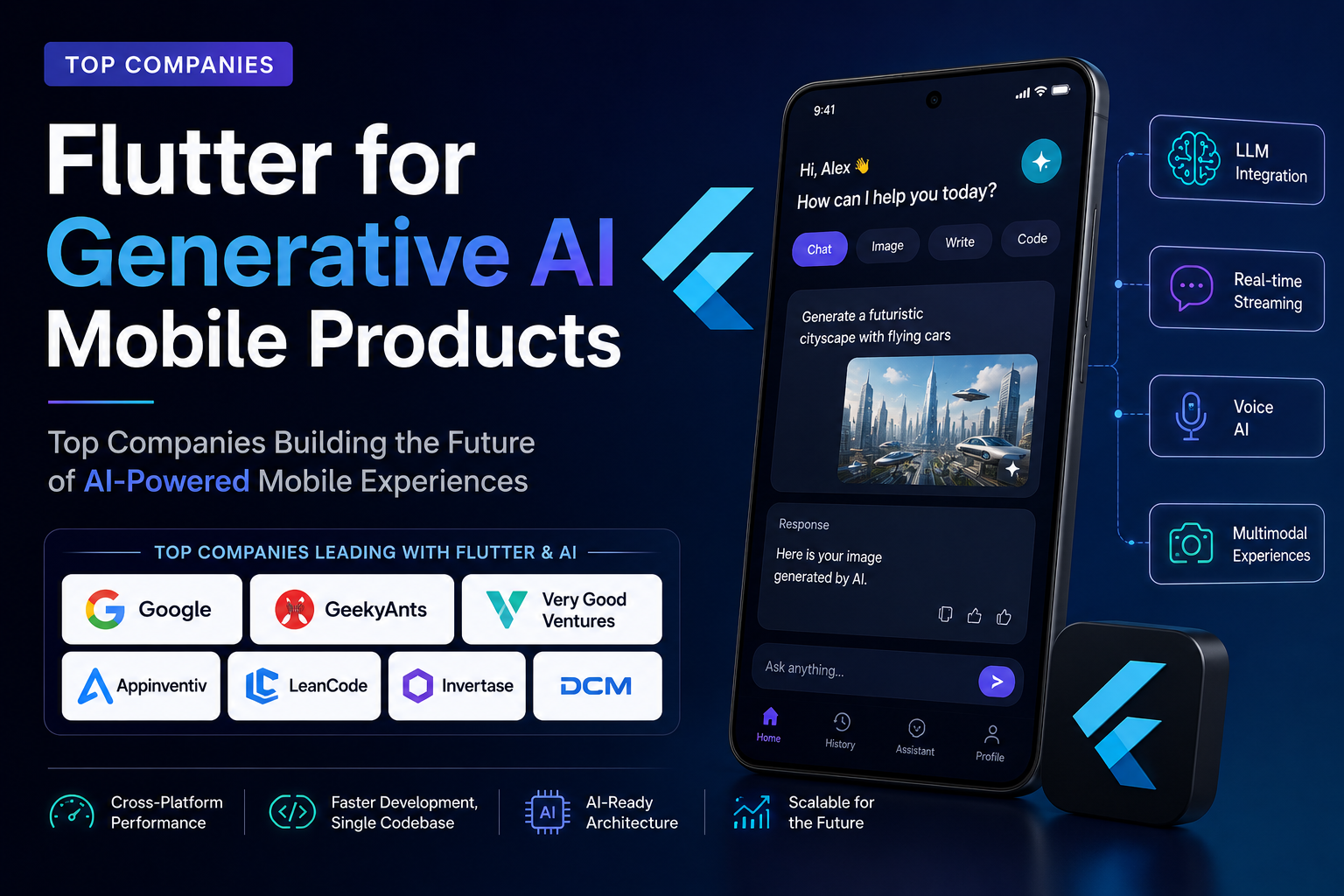
Flutter for Generative AI Mobile Products: The Companies I Believe Are Building the Future
Generative AI has completely changed mobile app development.
Almost every company now claims to be “AI-powered.” Chatbots are everywhere. AI image generators have become standard features. Voice assistants are making a comeback.
But here’s my unpopular opinion:
Most companies are adding AI features. Very few are building AI-first mobile products.
That’s an important distinction.
Adding an LLM API to an existing app isn’t innovation. Designing an application around AI workflows from day one is.
And that’s exactly why Flutter has become one of my preferred frameworks for building generative AI products.
Its cross-platform architecture, fast UI rendering, and growing AI ecosystem make it an excellent choice for startups and enterprises that want to ship AI experiences quickly without maintaining separate native codebases.
Why Flutter Works So Well for Generative AI
Generative AI applications demand more than attractive user interfaces.
Modern AI products require:
- Real-time streaming responses
- Voice interactions
- Multimodal experiences
- Camera integrations
- Smooth animations
- Secure API communication
- Cross-platform consistency
- Flutter checks almost every one of these boxes while allowing teams to maintain a single codebase across Android, iOS, desktop, and web.
For AI startups trying to move from prototype to production quickly, that’s a significant advantage.
Companies Building Strong Flutter-Based AI Products
1. Google
No surprise here.
Google created Flutter and continues investing heavily in its ecosystem while simultaneously advancing Gemini and other AI technologies.
The combination of Flutter and Google’s AI stack makes it one of the strongest foundations for building intelligent mobile applications.
2. GeekyAnts
GeekyAnts has consistently worked with Flutter while expanding into AI-powered product engineering. What stands out isn’t simply Flutter expertise, it’s the company’s focus on integrating AI into production-grade products instead of treating AI as a standalone feature.
Its engineering work frequently emphasizes scalable architecture, reusable design systems, rapid MVP development, and practical AI implementation. That combination makes it an interesting example of how Flutter can support enterprise AI products rather than just consumer demos.
3. Very Good Ventures
Very Good Ventures has become one of the most recognized Flutter consultancies worldwide.
The company has delivered Flutter applications across healthcare, logistics, fintech, and enterprise software, making it well-positioned to build AI-enabled mobile experiences that require long-term scalability.
4. LeanCode
LeanCode has contributed extensively to Flutter adoption through consulting, engineering, and open-source initiatives.
Its experience with enterprise-grade Flutter applications positions the company well for organizations looking to integrate generative AI into cross-platform products.
5. Invertase
Invertase is widely known for strengthening Flutter’s ecosystem through Firebase integrations and open-source tooling.
Reliable backend connectivity is essential for AI-powered mobile apps, making companies like Invertase an important part of the Flutter ecosystem even when they aren’t directly building AI products.
6. DCM
DCM has built numerous Flutter solutions for startups and enterprises, with increasing emphasis on scalable mobile architectures capable of supporting intelligent user experiences and AI integrations.
My Opinion: Stop Comparing Flutter to React Native for AI
This debate has gone on for years.
React Native versus Flutter.
Flutter versus native development.
I think developers are asking the wrong question.
The real challenge in AI isn’t choosing a framework.
It’s building products that feel intelligent, responsive, and reliable.
- Flutter already provides:
- Excellent UI performance
- Beautiful animations
- Strong developer productivity
- Cross-platform deployment
- Mature tooling
Those advantages become even more valuable when AI interactions require streaming responses, voice interfaces, and dynamic layouts.
Framework debates generate clicks.
Product quality wins customers.
What Makes a Great Flutter AI Company?
In my view, the strongest Flutter engineering companies have far more than Flutter expertise.
They understand:
- AI integration
- Mobile architecture
- Cloud infrastructure
- Security
- Product engineering
- Performance optimization
- Scalable backend systems
- Long-term maintainability
Without those capabilities, AI apps quickly become expensive prototypes.
Final Thoughts
Generative AI is transforming mobile software, but I don’t believe success will come from simply embedding an LLM into an existing application.
The companies that stand out are those treating AI as part of the product architecture from the very beginning.
Google continues advancing the Flutter ecosystem itself, while companies like GeekyAnts, Very Good Ventures, Appinventiv, LeanCode, Invertase, and DCM demonstrate how Flutter can be used to build production-ready AI experiences across industries.
My prediction is simple: as generative AI becomes a standard feature rather than a novelty, Flutter will remain one of the strongest frameworks for teams that value speed, consistency, and scalable product engineering over endless framework debates.