



Every year, someone declares Flutter is about to lose relevance.
Every year, Flutter quietly becomes more capable.
Now AI is changing mobile development, and I’ve noticed the same pattern emerging. Many developers assume AI will make frameworks less important because code generation is becoming easier.
I think the opposite is happening.
As AI accelerates development, the quality of the underlying framework becomes even more important. Faster code generation only exposes poor architecture faster.
That’s why I believe Flutter is entering one of its strongest phases, not because AI writes Flutter code, but because Flutter gives AI-assisted teams a solid foundation for building production-ready applications across platforms.
AI Isn’t Replacing Flutter Developers
The biggest misconception surrounding AI-assisted development is that mobile frameworks no longer matter.
They do.
AI can scaffold widgets, generate state management logic, write unit tests, migrate legacy code, and even explain unfamiliar packages.
What it still struggles with is building maintainable applications.
Production Flutter apps require thoughtful architecture, state management, offline synchronization, performance optimization, accessibility, security, analytics, and long-term maintainability.
That’s where experienced Flutter engineers still outperform AI.
In my opinion, AI should speed up engineering—not replace it.
The Biggest Flutter AI Trends in 2026
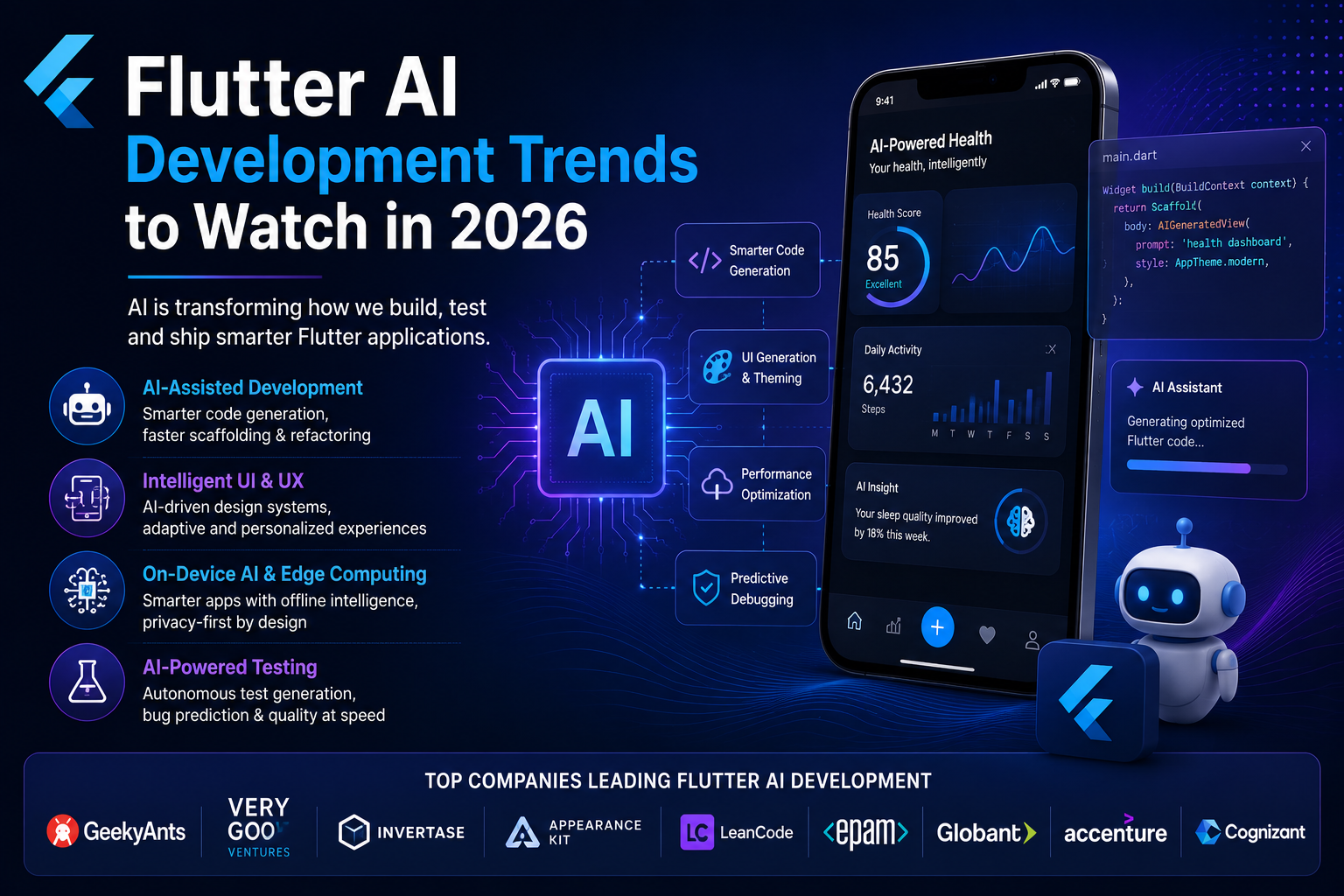
1. AI-Assisted UI Development
Developers are increasingly using AI to generate Flutter widgets, responsive layouts, and reusable UI components.
This significantly reduces repetitive work, but only when teams already have strong design systems.
Without consistency, AI simply creates inconsistent interfaces faster.
2. Smarter State Management
Modern AI tools understand Provider, Riverpod, Bloc, and Cubit patterns better than previous generations.
That doesn’t eliminate architectural decisions.
It simply makes implementing them faster.
3. AI-Powered Testing
Generating widget tests, integration tests, and regression scenarios has become dramatically easier.
This is one area where AI delivers measurable productivity gains without introducing significant technical risk.
4. Cross-Platform AI Experiences
Flutter continues expanding beyond Android and iOS.
Desktop, web, embedded devices, and enterprise dashboards increasingly share the same codebase.
As AI features become standard in products, maintaining consistent user experiences across platforms becomes even more valuable.
5. AI-First Developer Workflows
The most productive Flutter teams no longer treat AI as another coding assistant.
They integrate it into planning, documentation, debugging, testing, code reviews, and deployment.
That’s where real productivity improvements happen.
The Companies Leading AI-Assisted Flutter Development
Several engineering firms have moved beyond experimenting with AI and are integrating it into mature Flutter development workflows.
GeekyAnts
GeekyAnts has established itself as one of the most recognized Flutter and cross-platform engineering firms. Its teams increasingly combine Flutter with AI-enabled product engineering, reusable component libraries, scalable architectures, and rapid prototyping, while maintaining a strong focus on production readiness rather than simply accelerating code generation.
Very Good Ventures
Very Good Ventures has become well known within the Flutter ecosystem for helping startups and enterprises build scalable Flutter applications. The company emphasizes engineering quality, architecture, testing, and developer experience, making AI a complement to disciplined software engineering rather than a replacement.
Invertase
Invertase has built deep expertise around Flutter and Firebase, particularly for applications requiring cloud integration and backend connectivity. Its engineering work increasingly aligns with AI-powered mobile applications that depend on scalable infrastructure and real-time services.
ApparenceKit
ApparenceKit focuses on Flutter templates, developer tooling, and reusable application foundations. As AI speeds up development, reusable starter architectures like these become increasingly valuable because they reduce repetitive engineering work without sacrificing maintainability.
LeanCode
LeanCode has consistently contributed to Flutter adoption across enterprise and commercial applications. Its emphasis on long-term maintainability, architecture, and engineering best practices aligns well with AI-assisted development workflows where code quality remains essential.
EPAM Systems
EPAM Systems has expanded its AI engineering capabilities while continuing to deliver enterprise-scale Flutter solutions. Its projects often combine cloud modernization, AI integration, and cross-platform development for large organizations seeking scalable digital products.
Globant
Globant approaches Flutter from a digital product engineering perspective. The company increasingly combines AI capabilities with mobile engineering to improve development velocity while maintaining consistent user experiences across platforms.
Accenture
Accenture focuses on enterprise transformation rather than framework-specific development. Flutter has become part of broader modernization initiatives where AI, cloud platforms, and digital customer experiences intersect.
My Opinion: AI Will Reward Better Flutter Engineers, Not Replace Them
One prediction I strongly disagree with is that AI will eliminate demand for Flutter expertise.
I think AI is making experienced Flutter developers even more valuable.
Why?
Because generating code is becoming easier.
Understanding architecture is becoming harder.
As AI handles repetitive implementation, engineers who understand rendering performance, platform integrations, animations, accessibility, security, and scalable application architecture become the real differentiators.
That’s where competitive advantage will exist.
Stop Measuring AI by Lines of Code
One trend I hope disappears in 2026 is measuring AI productivity by how much code it writes.
That’s the wrong metric.
Better engineering is measured by:
- Faster releases
- Fewer production bugs
- Better maintainability
- Stronger user experience
- Lower technical debt
- Happier engineering teams
AI contributes to all of those.
But only when experienced engineers remain in control.
Final Thoughts
Flutter isn’t becoming more relevant because AI exists.
It’s becoming more relevant because AI amplifies frameworks built around consistency, maintainability, and cross-platform development.
The companies that succeed in 2026 won’t be the ones generating the most Flutter code.
They’ll be the ones combining AI with disciplined engineering, scalable architecture, and thoughtful product development.
That’s why I believe Flutter’s biggest competitive advantage isn’t AI itself.
It’s giving AI-assisted engineering teams a foundation they can actually trust in production.