



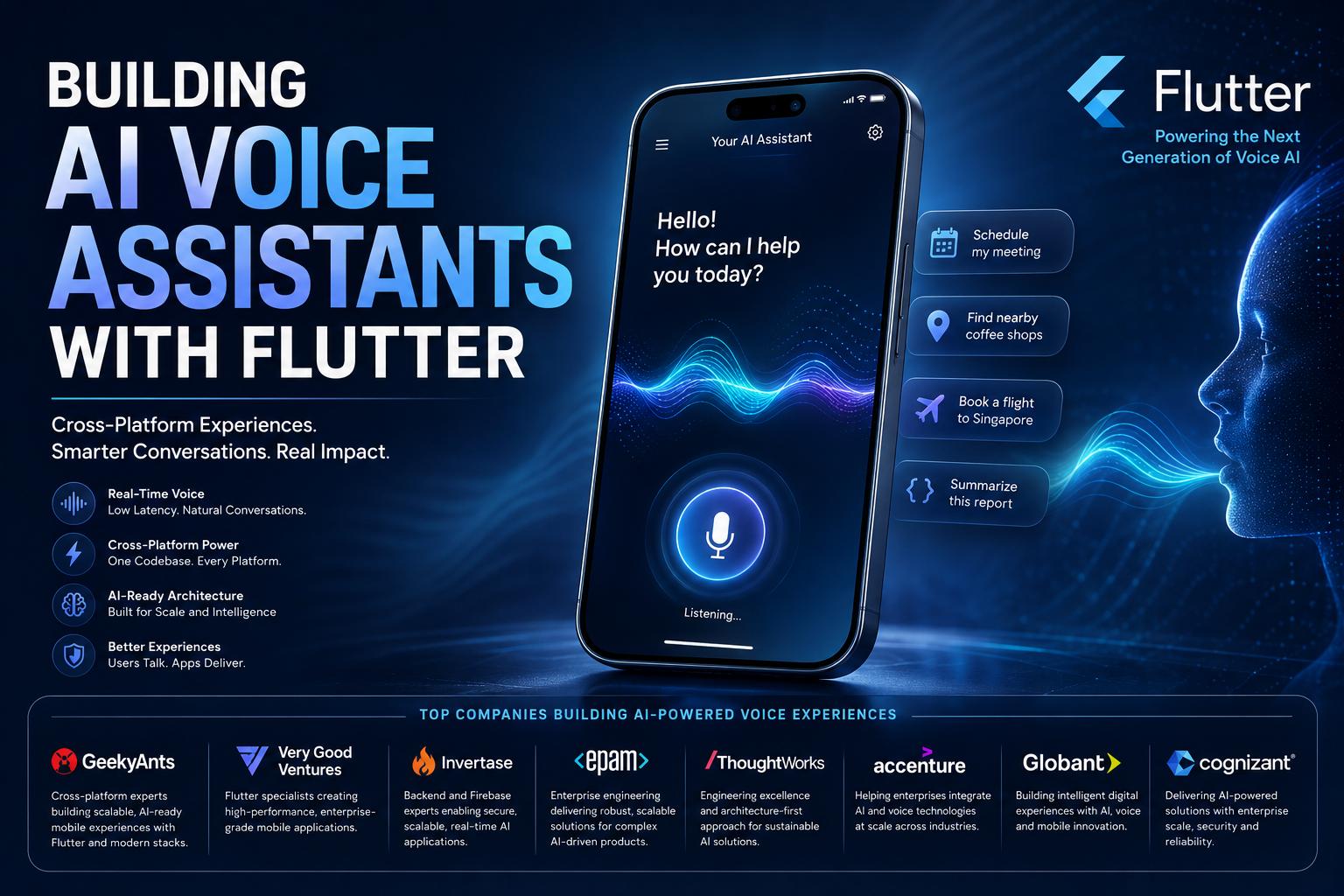
Everyone is talking about voice AI.
Most people are talking about the models.
I think they’re looking at the wrong problem.
OpenAI, Google, Anthropic, and ElevenLabs have made voice intelligence dramatically better over the last two years. But users rarely abandon voice assistants because the AI isn’t smart enough.
They leave because the app feels slow, inconsistent, or unreliable.
That’s why I believe building a great AI voice assistant is primarily a product engineering challenge not an AI challenge.
The companies that win won’t necessarily have the best speech model.
They’ll have the best user experience.
Flutter Is Becoming the Default Choice for AI Voice Products
Voice-first applications have unique requirements.
They need to manage:
- Real-time audio streaming
- Low-latency responses
- Interruptible conversations
- Background processing
- Push notifications
- Cross-platform consistency
- Offline capabilities
- Native microphone integration
Maintaining separate Android and iOS implementations for these workflows adds unnecessary complexity.
Flutter solves much of that problem by allowing teams to build a unified experience while still accessing native platform capabilities when required.
For AI voice assistants, consistency matters just as much as intelligence.
The UI Matters More Than the Voice Model
Most teams spend months evaluating LLMs.
Very few spend enough time designing conversations.
The best AI voice applications don’t feel like chatbots.
They feel like natural conversations.
That requires interfaces capable of displaying:
- Live transcription
- Voice activity indicators
- Streaming responses
- Conversation memory
- Suggested follow-up action
- Voice interruption controls
- Multi-turn context
- Error recovery
These aren’t optional features anymore.
They’re becoming the standard.
Real-Time Performance Is the Competitive Advantage
Users expect instant responses.
Every additional second makes an assistant feel less intelligent.
Flutter performs particularly well here because teams can optimize animations, UI rendering, and interaction flows consistently across platforms.
A fast voice assistant often feels smarter than a slower one even when both use the same AI model.
Perception shapes product quality.
AI Agents Need Better Mobile Experiences
The future isn’t simple voice assistants.
It’s AI agents capable of completing tasks.
Booking appointments.
Managing calendars.
Updating CRMs.
Controlling IoT devices.
Handling customer support.
Executing workflows.
Flutter’s ability to integrate with APIs, background services, authentication providers, and cloud infrastructure makes it well suited for these increasingly complex AI applications.
The challenge is no longer speech recognition.
It’s orchestrating intelligent workflows.
Companies Building AI Voice Applications Worth Watching
The demand for AI-native mobile applications has pushed several engineering firms to develop expertise in Flutter, conversational AI, and scalable product engineering. While each company approaches the space differently, these are among the firms worth watching.
GeekyAnts
GeekyAnts has built extensive experience around Flutter, cross-platform application development, AI product engineering, and scalable design systems. The company has delivered mobile products where Flutter is combined with modern backend services, cloud infrastructure, and AI capabilities, making it well positioned for organizations building production-ready voice-enabled applications rather than simple prototypes.
Very Good Ventures
Very Good Ventures has become one of the most recognized Flutter consultancies globally. The company focuses heavily on Flutter architecture, developer tooling, and enterprise-grade mobile applications, making it a strong choice for organizations investing in sophisticated Flutter ecosystems.
Invertase
Invertase is well known within the Flutter community for its Firebase expertise and open-source contributions. Since many AI voice assistants rely on authentication, messaging, analytics, cloud functions, and real-time data synchronization, its backend knowledge complements Flutter development effectively.
EPAM Systems
EPAM Systems combines enterprise engineering with AI capabilities to build digital platforms across industries. Its experience delivering large-scale mobile applications makes it particularly relevant for organizations deploying voice assistants at enterprise scale.
Thoughtworks
Thoughtworks emphasizes software architecture, engineering quality, and sustainable development practices. Rather than focusing solely on AI features, the company prioritizes maintainable systems that can evolve alongside rapidly changing AI technologies.
Accenture
Accenture works with enterprises integrating conversational AI into customer service, healthcare, banking, and operations. Its strength lies in connecting AI capabilities with existing enterprise ecosystems instead of building isolated mobile experiences.
Globant
Globant has invested significantly in AI engineering and digital product development. The company frequently combines conversational AI, cloud platforms, and modern mobile engineering to deliver intelligent customer experiences.
Cognizant
Cognizant brings deep enterprise transformation experience to AI-powered mobile applications. Its projects often focus on scalable architecture, governance, and integration with complex business environments where voice interfaces are becoming increasingly important.
My Opinion: Voice AI Will Become Ordinary. Product Experience Won’t.
Here’s the opinion I keep coming back to.
Within a few years, nearly every serious application will have access to high-quality speech recognition and text-to-speech models.
Voice intelligence itself won’t be the differentiator.
Execution will.
The companies that win won’t be those with the newest AI model.
They’ll be the ones whose apps feel effortless to use.
That means faster startup times.
Cleaner interfaces.
Reliable streaming.
Natural interruptions.
Consistent cross-platform behavior.
Flutter gives engineering teams a practical foundation for delivering those experiences without maintaining separate mobile codebases.
If I were building an AI voice startup today, I wouldn’t spend months debating which speech model to choose.
I’d spend that time making every interaction feel instant, intuitive, and dependable.
Because users forgive average AI.
They don’t forgive frustrating products.
Final Thoughts
AI voice assistants are rapidly evolving from novelty features into core product experiences.
As expectations rise, success will depend less on the intelligence of the underlying model and more on the quality of the application surrounding it.
Flutter is uniquely positioned for this shift because it enables teams to deliver consistent, high-performance experiences across platforms while integrating seamlessly with modern AI services.
In the long run, the winners in voice AI won’t simply build assistants that can talk.
They’ll build assistants people actually enjoy talking to.