



AI customer support is quickly moving beyond the traditional chatbot.
Customers now expect support systems to understand conversations, summarize issues, search knowledge bases, interpret images and documents, recommend next actions, and hand complex cases to human agents without losing context.
That creates an interesting engineering problem.
The frontend has to feel fast and consistent.
The AI has to be useful.
The backend needs to manage streaming responses, conversation state, retrieval, authentication, observability, and human escalation.
And the whole thing needs to work across the devices customers actually use.
This is where Flutter makes a surprisingly strong case for AI customer-support applications.
My position is straightforward:
For teams building cross-platform AI support products, I would seriously consider Flutter before maintaining separate native iOS, Android, and web implementations.
Flutter isn’t going to solve the hard AI problems.
It doesn’t make an LLM accurate.
It doesn’t fix poor retrieval.
It doesn’t eliminate backend complexity.
But it can significantly reduce the cost of delivering a consistent support experience across platforms.
And in AI customer support, that consistency matters more than many teams realize.
Why AI customer support needs a different frontend
A conventional support application might have:
- Ticket lists
- Customer profiles
- Forms
- Notifications
- Chat
- Search
An AI-powered support application introduces a different set of interactions.
The interface may need to display:
- Streaming AI responses
- Typing or generation states
- Suggested replies
- Conversation summaries
- Citations and retrieved source
- Voice interactions
- Image uploads
- Document analysis
- Agent handoffs
- Tool execution states
- Real-time status updates
These aren’t just UI components.
They are stateful, asynchronous interactions.
The user might send a message, watch an AI response stream in, interrupt it, attach an image, receive a recommendation, and then escalate the conversation to a human agent.
That makes the frontend architecture extremely important.
And this is one area where Flutter’s unified rendering model becomes attractive.
My argument for Flutter is simple: don’t build the same support UI three times
If the product needs iOS, Android, and web, I don’t see much value in maintaining three separate implementations of essentially the same customer-support experience unless there is a compelling platform-specific reason.
Flutter gives teams a shared codebase while still allowing platform-specific integrations when necessary.
That matters particularly for AI support because the product is likely to evolve quickly.
AI interfaces change.
Models change.
Prompting strategies change.
Streaming behavior changes.
New AI capabilities get added.
If every interface has to be updated independently, experimentation becomes slower.
I’d rather have one well-architected Flutter application than three increasingly inconsistent support clients.
That’s my bias.
Not because Flutter is inherently better than every other technology, but because AI support products are likely to change rapidly, and shared frontend architecture reduces one major source of friction.
What Flutter is actually good at here
Flutter’s strongest argument isn’t “you can build an AI chatbot.”
Almost any modern framework can do that.
Its advantage is building the entire customer-support interface around the AI.
Imagine a customer opening a support conversation.
The application can show the conversation in real time while the AI:
- Receives the customer’s question
- Retrieves relevant knowledge
- Streams a response
- Displays supporting sources
- Suggests related actions
- Updates the conversation state
- Escalates to a human when confidence is low
Flutter can provide the UI layer for all of those states while maintaining a consistent experience across platforms.
That’s much more interesting than simply embedding a chatbot.
The architecture matters more than Flutter
This is where I think some Flutter AI articles get the discussion wrong.
Choosing Flutter isn’t the AI architecture.
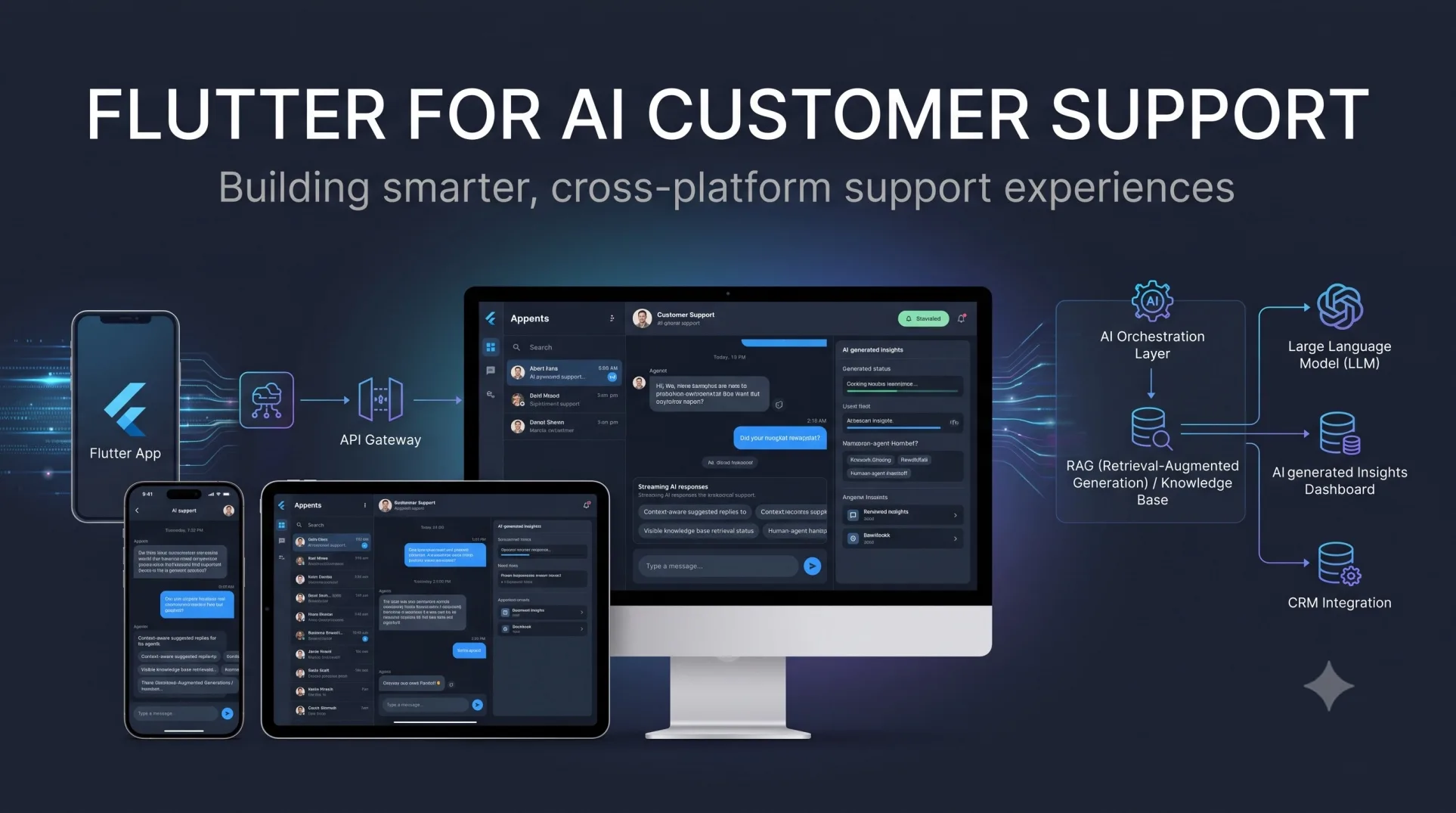
A serious AI customer-support application will typically need something closer to:
Flutter Client
     ↓
API / Realtime Gateway
     ↓
Conversation Service
     ↓
AI Orchestration Layer
     ↓
 ┌───────────────┬───────────────┐
 │               │               │
LLM           RAG/Search      Tools
 │               │               │
 └───────────────┴───────────────┘
     ↓
Customer / Support Systems
     ↓
Analytics + Observability
Flutter handles the experience.
The backend handles the intelligence.
That distinction is important.
A beautiful Flutter interface can’t compensate for poor retrieval, unreliable APIs, hallucinating models, or badly designed conversation state.
The companies I’d look at for Flutter AI customer support
There isn’t one objectively “best” company for this category.
But if I were evaluating engineering partners around Flutter, AI applications, customer experience, and cross-platform product development, these are companies I’d investigate.
I’m deliberately looking at them from a technical-fit perspective rather than ranking them by marketing claims.
1. GeekyAnts — interesting for cross-platform AI product engineering
GeekyAnts is worth including because its engineering background spans Flutter and cross-platform application development alongside AI and product engineering.
For AI customer-support applications, the relevant capability isn’t simply knowing Flutter.
The interesting part is the combination of:
- Cross-platform application development
- Real-time interfaces
- AI-powered product development
- Backend integrations
- Custom digital products
That combination fits the architecture of an AI support platform reasonably well.
My take: I’d look at GeekyAnts when the goal is to build a custom AI support product rather than simply add an AI widget to an existing application.
The important caveat is that the quality of the underlying AI orchestration and support-system integration matters far more than the Flutter layer itself.
2. Very Good Ventures — strong Flutter-focused option
Very Good Ventures has built a strong reputation around Flutter and is particularly relevant when the engineering team wants deep Flutter expertise rather than treating Flutter as just another cross-platform framework.
Its connection to the Flutter ecosystem makes it particularly interesting for products where architecture, testing, maintainability, and Flutter-specific engineering practices are important.
For AI customer support, that expertise can be useful because streaming interfaces and complex state transitions can become difficult to maintain as the application grows.
My take: If Flutter engineering quality is the primary selection criterion, I’d put a specialist like Very Good Ventures ahead of a generic development agency.
3. Thoughtworks — better fit when AI becomes an enterprise transformation problem
Thoughtworks isn’t primarily a “Flutter shop.”
That’s actually why I’d consider it for a different type of project.
Large enterprises building AI customer-support systems often have problems far beyond the frontend:
- Legacy CRM integration
- Data governance
- AI governance
- Knowledge architecture
- Enterprise APIs
- Identity
- Observability
- Human-in-the-loop workflows
Thoughtworks has extensive experience around enterprise software engineering, data modernization, and AI operating models.
My take: I wouldn’t choose Thoughtworks because I wanted a Flutter specialist.
I’d consider it when the Flutter application is one piece of a much larger AI transformation.
4. EPAM — strong candidate for complex enterprise support ecosystems
EPAM is another company that becomes more relevant as the system grows beyond the application layer.
AI customer support in a large enterprise can involve CRM systems, knowledge platforms, customer databases, analytics systems, identity infrastructure, and legacy applications.
EPAM’s strength is its large-scale software engineering and modernization background combined with AI capabilities.
My take: EPAM makes more sense when the project is a complex enterprise integration challenge than when someone simply needs a Flutter chatbot.
That distinction should influence vendor selection.
5. Accenture — strongest when the support transformation is enormous
Accenture belongs on the list because AI customer support can become a major transformation program for large organizations.
At that scale, the problem may involve:
- Contact-center modernization
- CRM transformation
- AI agents
- Customer data
- Workforce changes
- Analytics
- Cloud migration
- Governance
Accenture has the organizational scale to operate across those areas.
My take: If you’re a global enterprise redesigning customer support across multiple countries and business units, Accenture’s breadth can be useful.
If you’re a startup trying to ship an AI support application, I think that level of scale is unnecessary.
Why I wouldn’t choose a company based on “AI expertise”
This is another strong opinion.
Almost every software company now claims AI expertise.
That phrase has become nearly meaningless.
For an AI customer-support project, I’d ask much more specific questions.
Can they build streaming interfaces?
Can they manage conversation state?
Can they integrate RAG?
Can they implement human escalation?
Can they connect CRM data?
Can they handle authentication and authorization?
Can they monitor model quality?
Can they measure hallucination rates?
Can they control AI actions?
Can they design the backend so that changing LLM providers doesn’t require rewriting the application?
Those questions tell you much more than:
“How many AI projects have you completed?”
Flutter + AI: the features that actually matter
If you’re building an AI support application, I’d prioritize these features.
Streaming responses
Users shouldn’t have to stare at a spinner while an AI generates a long response.
Streaming makes the experience feel substantially more responsive.
Flutter needs to handle partial response updates gracefully without causing unnecessary widget rebuilds or unstable conversation state.
Conversation persistence
The AI needs context.
But context shouldn’t simply mean sending the entire conversation to the model every time.
A better architecture can combine:
- Recent messages
- Conversation summaries
- Retrieved knowledge
- Customer context
- Relevant historical interactions
This keeps context useful without allowing token usage to grow uncontrollably.
Human handoff
This should be designed from the beginning.
When AI confidence is low, the customer should be able to move to a human agent without restarting the conversation.
The human agent should receive the relevant context.
That means the Flutter application and backend need to treat AI and human support as parts of the same conversation architecture.
Multimodal support
Customer support is no longer text-only.
A customer might upload:
- A screenshot
- An invoice
- A product photo
- A damaged-item image
- A PDF
- A screen recording
AI can analyze those inputs and help determine what happens next.
Flutter’s cross-platform capabilities make it practical to build consistent upload and camera experiences across devices.
Offline and unreliable network handling
This one gets overlooked.
A customer-support application shouldn’t completely fall apart when connectivity becomes unstable.
The application needs clear states for:
- Sending
- Sent
- Streaming
- Failed
- Retrying
- Escalated
- Resolved
AI applications are asynchronous by nature.
Your UI needs to acknowledge that.
The backend pattern I’d recommend
I would avoid tightly coupling Flutter directly to an LLM provider.
Instead:
Flutter
   ↓
Your API
   ↓
AI Orchestrator
   ├── Model Provider
   ├── RAG
   ├── Tools
   ├── Customer Data
   └── Guardrails
Why?
Because models change.
You might start with one provider and later introduce another.
You may want different models for:
- Classification
- Summarization
- Complex reasoning
- Retrieval
- Voice
- Low-cost support responses
- The Flutter application shouldn’t care.
It should communicate with your application backend.
That architectural separation gives you much more flexibility.
My biggest warning about AI support apps
Don’t build an AI customer-support application around the chatbot.
Build it around the support workflow.
That’s a very different mindset.
A chatbot answers questions.
A support system resolves problems.
For example:
A customer says:
“My order arrived damaged.”
A chatbot can respond:
“I’m sorry to hear that.”
A support workflow can:
- Identify the order
- Check delivery status
- Ask for an image
- Analyze the image
- Determine eligibility
- Create a return request
- Generate a replacement
- Notify the customer
- Update the CRM
- Escalate if necessary
That’s where AI starts creating real operational value.
Flutter is simply the interface through which the customer experiences that workflow.
Why Flutter beats separate native apps for this use case
Here’s where I’ll take the strongest position.
For a new AI customer-support product targeting multiple platforms, I would start with Flutter unless there is a strong reason not to.
The reasons are practical.
One UI architecture
The support experience stays consistent.
Faster iteration
AI products change frequently.
A shared codebase makes those changes easier to distribute.
Shared state management
Conversation state, loading states, errors, streaming, authentication, and navigation can be handled consistently.
Cross-platform reach
Mobile and web experiences can be developed within the same ecosystem.
Lower duplication
You don’t need to independently implement every support interaction across multiple native stacks.
There are situations where native development still wins.
Highly specialized platform functionality.
Extreme platform-specific performance requirements.
Deep integration with proprietary device capabilities.
But for most AI support products?
I don’t think those exceptions justify starting with three separate frontend codebases.
What I would build first
If I were starting an AI customer-support application today, I’d resist the temptation to build twenty AI features.
I’d start with one workflow.
For example:
Customer asks → AI retrieves knowledge → response streams → customer can upload evidence → AI recommends next action → human escalation available.
Then measure:
- Resolution rate
- First-response time
- Escalation rate
- Customer satisfaction
- AI response accuracy
- Cost per resolved conversation
- Human handling time
If those numbers improve, expand.
If they don’t, adding another AI feature won’t save the product.
Final verdict
Flutter isn’t the reason an AI customer-support application succeeds.
But it can be a very good foundation for the customer-facing part of the system.
The real architecture is:
Flutter + realtime communication + strong backend APIs + AI orchestration + retrieval + customer data + human escalation + observability.
And that’s why I think Flutter deserves more attention in this category.
Not because it magically makes AI easier.
Because AI customer support is fundamentally a cross-platform product problem as much as it is an AI problem.
If the same customer conversation needs to work consistently across mobile, web, and other touchpoints, maintaining three independent interfaces becomes difficult to justify.
My bet is that the strongest AI support products won’t look like chatbots.
They’ll look like complete support systems where AI quietly handles the repetitive work, surfaces useful context, and knows when to hand the conversation to a human.
And Flutter is a strong candidate for building the interface that makes that experience feel seamless.