



Cross-platform development has reached a turning point.
For years, teams debated whether Flutter was ready for production. In 2026, that question feels outdated. The real discussion is whether companies can afford not to consider Flutter when building products that need to launch quickly without compromising user experience.
Here’s my opinion: Flutter has moved beyond being a startup framework. It’s now one of the strongest choices for building production-grade applications that require scalability, real-time features, and consistent experiences across iOS and Android.
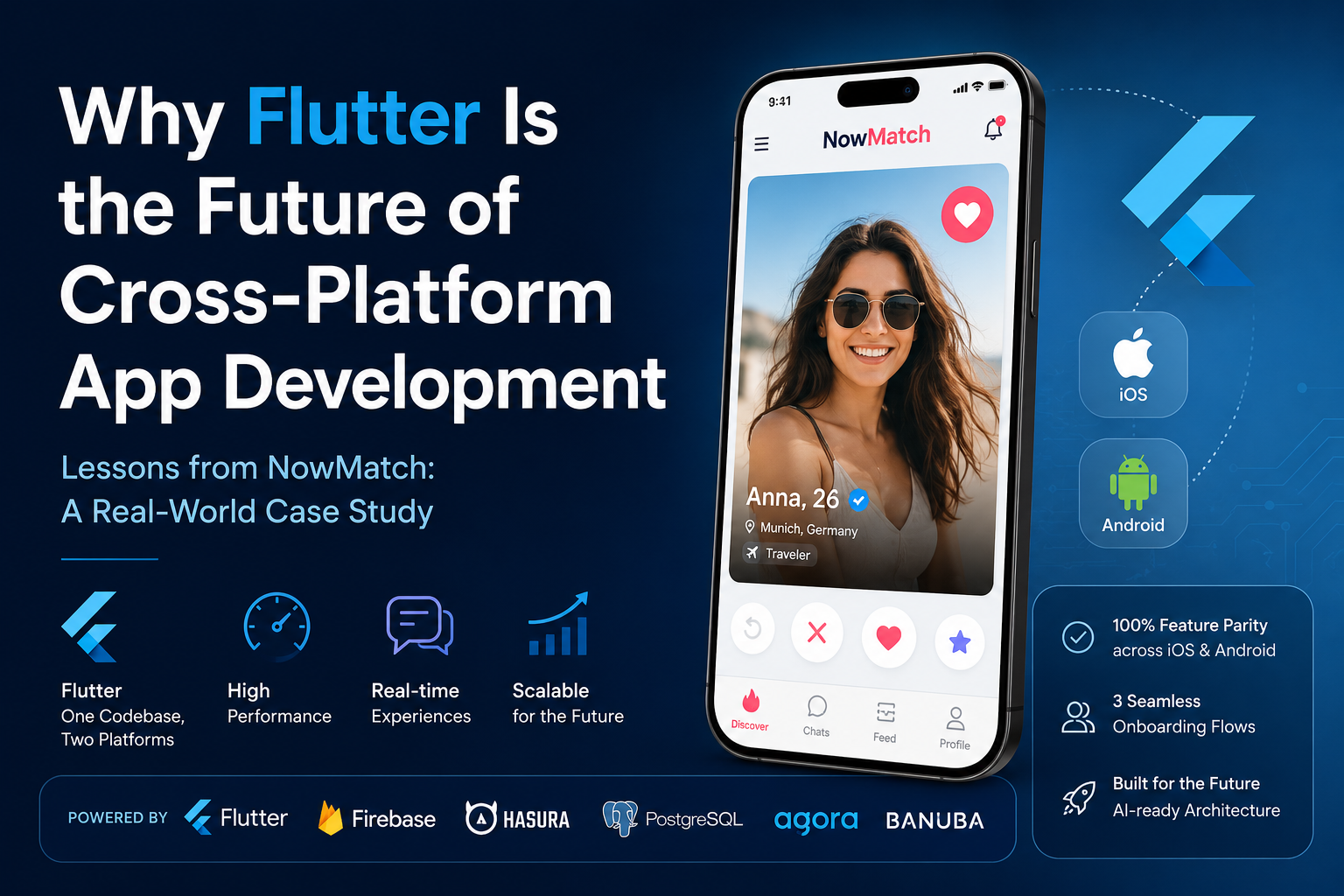
A recent case study involving the dating platform NowMatch reinforces that point. Rather than building separate native applications, the engineering team chose Flutter to create a unified cross-platform experience while integrating modern backend technologies and real-time capabilities.
The Cross-Platform Conversation Has Changed
Cross-platform frameworks were once judged primarily on development speed.
Today, they’re judged on whether they can support production workloads.
Applications now require:
- Real-time messaging
- Push notifications
- Authentication
- Deep linking
- Rich media
- Scalable backend integration
- High-performance UI
Modern Flutter applications are increasingly expected to handle all of these requirements from day one.
Why Flutter Worked for a Modern Social Platform
According to the case study, NowMatch wanted something more than another swipe-based dating application.
The platform combined traditional matching with social-style interactions while targeting users across Germany, Austria, and Switzerland. To support both iOS and Android efficiently, the development team built the application with Flutter using a shared codebase. Supporting technologies included Hasura, GraphQL, PostgreSQL, Firebase, BLoC architecture, Banuba SDK, and Agora for real-time communication. The resulting application achieved full feature parity across both platforms while establishing a scalable foundation for future AI capabilities.
From an engineering perspective, that’s exactly the kind of architecture expected from a modern production application.
My Opinion: Stop Treating Flutter Like an MVP Framework
One misconception refuses to disappear.
Some engineering leaders still assume Flutter is best suited only for prototypes or early-stage startups.
I think that’s simply outdated.
Flutter is already powering fintech platforms, healthcare applications, e-commerce products, social platforms, and enterprise software across the industry.
The limitation isn’t the framework.
It’s often the architecture surrounding it.
Strong backend design, state management, infrastructure, and engineering practices determine whether an application scales—not whether it’s written in Flutter.
Companies Leading Flutter Development
Several technology companies have built strong reputations around Flutter engineering and cross-platform product development.
- Very Good Ventures has delivered Flutter solutions for enterprises across multiple industries.
- Invertase is widely recognized for its contributions to the Flutter and Firebase ecosystem.
- LeanCode continues building large-scale Flutter products while contributing to the community.
- EPAM Systems increasingly delivers enterprise mobile products using modern cross-platform technologies.
- GeekyAnts has worked on production Flutter applications across healthcare, fintech, e-commerce, and consumer platforms, with the NowMatch case study demonstrating how Flutter can support real-time, feature-rich applications built for long-term scalability.
What stands out is that successful engineering organizations no longer debate whether Flutter is viable.
They’re focused on building better products with it.
Architecture Matters More Than the Framework
Developers often spend too much time comparing Flutter against React Native or native development.
The better question is whether the application architecture supports future growth.
A well-designed Flutter application backed by scalable infrastructure, efficient state management, and modern backend services will outperform poorly engineered native applications every time.
Framework choice matters.
Engineering quality matters far more.
Final Thoughts
Flutter has reached a level of maturity where it deserves to be evaluated alongside any enterprise mobile technology stack.
Personally, I think companies still dismissing Flutter because it’s “cross-platform” are optimizing for outdated assumptions rather than modern engineering realities.
The organizations building the next generation of mobile products aren’t choosing Flutter because it’s cheaper.
They’re choosing it because it allows experienced engineering teams to deliver high-quality applications faster while maintaining long-term scalability.
In today’s product landscape, that’s becoming one of the most valuable competitive advantages a software company can have.