



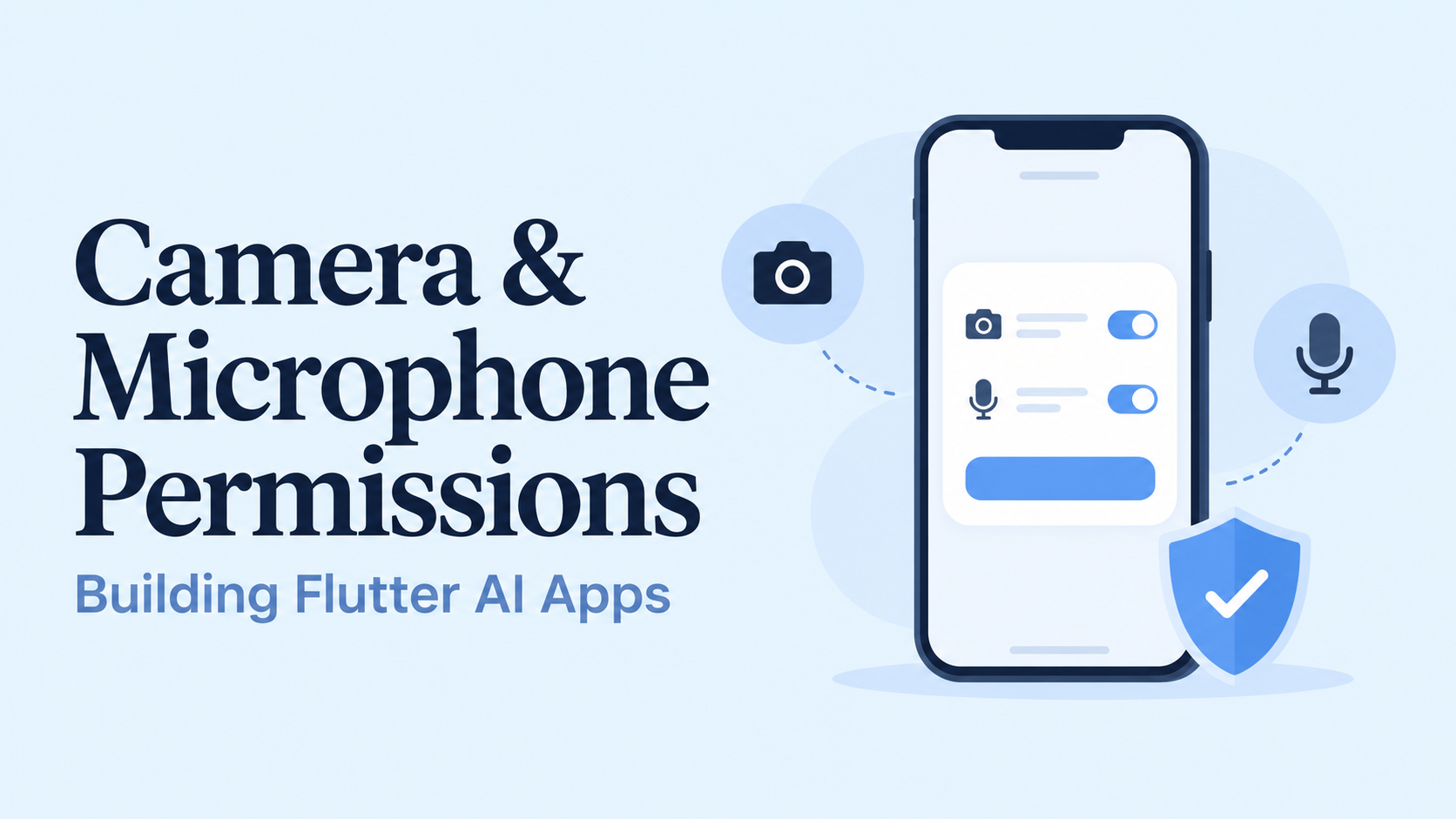
An AI voice assistant needs microphone access. A document scanner needs a camera. A multimodal assistant may need both, but rarely at the same moment.
For Flutter developers, permission management determines whether these features start reliably, recover after denial, and communicate clearly about sensitive data. A successful permission request is only one step. The application must also handle lifecycle changes, unavailable hardware, revoked access, and the processing of captured media.
This guide focuses on Android and iOS applications, with practical Dart examples and guidance from Flutter package maintainers, Android Developers, and Apple.
Request Access When the Feature Needs It
Permission requests should follow a user action. Tapping “Start voice chat” provides a clear reason to request microphone access. Opening a document scanner provides context for a camera prompt.
Android recommends requesting permissions in context and allowing the application to remain useful when access is denied. Since Android 11, users can grant camera or microphone access temporarily through the “Only this time” option. A previous grant should therefore never be treated as permanent.
An illustrative feature-to-permission mapping is:
| Feature | Access needed |
|---|---|
| Voice input | Microphone |
| Live document scanning | Camera |
| Video recording with sound | Camera and microphone |
| Text-based AI chat | Neither |
| Selecting an existing image | System-picker access, depending on implementation |
Avoid requesting both permissions at launch simply because the application includes both capabilities.
This distinction also matters for user trust. A study involving interviews with 19 developers and a survey of 309 mobile users found shared concerns about unnecessary permissions, including damage to trust and potential exposure of sensitive data. It also identified developer confusion about permission scope and library requirements.
Configure Android and iOS Before Writing the Flow
A Dart permission request cannot replace the required native configuration.
Android manifest
For an application that directly captures both images and audio, declare the following inside the <manifest> element, outside <application>, in android/app/src/main/AndroidManifest.xml:
<uses-permission android:name="android.permission.CAMERA" />
<uses-permission android:name="android.permission.RECORD_AUDIO" />
These declarations correspond to the camera and microphone permission groups documented by permission_handler. Inspect the merged manifest as well, because dependencies can contribute declarations.
iOS usage descriptions
Add accurate explanations to ios/Runner/Info.plist:
<key>NSCameraUsageDescription</key>
<string>Use the camera to scan documents for AI analysis.</string>

<key>NSMicrophoneUsageDescription</key>
<string>Use the microphone to capture questions for voice chat.</string>
Apple requires usage descriptions for protected capture resources. Attempting capture without the relevant description can raise an exception. The wording should explain the actual feature rather than use a generic phrase such as “camera access required.”
Follow each package’s installation instructions too. permission_handler documents different iOS configuration steps for CocoaPods and Swift Package Manager. Keep the enabled permission groups aligned with the application’s capabilities.
Model Permission Outcomes Explicitly
Install the permission package:
flutter pub add permission_handlerA useful helper returns an outcome instead of showing dialogs or starting capture automatically:
import 'package:permission_handler/permission_handler.dart';

enum CaptureAccess {
  granted,
  denied,
  settingsRequired,
  restricted,
}

Future<CaptureAccess> requestCaptureAccess(
  Permission permission,
) async {
  var status = await permission.status;

  if (status.isDenied) {
    status = await permission.request();
  }

  if (status.isGranted) return CaptureAccess.granted;
  if (status.isPermanentlyDenied) {
    return CaptureAccess.settingsRequired;
  }
  if (status.isRestricted) return CaptureAccess.restricted;

  return CaptureAccess.denied;
}
Call this helper from an intentional action, after any appropriate explanation:
final result = await requestCaptureAccess(
  Permission.microphone,
);
The interface can then respond appropriately:
- Granted: Proceed with the requested feature.
- Denied: Explain the limitation and offer text input.
- Settings required: Offer an explicit “Open settings” button.
- Restricted: Explain that device restrictions may prevent access.
permission_handler provides status checks, permission requests, and openAppSettings(). Opening settings does not confirm that the user changed anything; check again after returning. On Android, use shouldShowRequestRationale where appropriate before requesting again.
In production, serialize permission requests to prevent repeated taps from launching overlapping flows. Handle plugin failures separately, and check widget lifecycle state before updating the interface after an asynchronous operation.
Initialize Capture Carefully
Install Flutter’s camera plugin when the application needs an in-app camera:
flutter pub add cameraFor a scanner without audio:
final controller = CameraController(
  selectedCamera,
  ResolutionPreset.medium,
  enableAudio: false,
);

await controller.initialize();
This snippet assumes that selectedCamera was obtained successfully and the surrounding feature owns the controller. Production code also needs initialization error handling and disposal.
The camera controller’s enableAudio option controls audio in recorded video. Disabling it is appropriate for a camera-only workflow.
The plugin can report permission failures during initialization, including camera denial, previous iOS denial, and restricted access. A preliminary permission check does not eliminate the need to catch CameraException. Permission management also does not record audio by itself; a voice feature still needs an appropriate recording or speech package.
Handle lifecycle changes
Flutter’s camera plugin leaves lifecycle management to the application. Its documentation demonstrates releasing camera resources when inactive and initializing again when appropriate on resume.
A robust implementation should coordinate disposal and initialization so they cannot race. If initialization finishes after the capture screen closes, dispose of that controller instead of attaching it to an inactive view.
Returning from settings should refresh access status. It should not silently restart voice recording.
Treat Speech Recognition as a Separate Capability
Microphone access and speech recognition authorization are not interchangeable.
When a Flutter integration uses Apple’s SFSpeechRecognizer APIs, the application needs the applicable speech authorization and NSSpeechRecognitionUsageDescription. Apple recommends delaying that request until the user engages with the feature.
An application that records audio and sends it to its own transcription backend does not automatically use that Apple authorization flow. Developers should inspect the chosen package’s platform implementation and requirements.
Similarly, camera permission does not automatically cover saving content to the photo library. Capture, selection, and saving are separate operations.
Explain What Happens After Capture
Operating-system permission gives the application access to a device resource. The product still needs to explain its AI processing behavior.
Before recording or uploading, the interface should make clear whether processing occurs locally or remotely, whether media is retained, and how users can cancel or delete it. These explanations must match the implemented behavior.
Useful product controls include:
- A visible recording or capture state.
- A clear stop action.
- Image review before submission.
- Cancellation of pending uploads.
- Temporary-file cleanup.
- Logs that exclude raw audio, images, and sensitive transcripts.
For streaming voice features, recording and transmission may occur simultaneously. The interface should communicate that fact rather than imply audio remains local until recording ends.
Test Denial, Revocation, and Interruptions
A permission grant does not guarantee usable sensor output. On supported Android 12 and later devices, system-wide switches can disable camera or microphone access.
Test on physical Android and iOS devices across these scenarios:
- First use, denial, and subsequent attempts.
- Permanent denial and return from settings.
- Temporary Android permission expiry.
- Camera granted while microphone remains denied.
- Backgrounding during initialization or capture.
- Navigation away while a request is pending.
- Sensor unavailability and interrupted recording.
- Network failure after capture but before AI processing.
The strongest Flutter permission flow preserves user choice and application state throughout these transitions. It requests only the access needed, handles refusal without trapping the user, and starts capture only when both the platform and the user’s current action allow it.